


Description
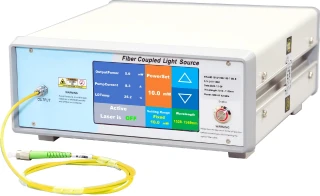
The Superluminescent Diode Light Source (SLED) from DAYY Photonics Corporation represents a cutting-edge advancement in optical technology. This Optical Spectral Engine (OSE1) is a superluminescence-based edge-emitting semiconductor light source that uniquely combines the high power and brightness of a laser diode with the low coherence of conventional light-emitting diodes. This innovative design ensures superior performance across a broad range of applications, making it an essential tool for industries requiring precise optical solutions.
DAYY Photonics' SLED offers an extensive range of center wavelengths from 770nm to 1700nm, providing exceptional versatility for various optical needs. Packaged in a 14-pin industry-standard butterfly package, this light source adheres to Telcordia GR-468 and RoHS/Reach standards, ensuring reliability and compliance with industry regulations. The SLED's low coherence length and low spectral ripple make it an ideal choice for applications demanding high precision and accuracy.
Engineered for superior power and spectral coverage, the SLED is perfect for broadband and high-power requirements. Its design supports a wide array of telecom applications, communications, and test applications. The product's ability to cover all main bands used in these fields makes it indispensable for professionals seeking robust and reliable optical solutions. Whether for broadband applications, passive component testing, fiber-optic sensing, or spectroscopy, the SLED from DAYY Photonics stands out as a top-tier choice for optical innovation.
DAYY Photonics Superluminescent Diode Light Source for Optical Applications
Specifications
| SLED Type: | Fiber Coupled |
|---|---|
| Center Wavelength (typical): | 770 nm |
| Bandwidth (FWHM): | 60 nm |
| Center Wavelengths: | 770nm – 1700nm |
| Bandwidths (FWHM): | 10nm to 100nm |
| Relative Intensity Noise (RIN): | -140dB/Hz – 125dB/Hz |
| Direct Modulation: | up to 600Mhz |
Got questions about specs? Use the inquiry form to ask.
 Download Data Sheet

Features
- Broad Product Range: Offers a wide selection of center wavelengths from 770nm to 1700nm.
- Flexible Bandwidths: Full Width at Half Maximum (FWHM) bandwidths ranging from 10nm to 100nm.
- Versatile Light Output: Available with FC/APC connector, with optional FC/PC or SMA connectors.
- Fiber Options: Choose between Single Mode (SM) or Polarization Maintaining (PM) fiber.
- Low Degree of Polarization: Options available with DAYY’s Photonics driver module ISB1.
- Superior Power and Spectral Coverage: Combines high power and brightness with low coherence.
- Compliance and Certification: Meets Telcordia GR-468 standards and RoHS compliance.
- Low Coherence Length: Ideal for applications requiring low coherence.
- Low Spectral Ripple: Ensures consistent performance across the spectrum.
- Relative Intensity Noise (RIN): Ranges from -140dB/Hz to -125dB/Hz.
- Direct Modulation: Capable of modulation up to 600MHz for specific models.
- Wide Range of Applications: Suitable for industrial and biomedical imaging systems, optical sensing, test and measurement, and research and development.
- Industry Standard Packaging: Packaged in a 14-pin industry standard butterfly package.
- Broadband and High-Power Requirements: Covers all main bands used in telecom applications, communications, and test applications.
Applications
Applications for Superluminescent Diode Light Source (SLED) Optical Spectral Engine OSE1
- Optical Coherence Tomography (OCT): Broadband, low-coherence SLED light source for medical OCT, ophthalmic imaging, dermatology imaging, dental imaging, endoscopic OCT, and high-resolution biomedical imaging systems.
- Industrial Optical Coherence Tomography: High-brightness SLD source for non-contact inspection, surface profiling, layered material analysis, coating thickness measurement, defect detection, and precision industrial imaging.
- Telecommunications Test and Measurement: Broadband fiber-coupled light source for telecom component testing, WDM/CWDM/DWDM system characterization, insertion loss testing, return loss testing, and optical network validation.
- Passive Optical Component Testing: Ideal for testing fiber optic components such as couplers, splitters, isolators, circulators, filters, attenuators, arrayed waveguide gratings, fiber Bragg gratings, and optical connectors.
- Fiber Optic Sensing: Low-coherence broadband source for distributed fiber sensing, interferometric sensing, strain sensing, temperature sensing, pressure sensing, vibration sensing, acoustic sensing, and structural health monitoring.
- Optical Metrology: Stable broadband SLED source for precision length measurement, displacement measurement, thickness gauging, surface roughness analysis, low-coherence interferometry, and dimensional inspection.
- White Light Interferometry: Low-coherence light source for interferometric measurement systems requiring short coherence length, high spectral stability, and broad wavelength coverage.
- Spectroscopy Systems: Broadband semiconductor light source for near-infrared spectroscopy, absorption spectroscopy, reflectance spectroscopy, biomedical spectroscopy, material analysis, and chemical sensing.
- Biomedical Imaging and Diagnostics: High-power low-coherence optical source for tissue imaging, retinal imaging, vascular imaging, intravascular imaging, non-invasive diagnostics, and laboratory biomedical instrumentation.
- Research and Development: Flexible SLED source for photonics research, fiber optics experiments, optical system prototyping, spectroscopy development, OCT platform development, and academic laboratory applications.
- Optical Spectrum Analyzer Calibration and Testing: Broadband source for evaluating spectrometers, optical spectrum analyzers, wavelength meters, photodetectors, and optical receiver modules.
- Photonic Integrated Circuit Testing: Fiber-coupled broadband light source for testing silicon photonics devices, integrated waveguides, modulators, filters, multiplexers, demultiplexers, and optical chip components.
- Optical Sensor Interrogation: Suitable for interrogating fiber Bragg grating sensors, Fabry-Perot sensors, Mach-Zehnder interferometers, and other wavelength-dependent optical sensing platforms.
- High-Resolution Imaging Systems: Broad bandwidth and low coherence make the OSE1 SLED source suitable for systems requiring improved axial resolution and reduced coherent artifacts compared with laser diode sources.
- Polarization-Sensitive Optical Systems: Available single-mode and polarization-maintaining fiber options support polarization-sensitive OCT, polarization-based sensing, birefringence measurement, and polarization-dependent loss testing.
- Optical Component Qualification: Telcordia GR-468 and RoHS-compliant SLED source for laboratory and production testing of optical components used in telecom, datacom, industrial, medical, and sensing markets.
- Broadband Source for Fiber Alignment: Useful in optical bench setups, fiber coupling systems, connector alignment, photonic device packaging, and production alignment stations.
- Datacom and Fiber Network Testing: Broadband optical source for characterizing fiber links, transceiver test setups, optical modules, short-reach communication systems, and high-speed optical interconnect components.
- Laser Diode Alternative for Low-Coherence Applications: Combines high optical power and brightness with low coherence, making it suitable for applications where laser speckle, interference artifacts, or high coherence are undesirable.
- Near-Infrared Light Source Applications: Wavelength coverage from 770 nm to 1700 nm supports NIR imaging, NIR spectroscopy, fiber optic instrumentation, biomedical diagnostics, industrial inspection, and optical sensing platforms.
- Quality Control and Manufacturing Test: Stabl
Frequently Asked Questions
What is the DAYY Photonics OSE1 Superluminescent Diode Light Source?
What wavelength range does the OSE1 SLED light source cover?
What spectral bandwidth is available for the DAYY Photonics OSE1 SLED?
What fiber and connector options are available for the OSE1 Superluminescent Diode Light Source?
How is an SLED light source different from a laser diode or LED?
What are the main applications of the DAYY Photonics OSE1 SLED light source?
Does the OSE1 SLED light source support modulation and low-noise operation?
Got more questions? Use the inquiry form to ask the supplier directly.
Similar Products


Your inquiry has been received.
Create an account by adding a password
Why create an account?
- Auto-complete inquiry forms
- View and manage all your past messages
- Save products to your favorites
- Close your account anytime — no hassle