
Description
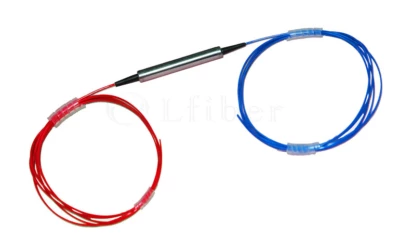
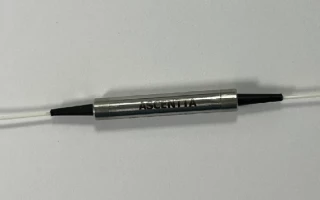
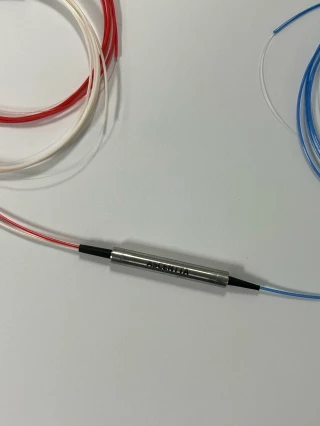
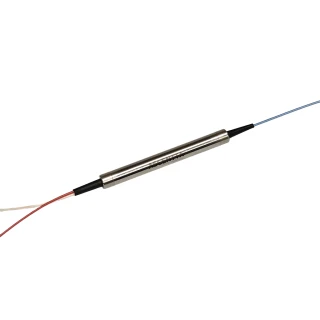
The high-extinction-ratio optical isolator (polarization-maintaining fiber optic isolators) is a fiber-coupled optical component which lets light pass through in one direction, but block it in the opposite direction. At the same time, by using PM Panda fibers it’s capable of maintaining a well-defined state of polarization (SOP) of the light with a high extinction ratio better than 20dB, 28dB, 30dB, or higher. This high extinction ratio optical isolator (PM isolator) is a good choice in many PM optical systems, since back-reflected light often have deleterious effects on the operating conditions of optical devices.
Notes:
- The polarization maintaining isolator (high extinction ratio) is customizable, and the above specifications are subject to change
without notice. - For device with connectors, IL is 0.3dB higher, RL is 5.0dB lower, and ER is 2.0dB lower.
- Unless otherwise specified, the slow axis of the fiber is aligned with the key of the PM fiber connector.
- Slow axis working and fast axis blocked as standard, while operating on both the slow and fast axis available on request.
- Bare fiber should not support the weight of the connector. So that if connectors needed, it’s better to choose the 900μm loose
tube jacket instead of the 250μm bare fiber. - For product customization or special requirements, please contact Lfiber’s sales department for availability.
Polarization Maintaining Isolator (High Extinction Ratio)
Specifications
| Type Of The Device: | Isolator |
|---|---|
| Operating Wavelength: | 1310 nm |
| Max Power: | 0.3 W |
| Min Isolation: | 28 dB |
| Product: | Polarization Maintaining Isolator (High Extinction Ratio) |
| Center Wavelengths: | 1310 nm, 1480 nm, 1550 nm |
| Operating Wavelength Range: | ±20 nm |
| Stage Options: | Single-stage, Dual-stage |
| Peak Isolation @ 23°C (Single-stage): | 42 dB |
| Peak Isolation @ 23°C (Dual-stage): | 58 dB |
| Isolation @ 23°C (Single-stage): | ≥28 dB |
| Isolation @ 23°C (Dual-stage): | ≥48 dB |
| Typ. Insertion Loss @ 23°C (Single-stage): | 0.4 dB |
| Typ. Insertion Loss @ 23°C (Dual-stage): | 0.5 dB |
| Insertion Loss @ -5 ~ +70°C (Single-stage): | ≤0.55 dB |
| Insertion Loss @ -5 ~ +70°C (Dual-stage): | ≤0.65 dB |
| Extinction Ratio @ 23°C (both Axis Working, Default): | ≥20 dB |
| Extinction Ratio @ 23°C (both Axis Working, High ER): | ≥28 dB |
| Extinction Ratio @ 23°C (fast Axis Blocked, Default): | ≥25 dB |
| Extinction Ratio @ 23°C (fast Axis Blocked, High ER): | ≥30 dB |
| Return Loss: | ≥50 dB |
| Power Handling: | ≤300 mW |
| Fiber Type: | PM panda fiber |
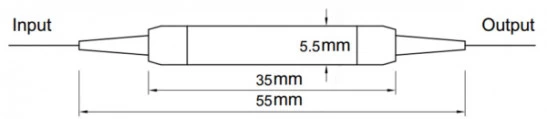
| Package Dimensions: | Φ5.5 × 35 mm |
| Operating Temperature: | -5 to +70 °C |
| Storage Temperature: | -40 to +85 °C |
| Axis Alignment Options: | Slow axis working & fast axis blocked; Fast axis working & slow axis blocked; Both axis working |
| Available Pigtail Types: | 250 μm bare fiber; 900 μm loose tube |
| Standard Fiber Lengths: | 0.5 m; 0.8 m; 1.0 m; 1.5 m; specified |
| Available Connectors: | None; FC/UPC; FC/APC; SC/UPC; SC/APC; LC/UPC; LC/APC; Others |
Got questions about specs? Use the inquiry form to ask.
 Download Data Sheet

Features
- High Extinction Ratio Polarization Maintaining Design – Engineered to preserve the state of polarization with an extinction ratio up to ≥30 dB (fast axis blocked) and ≥28 dB (both axes working), comparable to leading PM isolators on FindLight and global markets, ensuring excellent polarization control in demanding coherent and sensing systems.
- Low Insertion Loss for Maximum Optical Power Throughput – Typical insertion loss as low as 0.4 dB (single‑stage) and 0.5 dB (dual‑stage) at 23°C, with guaranteed low loss over the full operating range (≤0.55 / ≤0.65 dB from -5°C to +70°C), minimizing signal degradation in long‑haul and high‑capacity links.
- High Isolation for Superior Back‑Reflection Suppression – Peak isolation up to 42 dB (single‑stage) and 58 dB (dual‑stage) at room temperature, with guaranteed isolation ≥28 dB / ≥48 dB, effectively blocking backward‑propagating light and enhancing system stability and laser protection.
- Excellent Return Loss for Clean Signal Interfaces – Optical return loss ≥50 dB reduces back‑reflection at the device interface, supporting high‑performance applications such as fiber lasers, EDFAs, and precision optical measurement systems.
- Optimized for Key Telecom and Fiber Laser Wavelengths – Available at standard PM wavelengths of 1310 nm, 1480 nm, and 1550 nm with ±20 nm operating bandwidth, making it suitable for telecom, CATV, metro networks, DWDM systems, and C/L‑band fiber laser architectures.
- Single‑Stage and Dual‑Stage Configurations – Choice of compact single‑stage isolators for low‑loss setups or dual‑stage versions where maximum isolation and ultra‑low back‑reflection are required (e.g., high‑gain amplifiers, narrow‑linewidth lasers).
- Flexible Axis Alignment Options – Supports:
- Slow axis working, fast axis blocked (standard) – transmits only the slow axis while blocking the fast axis in the forward direction.
- Fast axis working, slow axis blocked – available for systems designed around fast‑axis propagation.
- Both axes working – for specialized polarization handling or when both orthogonal polarization states are required.
- PM Panda Fiber for High Polarization Stability – Built on standard PM panda fiber, ensuring robust birefringence and long‑term polarization stability, fully compatible with industry‑standard PM patch cords and pigtails.
- Compact Package for Dense Integration – Small cylindrical housing of Φ5.5 × 35 mm enables easy integration into space‑constrained modules, instruments, and OEM laser assemblies.
- Wide Operating and Storage Temperature Ranges – Qualified for operation from -5°C to +70°C and storage from -40°C to +85°C, suitable for both laboratory and field‑deployed telecom or sensing equipment.
- Moderate Power Handling for Telecom and Sensor Systems – Power handling up to ≤300 mW, ideal for typical optical communication links, fiber optic instrumentation, and many low‑ to medium‑power fiber laser setups.
- Multiple Fiber and Jacket Options – Available with:
- 250 μm bare PM fiber for compact splicing into existing fiber circuits.
- 900 μm loose tube for improved mechanical protection, especially recommended when connectors are used to avoid fiber stress at the connector interface.
- Customizable Pigtail Lengths – Standard lengths such as 0.5 m, 0.8 m, 1.0 m, and 1.5 m, with the option for user‑specified lengths to simplify routing and improve cable management in rack‑mount or benchtop systems.
- Wide Connector Compatibility – Offered with all common connector types:
- FC/UPC, FC/APC
- SC/UPC, SC/APC
- LC/UPC, LC/APC
- Customized or specialty connectors on request
- Standard Key Alignment for PM Connectors – Unless otherwise specified, the slow axis is aligned with the connector key, matching common alignment conventions in PM systems and simplifying system design and polarization management.
Applications
- Polarization-Maintaining Fiber Lasers
- Output isolation for single-frequency and narrow-linewidth PM fiber lasers
- Suppression of back reflections in high-coherence CW and pulsed PM laser systems
- Stabilization of polarization in PM ring and linear cavity fiber lasers
- Use in PM erbium-doped, ytterbium-doped, and Raman fiber laser sources
- Integration in seed lasers and master oscillator power amplifier (MOPA) architectures
- Coherent Optical Communication Systems
- Isolation for PM transmitters and receivers in coherent DWDM links
- Back reflection protection for IQ modulators and PM external modulators
- Polarization-maintaining isolation in homodyne and heterodyne coherent detection schemes
- Use in polarization-division multiplexed (PDM) and advanced modulation format systems
- Ingress isolation in transceivers operating at 1310 nm and 1550 nm windows
- High-Precision Fiber Optic Sensing
- Polarization-maintaining isolation in interferometric fiber sensors (Mach–Zehnder, Michelson, Sagnac)
- Use in fiber gyroscopes (FOGs) requiring high extinction ratio and low insertion loss
- Integration in distributed acoustic sensing (DAS) and distributed temperature/strain sensing (DTS/DSS)
- Back reflection control in Fiber Bragg Grating (FBG) based PM sensor networks
- Polarization control in phase-sensitive and polarization-sensitive sensing setups
- Quantum Optics and Quantum Communication
- Polarization-preserving isolation for single-photon and entangled-photon sources
- Protection of single-photon detectors and superconducting nanowire detectors from back reflections
- Use in quantum key distribution (QKD) systems employing polarization encoding
- Integration in quantum interference and entanglement experiments using PM fibers
- Test and Measurement Instruments
- Internal and external isolation in optical spectrum analyzers and tunable laser sources
- Use in polarization-maintaining optical time-domain reflectometers (PM-OTDR)
- Isolation for coherent receivers and heterodyne detection benches
- Incorporation in interferometers for metrology and coherence analysis
- Stabilization of polarization in research-grade and production test setups
- Optical Component and Module Protection
- Back reflection suppression for PM amplifiers (EDFA, TDFA, Raman amplifiers)
- Protection of PM modulators, isolator-integrated modulators, and PM AOM/EOM devices
- Use at the input/output of high-power PM devices to prevent feedback-induced damage
- Isolation in PM pump laser chains for amplifiers and laser systems
- Integration in PM optical subassemblies and hybrid photonic modules
- Fiber-Optic Interferometry and Coherence Control
- Improvement of fringe stability in PM interferometers and coherent combining systems
- Polarization-stable isolation in optical coherence tomography (OCT) and low-coherence interferometry
- Use in metrology systems requiring fixed polarization state and minimal back-reflection
- Enhancement of extinction in polarization-sensitive interferometric measurements
- Microwave Photonics and RF-over-Fiber
- Isolation in PM links that transport analog RF and microwave signals over fiber
- Reduction of spurious modulation and distortion caused by optical feedback
- Polarization-maintaining interfaces in optoelectronic oscillators (OEOs)
- Use in phased-array antenna remoting and timing distribution systems
- Polarization-Sensitive Measurement and Control
- Integration in setups for polarization extinction ratio measurement and calibration
- Use in PM polarization controllers and polarization-maintaining splitter/combiner networks
- Stabilization of polarization in ellipsometry and other polarization analysis instruments
- Isolation between cascaded polarization-sensitive components to prevent feedback coupling
- Laboratory Research and Prototyping
- General-purpose PM isolator for R&D in photonics, fiber optics, and laser physics
- Use in custom PM optical benches where both slow-axis working and both-axis working modes are needed
- Enabling high-extinction, low-drift experiments over 1310 nm, 1480 nm, and 1550 nm bands
- Support for prototype fiber systems that must emulate real-world telecom or sensing environments
Frequently Asked Questions
What is a high extinction ratio polarization maintaining (PM) optical isolator and what does it do?
What are the key specifications of this PM optical isolator (insertion loss, isolation, extinction ratio, power handling)?
What is meant by “slow axis working and fast axis blocked” vs “both axis working” for this PM isolator?
How do single‑stage and dual‑stage polarization maintaining isolators differ and when should I choose each?
What fiber types, pigtail options, and connector configurations are available for this PM isolator?
What are the mechanical dimensions and operating/environmental conditions of this PM isolator?
Is this polarization maintaining isolator customizable and how can I specify a custom version?
Got more questions? Use the inquiry form to ask the supplier directly.
Similar Products



Your inquiry has been received.
Create an account by adding a password
Why create an account?
- Auto-complete inquiry forms
- View and manage all your past messages
- Save products to your favorites
- Close your account anytime — no hassle