

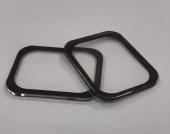
Description
Tempotec makes crystal quartz depolarizers and film linear polarizers to custom sizes. Depolarizers scramble the polarization of a laser beam using a crystal quartz wedge design, with angle tolerance down to 1 arcmin. Linear polarizers combine a polarizing film with glass or PMMA substrates for the visible band, reaching an extinction ratio above 7500:1.
NOTE - Price range is for reference only, final quotation subject to actual specifications & quantity.
Custom Linear Polarizers & Quartz Depolarizers – Tempotec
Specifications
| Substrate Material: | Custom |
|---|---|
| Shape: | Round, Square, Rectangle |
| Wavelength Range: | 400 – 700 nm |
| Surface Quality, S1 (scratch-dig): | 10-5, 20-10, 40-20, 60-40, 80-50 |
| Surface Quality, S2 (scratch-dig): | 10-5, 20-10, 40-20, 60-40, 80-50 |
| Surface Flatness Over CA, S1 (@633nm Or Per Manufacturer): | <= Lambda/4 |
| Surface Flatness Over CA, S2 (@633nm Or Per Manufacturer): | <= Lambda/4 |
| Extinction Ratio @ AOI And Peak Wavelength (Tp/Ts): | >= 7500:1 |
Got questions about specs? Use the inquiry form to ask.
 Download Data Sheet

Features
- Depolarizers: crystal quartz, diameter tolerance down to ±0.05 mm, angle tolerance down to 1 arcmin
- Depolarizer flatness up to λ/4 @ 632.8 nm, surface quality up to 10-5 scratch-dig, AR coatedLinear polarizers: polarizing film on glass or PMMA, 400–700 nm
- Single transmittance 42.9%, crossed transmittance < 0.0008
- Polarizing coefficient > 99.8%, extinction ratio > 7500:1
- Working temperature −40 to +70 °C; diameter tolerance ±0.05 mm
Applications
- Removing polarization sensitivity in spectrometers, gratings and detectors (depolarizers)
- Fiber coupling and laser systems that need unpolarized light
- Display, LCD and screen testing (linear polarizers)
- Machine vision glare reduction and stress analysis
- Microscopy, photography and visible imaging
Frequently Asked Questions
What does a depolarizer do?
It converts polarized light into light with a spatially varying polarization, so the beam behaves as unpolarized on average. This removes polarization-dependent errors in instruments.
What extinction ratio do the linear polarizers offer?
Greater than 7500:1, with a polarizing coefficient above 99.8% and crossed transmittance below 0.0008.
What wavelength range do the film polarizers cover?
400–700 nm (visible).
Are film polarizers suitable for high-power lasers?
Film polarizers on glass or PMMA are best for low-power and imaging use. For high-power lasers, a crystal or coated polarizing beamsplitter is usually the better choice.
Can you make custom sizes?
Yes. Both depolarizers and linear polarizers are made to your diameter and specifications, with diameter tolerance down to ±0.05 mm.
Got more questions? Use the inquiry form to ask the supplier directly.
Similar Products

PP-UVFS-25.4-3.0-BTFP34 High Power Thin-Film Polarizer for 1030nm and 515nm Lasers
Optoman

PP-UVFS-25.4-3.0-TFP4537 800nm High Power Thin-Film Polarizer
Optoman
PP-UVFS-50.8-3.0-TFP62-AR619 High Power Thin-Film Polarizer 735–755 nm
Optoman

PP-UVFS-25.4-6.35-TFP67 Ultrafast Thin-Film Polarizer, 1030 nm
Optoman

PP-UVFS-12.7-3.0-TFP67 Thin-Film Polarizer for 1030 nm Ultrafast Yb:YAG Lasers
Optoman

PP-UVFS-50.8-8.0-TFP4526 High-Power 1030 nm Thin-Film Polarizer
Optoman

PP-UVFS-25.4-6.35-TFP77 High-Power 532 nm Thin-Film Polarizer
Optoman
PP-UVFS-12.7-2.3-TFP4535 High-Power 1064 nm Thin-Film Polarizer
Optoman

PP-UVFS-25.4-6.35-TFP95 High Power UV Thin-Film Polarizer 343 nm
Optoman

PP-UVFS-25.4-3.0-TFP4514 High-Damage Thin-Film Polarizer 795-805 nm
Optoman
PP-UVFS-20.0x15.0-6.0-TFP94 1064nm High Power Thin Film Polarizer
Optoman

PP-UVFS-25.4-3.0-BTFP27 1030nm UVFS Thin Film Polarizer
Optoman
Thank You!
Your inquiry has been received.
Create an account by adding a password
Why create an account?
- Auto-complete inquiry forms
- View and manage all your past messages
- Save products to your favorites
- Close your account anytime — no hassle