


Description
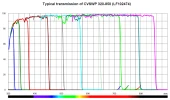
The CVSWP 320-850 (LF102474) is a continuously variable shortpass filter, also known as a linear variable shortpass filter (LVF). Its 50 % cut-off wavelength moves smoothly from 320 nm to 850 nm along a 58 mm length, so a single optical component gives a tunable shortpass edge across the UV, visible and near-infrared. That replaces a set of fixed shortpass filters or a filter wheel.
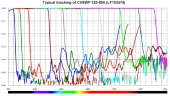
The filter transmits wavelengths shorter than the local edge and blocks longer wavelengths to at least OD 2. Blocking reaches OD 2 within 2 % of the edge wavelength, which keeps the transition from passband to stopband sharp. Average transmission reaches 90 % from 520 to 850 nm. Blocking extends far beyond the edge, roughly 1.4 × the edge wavelength + 220 nm, which suppresses stray light in spectroscopy and tunable-source setups.
Combined with a linear variable longpass filter, the CVSWP 320-850 forms a tunable bandpass with adjustable center wavelength and bandwidth. That makes it a building block for compact monochromators, tunable light sources and hyperspectral instruments.
CVSWP 320-850 Linear Variable Shortpass Filter – Tunable 320–850 nm
Specifications
| Filter Type: | Shortpass |
|---|---|
| Tuning Range: | 320 – 850 nm |
| Gradient Length: | 58 mm |
| Average Dispersion: | 9.1 nm/mm |
| Average Transmission: | 42 – 90 % |
| Blocking (OD): | 2 |
| Near-edge Average T (520–850 Nm): | ≥ 90% between 0.95 × λ50% and 0.99 × λ50% |
| Broad-band Average T (blocking): | ≤ 0.02% from 1.03 × λ50% to (1.4 × λ50% + 220 nm), 395–815 nm |
| Broad-band Tmax (enhanced Blocking): | ≤ 0.2% from 1.03 × λ50% to (1.4 × λ50% + 220 nm), 320–850 nm |
| Broad-band Tmax (blocking): | ≤ 1% from 1.02 × λ50% to (1.45 × λ50% + 220 nm), 320–850 nm |
| Broad-band Tmin (520–850 Nm): | ≥ 87% from (λ50% − 100 nm) to 0.98 × λ50% |
| Broad-band Tmin (430–520 Nm): | ≥ 80% from 0.83 × λ50% to 0.98 × λ50% |
| Broad-band Tmin (370–430 Nm): | ≥ 70% from 0.88 × λ50% to 0.98 × λ50% |
| Broad-band Tmin (330–370 Nm): | ≥ 60% from 0.94 × λ50% to 0.98 × λ50% |
| Broad-band Tmin (320–330 Nm): | ≥ 40% from 305 nm to 0.98 × λ50% |
| Model: | CVSWP 320-850 (LF102474) |
| Near-edge Average T (430–520 Nm): | ≥ 85% between 0.95 × λ50% and 0.99 × λ50% |
| Near-edge Average T (370–430 Nm): | ≥ 65% between 0.95 × λ50% and 0.99 × λ50% |
| Near-edge Average T (320–370 Nm): | ≥ 42% between 0.96 × λ50% and 0.99 × λ50% |
| OD2 Blocking Distance From λ50%: | within 0.02 × λ50% |
| Blocking Level: | OD2 |
| Mechanical Travel For λ50%: | ≤ 58 mm |
| Manufacturer Part Number (MPN): | LF102474 |
| FindLight SKU: | FL-24903 |
Got questions about specs? Use the inquiry form to ask.
 Download Data Sheet

Features
- Continuously tunable shortpass edge: 320–850 nm over 58 mm (≈ 9 nm/mm average dispersion)
- Steep edge: OD 2 blocking reached within 2 % of the 50 % cut-off wavelength
- High transmission: up to 90 % average (520–850 nm), 85 % (430–520 nm), 65 % (370–430 nm)
- Deep, wide blocking:
- ≥ OD 2 broadband
- ≥ OD 2.7 over most of the stopband
- average OD 3.7 for edge positions from 395 to 815 nm
- Broadband UV–NIR coverage: one filter for the near-UV, visible and NIR
- Solid-state wavelength selection: no gratings, rotating parts or filter changes
- Combines with longpass LVFs to build a tunable bandpass
Applications
- Tunable light sources and monochromators: select excitation or illumination wavelengths by translating the filter
- Compact and handheld spectrometers: wavelength-selective element placed over a linear detector array
- Hyperspectral and multispectral imaging: spectral filtering for push-broom and snapshot systems
- Fluorescence microscopy and spectroscopy: adjustable excitation cleanup and emission filtering
- Detector and camera testing: spectral response measurement across 320–850 nm
- Stray-light and order-sorting suppression: blocking long-wavelength light in spectroscopic instruments
Export & Trade Information
| ECCN: | EAR99 |
|---|---|
| HTS Code: | 9001.90.9000 |
| Estimated US Tariff: | 10% |
Frequently Asked Questions
What is the CVSWP 320-850 linear variable shortpass filter used for?
How do I select a specific cut-off wavelength?
How steep is the edge, and how much light is blocked?
What transmission can I expect in the passband?
Does beam size affect performance?
Can I build a tunable bandpass filter with it?
How far beyond the edge does the blocking extend?
Got more questions? Use the inquiry form to ask the supplier directly.
Similar Products
Your inquiry has been received.
Create an account by adding a password
Why create an account?
- Auto-complete inquiry forms
- View and manage all your past messages
- Save products to your favorites
- Close your account anytime — no hassle