


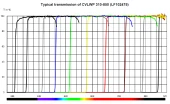
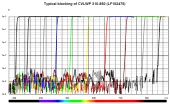
Description
The CVLWP 310-850 (LF102475) is a continuously variable longpass filter, also known as a linear variable longpass filter (LVF). Its 50 % cut-on wavelength moves smoothly from 310 nm to 850 nm along a 58 mm length, giving a tunable longpass edge across the UV, visible and near-infrared from a single optical component. That replaces a set of fixed longpass filters or a filter wheel.
The filter transmits wavelengths longer than the local edge and blocks shorter wavelengths down to 190 nm. The edge is very steep: OD 2 blocking is reached within 1 % of the 50 % wavelength, and at least OD 3 is guaranteed from 190 nm up to 3 % below the edge at every position. Average transmission just above the edge reaches 92 % from 420 to 850 nm and remains 85 % in the near-UV.
Combined with a linear variable shortpass filter such as the CVSWP 320-850, the CVLWP 310-850 forms a tunable bandpass with adjustable center wavelength and bandwidth. That makes it a building block for compact monochromators, tunable light sources and hyperspectral instruments.
CVLWP 310-850 Linear Variable Longpass Filter – Tunable 310–850 nm
Specifications
| Filter Type: | Longpass |
|---|---|
| Tuning Range: | 310 – 850 nm |
| Gradient Length: | 58 mm |
| Average Dispersion: | 9.3 nm/mm |
| Average Transmission: | 85 – 92 % |
| Blocking (OD): | 3 |
| Model: | CVLWP 310-850 (LF102475) |
| Mechanical Length For λ50% Travel: | ≤ 58 mm |
| Blocking Level: | OD2 within 0.01 * λ50% |
| Near-edge Average Transmittance (310–420 Nm): | ≥ 85 % from 1.01 * λ50% to 1.1 * λ50% |
| Near-edge Average Transmittance (420–850 Nm): | ≥ 92 % from 1.01 * λ50% to 1.1 * λ50% |
| Broad-band Minimum Transmittance (310–420 Nm): | ≥ 80 % from 1.02 * λ50% to λ50% + 120 nm |
| Broad-band Minimum Transmittance (420–850 Nm): | ≥ 90 % from 1.02 * λ50% to λ50% + 120 nm |
| Broad-band Blocking Maximum Transmittance (310–850 Nm): | ≤ 1 % from 190 nm to 0.99 * λ50% |
| Enhanced Broad-band Blocking Maximum Transmittance (310–850 Nm): | ≤ 0.1 % from 190 nm to 0.97 * λ50% |
| Broad-band Blocking Average Transmittance (310–850 Nm): | ≤ 0.05 % from 190 nm to 0.97 * λ50% |
| Manufacturer Part Number (MPN): | LF102475 |
| FindLight SKU: | FL-24904 |
Got questions about specs? Use the inquiry form to ask.
 Download Data Sheet

Features
- Continuously tunable longpass edge: 310–850 nm over 58 mm (≈ 9.3 nm/mm average dispersion)
- Very steep edge: OD 2 blocking within 1 % of the 50 % cut-on wavelength
- Deep blocking: ≥ OD 3 guaranteed from 190 nm to 0.97 × the edge wavelength; average OD 3.3
- High transmission: up to 92 % average (edge at 420–850 nm), 85 % in the near-UV
- Deep-UV blocking from 190 nm: suppresses short-wavelength excitation and stray light
- Solid-state wavelength selection: no gratings, rotating parts or filter changes
- Pairs with the CVSWP 320-850 to build a tunable bandpass
Applications
- Fluorescence microscopy and spectroscopy: adjustable emission filtering that blocks excitation light below the edge
- Raman and photoluminescence spectroscopy: tunable rejection of the excitation line and shorter wavelengths
- Tunable light sources and monochromators: combined with a shortpass LVF for variable bandpass output
- Compact and handheld spectrometers: wavelength-selective element over a linear detector array
- Hyperspectral and multispectral imaging: spectral filtering for push-broom and snapshot systems
- Order-sorting in spectrometers: blocking higher diffraction orders at short wavelengths
Export & Trade Information
| ECCN: | EAR99 |
|---|---|
| HTS Code: | 9001.90.9000 |
| Estimated US Tariff: | 10% |
Frequently Asked Questions
What is the CVLWP 310-850 linear variable longpass filter used for?
How do I select a specific cut-on wavelength?
How steep is the edge, and how much light is blocked?
What transmission can I expect in the passband?
Does beam size affect performance?
Can I build a tunable bandpass filter with it?
Got more questions? Use the inquiry form to ask the supplier directly.
Similar Products
Your inquiry has been received.
Create an account by adding a password
Why create an account?
- Auto-complete inquiry forms
- View and manage all your past messages
- Save products to your favorites
- Close your account anytime — no hassle