


Description
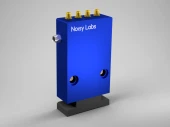
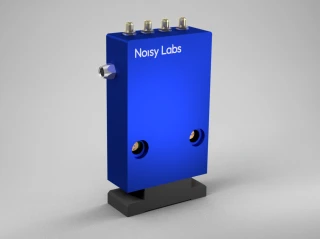
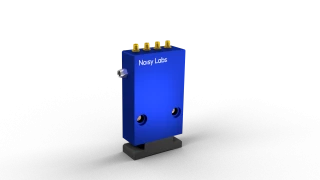
The High Quantum Efficiency Low Noise Balanced Detector from Noisy Labs is a precision photodetection module designed for ultra-low-noise optical measurements at 1550 nm. Optimized for applications where signal fidelity is critical, the detector combines high-quantum-efficiency photodiodes, excellent common-mode rejection, and low electronic noise to enable shot-noise-limited measurements in demanding photonics experiments.
Available in configurations for 1550 nm, the detector achieves quantum efficiency exceeding 95% while providing common-mode rejection ratios greater than 50 dB and up to 20 dB dark noise clearance. The balanced detection architecture effectively suppresses common-mode intensity noise from the local oscillator, allowing weak optical signals to be measured with exceptional sensitivity.
Designed for research laboratories, quantum technology, coherent communications, and precision interferometric measurements, the detector features a compact form factor, RF demodulation input with customizable modulation frequency, and stable operation across a wide range of optical input powers. Its robust performance makes it an excellent solution for homodyne detection, heterodyne detection, squeezed-light experiments, optical metrology, and other low-noise photonic applications.
High Quantum Efficiency Low Noise Balanced Detector for 1550 nm
Specifications
| Max Total Input Power: | 20 mW |
|---|---|
| 3dB Bandwidth: | 70 MHz |
| Output Impedance: | 50 Ohm |
| Dark Noise Clearance (min): | 15 dB |
| DC Output Voltage: | -5 – 5 V |
| RF Input Frequency: | 0.15 – 100 MHz |
| RF Input Power (max): | 12 dBm |
| Central Wavelength: | 1550 nm |
| Quantum Efficiency: | >95% |
| Active Area Size: | 0,1 mm diameter |
| Angle Of Incidence: | 10 deg |
| AC High Pass Cutoff: | 300 kHz (adjustable upon request) |
Got questions about specs? Use the inquiry form to ask.
 Download Data Sheet

Features
- High quantum efficiency exceeding 95% at 1550 nm
- Balanced detector architecture for low-noise optical signal detection
- Common-mode rejection ratio greater than 50 dB at 1 MHz to suppress correlated laser intensity noise
- Dark noise clearance up to 20 dB below vacuum noise for high-sensitivity measurements
- Linear shot-noise scaling with increasing local oscillator power
- Available with 100 μm photodiodes at 1550 nm and 3dB bandwidth of 70 MHz for straightforward integration with measurement electronics
- Compact benchtop package with ±12 V power supply
- Suitable for laboratory, OEM, and quantum photonics applications
Applications
- Balanced homodyne and heterodyne detection
- Quantum optics and squeezed-light experiments
- Continuous-variable quantum key distribution (CV-QKD), Coherent optical communication receivers
- Laser intensity noise characterization
- Optical interferometry and precision metrology
- Optical coherence and phase-sensitive measurements
- Photonics research laboratories
- Scientific instrumentation and OEM optical systems
Frequently Asked Questions
What is a balanced photodetector?
What wavelengths are supported by this detector?
Why is common-mode rejection ratio important?
Which applications benefit most from balanced detection?
Can this detector be integrated into OEM or laboratory systems?
Got more questions? Use the inquiry form to ask the supplier directly.
Similar Products
Your inquiry has been received.
Create an account by adding a password
Why create an account?
- Auto-complete inquiry forms
- View and manage all your past messages
- Save products to your favorites
- Close your account anytime — no hassle