


Description
The K2-1000 is a high-power 1 GHz dual-comb femtosecond laser system engineered for advanced spectroscopy, precision ranging, nonlinear optical studies, and optical frequency comb applications. Based on a novel single-cavity dual-comb architecture, the system generates two highly coherent femtosecond pulse trains with slightly different repetition rates, enabling ultrafast optical delay scanning and high-precision heterodyne measurements without the complexity of conventional multi-laser synchronization systems.
Designed as a high-performance platform for scientific research and advanced photonic instrumentation, the K2-1000 combines ultrashort pulse generation, high average power, ultralow relative intensity noise, and exceptional timing stability in a compact turnkey architecture optimized for dual-comb spectroscopy and ultrafast optical measurements.
Operating at a 1 GHz repetition rate with output powers exceeding 2 W per beam and pulse durations below 100 fs, the system delivers high power per comb line for demanding spectroscopy and nonlinear optics applications. The shared-cavity design provides passive mutual coherence and sub-cycle relative timing jitter in free-running operation, eliminating the need for complex high-speed locking electronics and optical amplification.
The K2-1000 is ideally suited for dual-comb spectroscopy, precision ranging, gas sensing, THz time-domain spectroscopy, pump-probe measurements, nonlinear optical studies, supercontinuum generation, and high-speed time-resolved spectroscopy.
Available options include integrated second-harmonic generation (SHG), wavelength conversion via optical parametric oscillator (OPO), supercontinuum generation configurations, ultrabroadband operation, fiber-coupled outputs, and stabilized repetition-rate control.
Key Advantages:
- Single-Cavity Dual-Comb Architecture
The K2-1000 generates two highly coherent femtosecond frequency combs within a single laser cavity. This shared-cavity architecture improves mutual coherence, reduces timing drift, eliminates complex synchronization electronics, and enables compact high-performance dual-comb systems. - High Power per Comb Line
The 1 GHz repetition rate combined with output powers exceeding 2 W per beam provides high optical power per comb line, supporting demanding spectroscopy, nonlinear optics, and precision measurement applications. - Ultralow Noise Performance
The system delivers ultralow relative intensity noise and sub-cycle relative timing jitter for highly sensitive spectroscopy and ultrafast optical measurements requiring exceptional phase and timing stability. - GHz Repetition Rate Operation
Operating at a 1 GHz repetition rate enables fast optical delay scanning, high spectral resolution, rapid acquisition speeds, and efficient dual-comb spectroscopy without moving mechanical components. - Compact Turnkey Platform
The compact integrated design simplifies implementation of advanced dual-comb spectroscopy and ultrafast measurement systems while reducing footprint and system complexity compared to conventional multi-laser architectures. - Flexible Spectroscopy and Nonlinear Optics Platform
Available SHG, OPO, supercontinuum generation, and broadband configurations support wavelength flexibility and application-specific optimization across spectroscopy, sensing, and nonlinear optical research.
K2-1000 High-Power Dual-Comb Laser System for Spectroscopy
Specifications
| Rep Rate: | 900 – 1100 MHz |
|---|---|
| Time Resolution: | 1 fs |
| Laser Wavelength: | 525 nm, 1050 nm, Custom |
| Laser Wavelength Range (option 1): | 1040 – 1060 nm |
| Laser Wavelength Range (option 2): | 520 – 530 nm |
| Laser Wavelength Range (option 3): | 347 – 353 nm |
| Power Per Comb: | >2 W |
| Pulse Duration (FWHM): | <100 fs |
| Repetition Rate Difference: | tunable between -100 kHz and +100 kHz |
| Relative Timing Noise: | <10 fs [1 kHz, 100 kHz] |
| Power Consumption: | <150 W |
| Electrical Requirements: | 100-120 VAC, 3 A, 50-60 Hz / 200-240 VAC, 1.5 A, 50-60 Hz |
| Operating Temperature: | 15 – 30 °C |
| Relative Humidity: | 20 – 70% (non-condensing) |
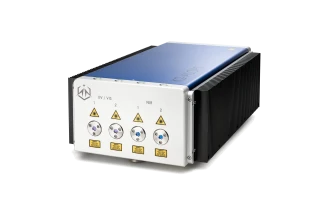
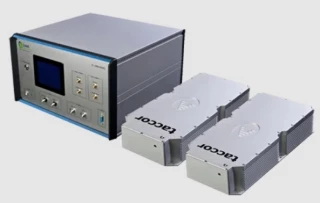
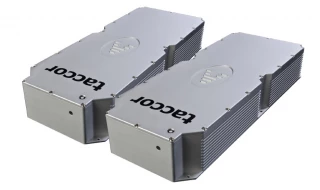
| Laser Head Dimensions: | 494 x 291 x 179 mm³ |
| Beam Output Height: | 75 mm on (W) side |
| K2-Link Control Unit Dimensions: | 395 x 436 x 88 mm³ (19" rack mountable, 2U) |
Got questions about specs? Use the inquiry form to ask.
 Download Data Sheet

Features
- Compact Solution for Spectroscopy: Ideal for R&D applications, providing a high-power platform for nonlinear studies.
- High-Power Dual-Comb Laser System: Delivers over 2 W per beam with ultralow RIN and relative timing noise.
- 1 GHz Repetition Rate: Offers a stable and precise repetition rate for advanced applications.
- Ultrafast Pulse Duration: Less than 100 fs pulse duration ensures high precision in time-resolved experiments.
- Sub-Cycle Relative Timing Jitter: Achieves sub-cycle precision with minimal noise interference.
- Repetition Rate Control: Features tunable repetition rate difference between -100 kHz and +100 kHz.
- Integrated Second Harmonic and Optical Isolation: Enhances performance and stability.
- Supercontinuum Option (SCG): Available for extended spectral applications.
- Custom Options Available: Tailor the system for specific needs such as time-resolved spectroscopy and precision ranging.
- Advanced Controls and Outputs: Includes two spatially separated pulse trains, trigger signals, and remote control via K2-Link.
- Robust Design: Operates efficiently within a temperature range of 15 – 30 °C and relative humidity of 20 – 70%.
- Low Power Consumption: Consumes less than 150 W, suitable for various laboratory environments.
- Flexible Electrical Requirements: Compatible with 100-120 VAC or 200-240 VAC power supplies.
Applications
- Dual-Comb Spectroscopy
The K2-1000 is optimized for high-resolution dual-comb spectroscopy using two highly coherent optical frequency combs generated from a shared-cavity architecture. The system enables rapid broadband spectral acquisition, high sensitivity, and precise molecular spectroscopy without mechanical scanning components. - Multi-Species Gas Sensing
The ultralow-noise dual-comb architecture supports highly sensitive gas spectroscopy and simultaneous detection of multiple gas species for environmental monitoring, industrial process control, atmospheric studies, and combustion diagnostics. - Precision Ranging and LiDAR
The coherent dual-comb architecture enables long-range precision optical ranging and interferometric distance measurements with high temporal resolution and dead-zone-free operation for scientific and industrial metrology applications. - Time-Resolved Spectroscopy
With sub-100 fs pulse durations and high repetition rate operation, the K2-1000 supports ultrafast pump-probe spectroscopy and time-resolved optical measurements requiring exceptional temporal precision and rapid acquisition. - THz Time-Domain Spectroscopy (THz-TDS)
The system is well suited for THz generation and detection in THz time-domain spectroscopy systems used for material characterization, semiconductor inspection, biomedical imaging, and non-destructive testing. - Nonlinear Optical Studies
The combination of high peak power, ultrashort pulses, and high power per comb line supports nonlinear optical experiments including harmonic generation, supercontinuum generation, ultrafast material studies, and nonlinear spectroscopy. - Supercontinuum Generation
The available supercontinuum generation configuration enables broadband ultrafast light generation for spectroscopy, metrology, optical characterization, and nonlinear photonics applications. - Optical Frequency Comb Metrology
The K2-1000 supports precision optical frequency comb applications requiring ultralow phase noise, high mutual coherence, and stable femtosecond pulse generation for advanced optical metrology systems.
Why Single-Cavity Dual-Comb Technology?
Traditional dual-comb spectroscopy systems typically rely on two independent mode-locked lasers requiring complex synchronization electronics and active stabilization. These architectures increase system complexity, footprint, and sensitivity to environmental drift.
The K2-1000 simplifies this approach by generating two highly coherent femtosecond pulse trains within a single shared optical cavity. This architecture passively stabilizes the relative intensity, timing, and phase noise between the combs while eliminating the need for high-speed locking electronics and optical amplification.
The result is a more compact, robust, and stable dual-comb spectroscopy platform capable of ultrafast optical delay scanning, high-resolution spectroscopy, and precision ranging with improved noise performance and simplified system integration.
Frequently Asked Questions
What is the K2-1000 laser system used for?
What is the repetition rate of the K2-1000 laser system?
What is the pulse duration of the K2-1000 laser system?
How much power does each beam of the K2-1000 laser system produce?
What are the dimensions of the K2-1000 laser head?
What is the operating temperature range for the K2-1000 laser system?
What are the electrical requirements for the K2-1000 laser system?
What is a dual-comb laser system?
What are the advantages of single-cavity dual-comb technology?
Why is a 1 GHz repetition rate important in dual-comb spectroscopy?
Got more questions? Use the inquiry form to ask the supplier directly.
Similar Products
Your inquiry has been received.
Create an account by adding a password
Why create an account?
- Auto-complete inquiry forms
- View and manage all your past messages
- Save products to your favorites
- Close your account anytime — no hassle