

Description
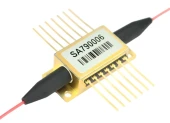
This butterfly-packaged semiconductor optical amplifier (SOA) is a high-performance 1060 nm, medium-gain device designed for demanding applications such as swept-source lasers, tunable lasers, and OCT medical imaging systems. Built in a compact 14-pin butterfly package with integrated TEC and thermistor, it delivers stable optical amplification with low power consumption and excellent polarization performance. Compared with typical 1060 nm SOAs used in OCT and laser seeding systems, this device stands out for its combination of 25 dB small-signal gain, polarization-maintaining output, and robust thermal management, making it an ideal choice for integration into precision photonic instruments.
Operating at a center wavelength around 1060–1070 nm, the SOA provides a typical small-signal gain of 25 dB with a -3 dB gain bandwidth of approximately 50 nm, offering ample optical gain over a broad spectral window frequently used in ophthalmic and intravascular OCT as well as interferometric sensing. The amplifier can deliver up to 15 dBm of output power (at 1060 nm, 5 dBm input, 400 mA drive current), which is sufficient for many swept-source and tunable laser architectures that require moderate optical power with high gain and clean polarization. A polarization extinction ratio of at least 20 dB ensures reliable polarization-maintaining performance, helping to preserve system fringe visibility and measurement accuracy in polarization-sensitive setups.
The device is engineered for low noise operation, with a typical noise figure around 8 dB (maximum 10 dB at 1060 nm and 400 mA). This is comparable to or better than many conventional SOAs in this wavelength range, supporting high signal-to-noise ratio in OCT imaging chains, laser cavity designs, and pre-amplifier stages. The amplifier’s electrical characteristics are optimized for practical system integration: the operating current is typically 400 mA (up to 600 mA), with a forward voltage up to 2 V, allowing straightforward driving with standard laser diode or SOA current controllers. Total power consumption remains below 4 W, which helps manage system-level thermal budgets and supports deployment in compact or portable instruments.
For precise temperature control and long-term wavelength and gain stability, the SOA is mounted in a hermetic 14-pin butterfly package with an integrated thermoelectric cooler (TEC) and thermistor. The TEC current is specified up to 1.8 A with a TEC voltage up to 3.4 V, enabling efficient stabilization of the chip temperature across a wide operating range. The 10 kΩ thermistor at 25 °C provides accurate temperature feedback for closed-loop controllers. Hermetic sealing (on the order of 10-12 to 10-8 Pa·m3/s) protects the semiconductor chip from moisture and contaminants, increasing reliability and lifetime in clinical, industrial, and research environments. The clear pin assignment, including dedicated Chip(+/−), TEC(+/−), thermistor leads, and ground, simplifies electrical interfacing and supports fast integration into existing driver platforms.
The amplifier is specified for a case operating temperature from -10 °C to +70 °C and a storage temperature up to +85 °C, providing flexibility for use in laboratory instruments, OEM modules, and field-deployed optical systems. Its 1060 nm spectral position makes it especially well-suited for next-generation OCT systems requiring deeper tissue penetration and reduced scattering compared with shorter wavelengths, as well as for fiber-based sensing and metrology solutions that exploit the low-loss window of specialty fibers in this band. Taken together, the medium gain, polarization-maintaining performance, broad bandwidth, and integrated thermal control make this butterfly SOA a robust, integration-ready solution for advanced photonic designs at 1060 nm.
1060 nm Polarization-Maintaining Semiconductor Optical Amplifier
Specifications
| Operating Wavelength: | 1060 nm |
|---|---|
| 3dB Optical Bandwidth: | 50 nm |
| Saturation Output Power: | 15 dBm |
| ASE Center Wavelength: | 1070 nm |
| Operating Wavelength: | 1060 nm |
| -3 DB Gain Bandwidth: | 50 nm |
| Maximum Optical Power: | 15 dBm |
| Small-signal Gain: | 25 dB |
| Polarization Extinction Ratio: | 20 dB |
| Noise Figure (typical): | 8 dB |
| Noise Figure (maximum): | 10 dB |
| Operating Current (typical): | 400 mA |
| Operating Current (maximum): | 600 mA |
| Forward Voltage (maximum): | 2 V |
| TEC Current (maximum): | 1.8 A |
| TEC Voltage (maximum): | 3.4 V |
| Thermistor Resistance (min): | 9.5 kΩ |
| Thermistor Resistance (typical): | 10 kΩ |
| Thermistor Resistance (max): | 10.5 kΩ |
| Thermistor Current (maximum): | 5 mA |
| Hermeticity (min): | 1×10^-12 Pa·m³/s |
| Hermeticity (typical): | 1×10^-11 Pa·m³/s |
| Hermeticity (max): | 1×10^-8 Pa·m³/s |
| Operating Case Temperature (min): | -10 °C |
| Operating Case Temperature (max): | 70 °C |
| Storage Temperature (max): | 85 °C |
| Total Power Consumption (maximum): | 4 W |
| Center Wavelength Class: | 1060 nm |
| Gain Type: | Medium Gain |
| Polarization Type: | PM |
Got questions about specs? Use the inquiry form to ask.
 Download Data Sheet

Features
- High-Gain 1060 nm Semiconductor Optical Amplifier – Optimized for 1060 nm operation with a typical 25 dB small-signal gain at Pin = -25 dBm, ideal for signal boosting in short‑wavelength applications.
- Butterfly-Packaged SOA with PM Fiber – Rugged 14‑pin butterfly package with integrated polarization-maintaining (PM) fiber output, ensuring stable polarization for interferometric and coherent systems.
- Medium-Gain Design for OCT and Swept-Source Lasers – Tailored for OCT medical imaging and swept-source / tunable lasers around 1060 nm, delivering clean amplification for high-resolution imaging.
- 50 nm −3 dB Gain Bandwidth – Broad ~50 nm optical bandwidth around 1060 nm enables amplification of wide spectral sweeps and broad-linewidth sources.
- High Output Power up to 15 dBm – Supports a maximum optical output power of 15 dBm (If = 400 mA, Pin = 5 dBm @ 1060 nm), suitable for power-demanding fiber and free-space systems.
- Low Noise Figure – Typical noise figure of 8 dB (max 10 dB) at 1060 nm for improved system sensitivity in OCT and other precision measurement setups.
- Excellent Polarization Extinction Ratio – PER ≥ 20 dB at 25 °C and If = 400 mA, ensuring high-quality polarization control for interferometric, sensing, and coherent detection applications.
- Low Power Consumption, TEC-Stabilized – Total power consumption ≤ 4 W with integrated thermoelectric cooler (TEC) and thermistor for precise temperature and wavelength stability.
- Integrated TEC and Thermistor for Closed-Loop Control – Dedicated pins for TEC (+/−) and 10 kΩ thermistor (9.5–10.5 kΩ @ 25 °C) allow accurate temperature management and enhanced reliability.
- Wide Operating Temperature Range – Specified case temperature from −10 °C to +70 °C, with storage up to +85 °C, supporting demanding lab, field, and OEM environments.
- Compact, Industry-Standard 14-Pin Pinout – Standardized 14‑pin butterfly configuration with a clearly marked Pin #1 notch for straightforward integration with common SOA/laser diode drivers.
- Low Drive Voltage and Current – Typical forward drive at Vf ≈ 2 V and If up to 400–600 mA, compatible with conventional telecom-style laser diode drivers and current controllers.
- High-Reliability Hermetic Package – Fully hermetic design with leak rate on the order of 10⁻¹²–10⁻⁸ Pa·m³/s, protecting the SOA chip from moisture and contamination for long lifetime.
- Optimized for 1060 nm ASE and Gain – ASE center wavelength around 1070 nm at If = 400 mA, well aligned with 1060 nm gain peak for efficient amplification and high signal-to-noise ratio.
- Ideal for OEM Integration and System Upgrades – Suitable for OCT engines, swept-source lasers, test and measurement systems, and research setups requiring a robust, plug‑and‑play 1060 nm SOA module.
- Application-Ready Electrical and Thermal Interfaces – Supports TEC currents up to 1.8 A and TEC voltage up to 3.4 V, enabling efficient thermal regulation with standard TEC controllers.
- Stable Performance Over Environmental Variations – Designed to maintain gain, power, and PER over its full operating temperature range, reducing recalibration needs in field-deployed systems.
- Low Input Power Operation – Optimized to deliver high gain at low input levels (e.g., Pin = −20 to −25 dBm), making it ideal as a pre-amplifier in low-signal OCT and sensing applications.
Applications
Applications of 1060 nm Butterfly-Packaged Semiconductor Optical Amplifier (Butterfly SOA, Medium Gain, PM)
- Optical Coherence Tomography (OCT) Medical Systems
- Signal amplification in swept-source OCT systems for ophthalmology, cardiology, and dermatology
- Enhancing sensitivity and imaging depth in anterior and posterior segment eye imaging
- Use in intravascular OCT catheters for high‑resolution vascular imaging
- Integration in compact, portable OCT diagnostic platforms
- Swept-Source and Tunable Laser Systems
- Gain medium and booster amplifier for 1060 nm swept-source lasers
- Power amplification for tunable lasers in the 1035–1085 nm range (within the ~50 nm 3 dB gain bandwidth)
- Linewidth-preserving amplification in narrow-line tunable sources
- Output power enhancement for ultra-fast wavelength-swept lasers used in imaging and sensing
- Fiber-Optic Sensing and Instrumentation
- Amplification in interferometric fiber sensors operating around 1.06 µm
- Use in fiber gyroscopes and fiber Bragg grating (FBG) interrogation units near 1060 nm
- Optical amplification for distributed and point sensing in structural health monitoring
- Signal conditioning in polarization-maintaining (PM) sensor networks
- Industrial and Scientific Laser Systems
- Power boosting of 1060 nm seed lasers for research and metrology
- Pre-amplifier stage for ytterbium-based fiber laser systems operating near 1.06 µm
- Amplification in mode-locked or CW scientific lasers requiring stable PM operation
- Use in laboratory test benches for nonlinear optics experiments around 1 µm
- Optical Communication and Test
- Specialty short-reach optical links and free-space optical communication near 1060 nm
- Amplified links in research testbeds using non-standard wavelength windows
- Optical pre-amplifier or booster in lab characterization of 1 µm photonic components
- Use in BER testing and system margin evaluation for 1.06 µm systems
- Free-Space and LIDAR-Related Applications (1 µm Window)
- Signal amplification in eye-safe free-space ranging systems operating near 1.06 µm
- Pre-amplification for prototype time-of-flight and LIDAR-like measurement systems at 1060 nm
- Use in atmospheric and environmental optical measurement setups within the 1 µm band
- Polarization-Maintaining (PM) Photonic Systems
- Amplification in PM fiber-based interferometers at 1060 nm
- Use in coherent detection schemes where high polarization extinction ratio is critical
- Stabilized PM links in precision measurement and quantum-related experiments near 1 µm
- OEM Integration and Module Development
- Integration into OEM swept-source OCT engines and subsystems
- Use as an embedded amplifier in compact butterfly-based photonic modules
- Prototype and volume products for medical imaging equipment manufacturers
Frequently Asked Questions
What is the 1060 nm butterfly-packaged semiconductor optical amplifier (SOA) and what are its key features?
What are the typical optical performance specifications of this 1060 nm medium-gain SOA?
How is the 14‑pin butterfly SOA pinned out and how do I connect it electrically?
What fiber and polarization properties does this SOA have?
What thermal management and operating temperature conditions are recommended?
Is this 1060 nm SOA suitable for OCT and swept-source or tunable laser applications?
What precautions should I take when using this semiconductor optical amplifier?
Got more questions? Use the inquiry form to ask the supplier directly.
Your inquiry has been received.
Create an account by adding a password
Why create an account?
- Auto-complete inquiry forms
- View and manage all your past messages
- Save products to your favorites
- Close your account anytime — no hassle