


Description
The ForeSight™ Fiber Optic Distributed Strain and Temperature Sensor (DSTS) with BOTDR module from OZ Optics is a high‑performance Brillouin-based monitoring platform designed for long-distance, single-ended structural and environmental measurements. Leveraging spontaneous Brillouin Optical Time Domain Reflectometry (BOTDR), this system transforms standard single mode telecommunications fiber into a dense array of virtual sensors, capable of monitoring strain and temperature continuously along tens of kilometers of fiber. With spatial resolution as fine as 1 meter and sensing ranges up to 70 km per channel, it offers a powerful combination of detail and coverage for mission-critical infrastructure across energy, civil engineering, and geohazard applications.
Unlike point sensors that provide localized measurements only where a device is installed, the BOTDR-based ForeSight™ DSTS measures Brillouin backscatter along the full fiber length to derive a continuous strain and temperature profile. This distributed approach allows users to detect subtle changes such as developing cracks, ground movement, leaks, or thermal anomalies before they escalate into failures. Because the measurement is single-ended, access is required only from one side of the fiber, which greatly simplifies deployment in pipelines, subsea cables, tunnels, wells, and other locations where dual-end access is not practical. Even if the fiber is damaged or broken, the system continues to provide valid, high-resolution measurements right up to the break point, significantly improving resilience and diagnostic capability during fault events.
The ForeSight™ DSTS BOTDR module is engineered around standard low-cost single mode telecom fiber, making it straightforward to integrate into existing fiber routes or to design into new builds without specialized optical cable. In comparison with distributed temperature sensing (DTS) systems based on Raman scattering and distributed acoustic sensing (DAS) systems based on Rayleigh, Brillouin DSTS adds direct strain measurement with high accuracy alongside temperature monitoring. Typical performance includes temperature accuracy on the order of ±0.8 °C and strain accuracy on the order of tens of microstrain (με), enabling operators to correlate structural loading, deformation, and thermal behavior at a granularity suitable for advanced asset management and predictive maintenance strategies.
For oil and gas operators, the system provides reliable long-distance monitoring for pipelines, wellbores, and refineries. Installed along pipelines, the distributed strain and temperature data can be used to identify leaks, localized deformation, ground movement, and thermal anomalies over distances up to 70 km per channel, with sufficient spatial resolution to pinpoint the affected region for rapid intervention. In wells, the system supports integrity management through continuous profiling of temperature and strain, helping to reveal casing deformation, fluid movement, or pressure-related effects when used with appropriate sensing cables. In refineries, distributed temperature profiling contributes to process optimization, improved thermal balancing, and early detection of abnormal conditions that could impact efficiency, safety, or uptime.
In large civil structures, the ForeSight™ DSTS BOTDR module delivers comprehensive structural health monitoring capabilities across dams, bridges, tunnels, retaining walls, and foundations. When embedded in or attached to concrete, rock, soil, or structural steel, the fiber captures distributed strain and temperature patterns associated with crack formation, seepage, sediment build-up, or deformation. This continuous, full-length view enables engineers to move from periodic inspections to continuous condition-based assessment, extending asset life and enhancing safety. The ability to monitor up to 70 km per channel with meter-level spatial resolution makes the system especially well-suited to long dams, levees, and extended civil works where conventional point sensors would be impractical or cost-prohibitive.
The system is equally effective in geotechnical and geohazard monitoring scenarios. Installed along slopes, embankments, levees, or road and rail corridors, the BOTDR-based sensor reveals patterns of landslide initiation, subsidence, or ground deformation over time. Subtle cumulative strain changes are often the earliest indicators of instability; by mapping these changes continuously, stakeholders can track trends, define alarm thresholds, and plan mitigation measures well before catastrophic movement occurs. When integrated with specialized sensing cables or anchors, the fiber can be configured to capture both near-surface and deep-seated movements, supporting modern performance-based design and risk management methodologies.
<Fiber Optic Distributed Strain and Temperature Sensors (DSTS): BOTDR
Specifications
| Spatial Resolution: | 1 m |
|---|---|
| Max Sensing Range: | 70 km |
| Dynamic Range: | 15 dB |
| Temperature Range: | -100 – 500 deg C |
| Temperature Resolution: | 0.005 deg C |
| Strain Range: | -0.2 – 1 % |
| Temperature Accuracy (σ): | ±0.8 °C |
| Strain Accuracy (σ): | 16 με |
| Fiber Type: | Single-mode telecom fiber |
| Measurement Type: | Single-end measurement |
| Sensing Principle: | Brillouin Optical Time Domain Reflectometry (BOTDR), spontaneous Brillouin scattering |
Got questions about specs? Use the inquiry form to ask.
 Download Data Sheet

Features
- Single-End Distributed Strain & Temperature Sensing
Measures strain and temperature continuously along a fiber from one end only, simplifying installation where dual access is not possible. - Long-Range Monitoring up to 70 km per Channel
Brillouin Optical Time Domain Reflectometer (BOTDR) technology delivers distributed measurements over distances up to 70 km per channel, ideal for pipelines, power lines, dams, and long civil structures. - Fine Spatial Resolution Down to 1 m
Achieves spatial resolution as low as 1 meter, enabling highly localized detection of leaks, hot spots, cracks, deformations, and geohazards along extended assets. - High Measurement Accuracy
Typical accuracy of approximately ±0.8 °C in temperature and ±16 με (microstrain) in strain (σ), supporting reliable structural health and process monitoring. - Uses Standard Low-Cost Telecom Single-Mode Fiber
Operates over standard SMF (e.g., ITU-T G.652), minimizing sensor cable costs and allowing use of existing fiber infrastructure where available. - Robust BOTDR Based on Spontaneous Brillouin Scattering
Utilizes spontaneous Brillouin backscatter, allowing fully distributed sensing without in-line active components or discrete sensors along the route. - Measurement Continues Up to Fiber Break Point
Maintains measurement capability up to the location of a fiber break, supporting fault localization and partial data recovery in damaged networks. - Multi-Channel System Architecture
Supports multiple sensing channels in a compact 3U chassis, enabling monitoring of several fibers, routes, or assets from a single system. - Not Sensitive to Hydrogen Darkening
Sensing principle is inherently resilient in hydrogen-rich environments where fiber attenuation may change, making it suitable for oil & gas wells and refineries. - Wide Application Coverage Across Industries
Designed for oil & gas pipelines and wells, refineries, dams, tunnels, bridges, highways, geohazard zones, overhead power lines, and submarine cable routes. - Comprehensive Oil & Gas Monitoring
Enables pipeline leakage detection, well integrity monitoring, and downhole temperature/strain/pressure profiling with appropriate sensing cable and installation methods. - Refinery Process Optimization
Distributed temperature profiling improves thermal efficiency, supports process control, reduces downtime, and enhances safety monitoring in refineries and processing plants. - Dam and Civil Infrastructure Health Monitoring
Monitors internal dam temperature, crack development, seepage, sediment movement, and structural deformation continuously along the entire asset. - Structural Health Monitoring (SHM) of Large Assets
Provides continuous strain and crack monitoring for bridges, tunnels, buildings, storage tanks, and large civil structures over tens of kilometers. - Highway & Geohazard Surveillance
Detects highway subsidence, landslides, levee deformation, and ground movement trends, enabling predictive maintenance and early-warning systems. - Overhead Power Line Condition Monitoring
Detects icing, conductor strain, and broken wires along power transmission routes without additional active components along the line, simplifying deployment. - Submarine and Buried Cable Monitoring
Enables ongoing quality, strain, and temperature status assessment along submarine and buried communication or power cables, improving asset reliability. - Immune to Electromagnetic Interference (EMI)
Optical fiber sensing is inherently immune to EMI and RF noise, making it suitable for high-voltage and industrial environments. - Distributed Sensing with No In-Line Power
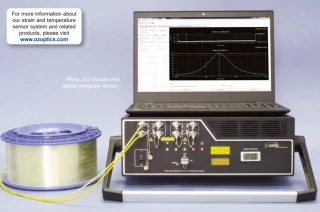
The sensing fiber contains no powered components; interrogation and processing occur entirely at the instrument end, increasing reliability and safety. - Compact, Rack-Mountable 3U Form Factor
Fits standard racks for integration into control rooms and data centers, and can be paired with a laptop or PC for configuration and data visualization. - Scalable and Integrable with SCADA & Monitoring Platforms
Designed to interface with industrial control and asset management systems, enabling centralized, real-time condition monitoring across large infrastructures.
Applications
- Oil and Gas Pipeline Leakage Monitoring
Utilize the BOTDR-based distributed strain and temperature sensors to detect and locate leaks, wall thinning, and mechanical damage along buried or above-ground oil and gas pipelines. The system provides continuous 24/7 monitoring over distances up to 70 km per channel with meter-level spatial resolution, enabling early detection of anomalies, safer operation, and reduced environmental impact compared with point sensors and periodic inspections. - Oil and Gas Well Integrity and Completion Monitoring
Deploy standard single mode fiber in or along production and injection wells to track distributed temperature and strain profiles in real time. Changes in Brillouin frequency shift can reveal casing deformation, tubular buckling, cement failure, inflow/outflow zones, and water or gas breakthrough. This supports integrity management, optimization of artificial lift, and safer, more efficient well interventions. - Refinery and Process Plant Efficiency Monitoring
Implement distributed temperature sensing along process lines, heat exchangers, furnaces, and storage tanks in refineries and petrochemical plants. The DSTS system enables optimization of heat integration, early detection of hot spots, blockages, and insulation failures, improving overall energy efficiency and throughput while reducing unplanned downtime and maintenance costs. - Dam and Embankment Structural Health Monitoring
Embed or surface-mount sensing fibers in concrete dams, embankments, spillways, and foundations to monitor distributed strain and temperature. The system can detect crack initiation, seepage paths, sediment buildup, internal erosion, and deformation over the entire structure. Long-range coverage and high spatial resolution allow operators to pinpoint zones of concern and improve dam safety management. - Civil Infrastructure and Structural Health Monitoring (SHM)
Integrate Brillouin-based sensing fibers into bridges, tunnels, high-rise buildings, rail structures, and foundations for continuous structural health monitoring. Distributed strain and temperature measurements help identify crack growth, joint movement, settlement, thermal loading effects, and long-term creep, supporting predictive maintenance and life-cycle management of critical assets. - Geohazard, Landslide, and Ground Deformation Monitoring
Install sensing cables in slopes, levees, embankments, tailings dams, and along transportation corridors to monitor ground movement. The DSTS technology provides distributed strain data that highlight zones of differential settlement, tension cracks, and shear deformations. This helps forecast landslides, subsidence, and levee failures, allowing timely mitigation and evacuation planning. - Highway and Railway Safety Monitoring
Lay telecom-grade single mode fiber along highways and railways to continuously measure distributed strain and temperature along the entire route. The system can detect embankment settlement, subgrade deformation, sinkholes, frost heave, and structural changes in bridges or tunnels connected to the route. Early identification of anomalies helps maintain safe operation and reduces the risk of catastrophic failures. - Overhead Power Line and Transmission Corridor Monitoring
Use the BOTDR module with fiber installed along overhead power lines, ground wires, or within optical ground wire (OPGW) to monitor conductor sag, tension, icing, galloping, and mechanical damage. Distributed strain and temperature profiles help operators detect broken strands, overloaded spans, and icing events without the need for active components along the line, improving reliability and reducing inspection costs. - Submarine and Undersea Cable Health Monitoring
Apply distributed Brillouin sensing to submarine telecom or power cables for real-time monitoring of mechanical strain and temperature along long undersea routes. The system can localize anchor drags, fishing gear impacts, ground movements, and localized heating in power cables, assisting in asset protection, fault localization, and efficient maintenance of subsea infrastructure. - Offshore Platform, Riser, and Subsea Structure Monitoring
Attach sensing fibers to risers, umbilicals, flowlines, and subsea structures to monitor dynamic strain and temperature changes due to waves, currents, vortex-induced vibrations, and operational loading. Continuous distributed data improves fatigue assessment, integrity management, and lifetime extension strategies for offshore oil, gas, and renewable energy installations.
Frequently Asked Questions
What is the OZ Optics ForeSight BOTDR Distributed Strain and Temperature Sensor and how does it work?
What are the key performance specifications of this BOTDR distributed sensing module?
What applications are best suited for this fiber optic distributed strain and temperature sensing system?
What type of optical fiber and cabling are required for the BOTDR distributed sensor system?
How does this BOTDR system compare to other distributed temperature and strain sensors (e.g., DTS and BOTDA) on the market?
Is the BOTDR distributed sensor affected by hydrogen or harsh industrial environments?
How is the system installed, calibrated, and integrated with existing monitoring or SCADA systems?
Got more questions? Use the inquiry form to ask the supplier directly.
Similar Products


Your inquiry has been received.
Create an account by adding a password
Why create an account?
- Auto-complete inquiry forms
- View and manage all your past messages
- Save products to your favorites
- Close your account anytime — no hassle