


Description
Foresight™ Fiber Optic Distributed Temperature Sensors (B‑DTS) – Low‑Cost Brillouin BOTDA System
The Foresight™ Fiber Optic Distributed Temperature Sensor (B‑DTS) from OZ Optics is an advanced Brillouin Optical Time Domain Analysis (BOTDA) platform engineered for long‑range, high‑resolution temperature monitoring. Using stimulated Brillouin scattering in standard telecom‑grade single mode fiber, this system continuously measures temperature variations along the full length of an optical fiber, transforming the fiber itself into a continuous line sensor. Unlike point sensors, which only capture data at discrete locations, the Foresight™ B‑DTS delivers a truly distributed profile, making it ideally suited for critical infrastructure and industrial environments where comprehensive thermal mapping is required.
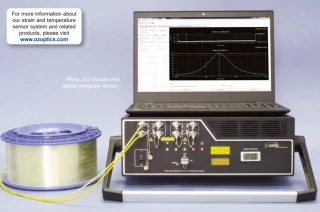
Built around a robust 3U rack‑mountable chassis and typically operated via a laptop or workstation, the system offers a powerful balance of performance and cost. The low‑cost Brillouin BOTDA architecture provides a maximum sensing range of up to 100 km per channel with spatial resolution as fine as 1 m, enabling precise localization of anomalies over very long distances. This performance level is comparable to, and often exceeds, many conventional Raman‑based DTS solutions, while providing better range and reduced sensitivity to optical loss variations along the fiber. With temperature precision on the order of ±0.3 °C under typical conditions, the Foresight™ platform supports both fast and dynamic measurements, making it suitable for real‑time monitoring as well as detailed diagnostic campaigns.
One of the key advantages of Brillouin‑based distributed sensing is its immunity to attenuation changes that frequently affect long optical links. In many industrial and energy applications, hydrogen darkening and other aging effects can alter fiber attenuation over time, which may compromise measurement accuracy in conventional systems. The Foresight™ B‑DTS architecture is inherently robust against such variations, providing stable readings even when deployed in harsh environments or over aging fiber infrastructure. The use of standard, low‑cost single mode telecom fiber further simplifies deployment and minimizes total lifecycle cost, since the same fiber can often serve both sensing and communication roles where design constraints allow.
The system supports between 2 and 25 channels, depending on configuration, creating an extremely scalable solution for large assets and multi‑segment networks. Fiber loops and single‑end configurations are both supported, allowing the sensing architecture to be adapted to the physical layout of pipelines, wells, cables, or structures. Spatial resolution can be configured from approximately 1 m to several meters, while spatial step sizes can be set as low as a few centimeters, delivering a high‑definition temperature profile tailored to the application. These capabilities make the Foresight™ B‑DTS particularly effective for early detection of localized hot spots, leaks, insulation failures, and other incipient faults.
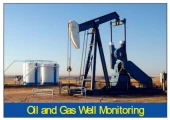
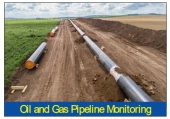
In the oil and gas sector, the Foresight™ B‑DTS is well suited for both pipeline and well monitoring. Along pipelines, continuous temperature profiling enables early detection of leakage or product loss by identifying local temperature anomalies, even when they occur tens of kilometers away from the control station. With a sensing range of up to 100 km per channel and fast acquisition times, operators can monitor extended pipeline sections with high confidence and minimal instrumentation along the route. In wells and reservoirs, distributed temperature measurements help evaluate well integrity, detect casing leaks, monitor thermal stimulation processes, and infer downhole flow profiles when combined with suitable sensing cables and installation techniques. The system’s immunity to hydrogen‑induced attenuation changes is particularly valuable in these environments, where downhole conditions can be extreme.
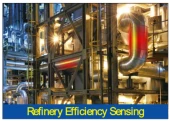
In refineries and processing facilities, detailed temperature mapping can significantly improve energy efficiency and process stability. By deploying sensing fibers around reactors, furnaces, heat exchangers, and critical process lines, engineers can identify uneven heating, insulation degradation, blockages, or maldistribution that would otherwise be difficult to detect with discrete sensors. This granular visibility into temperature distribution helps optimize operating conditions, reduce fuel consumption, and prevent unplanned downtime, while maintaining stringent safety margins. The ability to use standard telecom fiber also facilitates routing sensors through complex plant layouts without extensive mechanical modifications.
Foresight Fiber Optic Brillouin Distributed Temperature Sensors
Specifications
| Spatial Resolution: | 1 m |
|---|---|
| Max Sensing Range: | 100 km |
| Temperature Range: | -270 – 2100 deg C |
| Temperature Resolution: | 0.005 deg C |
| Model: | Foresight™ Series |
| Number Of Channels: | 2 to 25 |
| Sensor Configuration: | Loop fiber, single end configuration optional |
| Sensing Range Options: | 60 km, 100 km |
| Spatial Resolution: | 1 m to 6 m |
| Spatial Resolution: | 1 m to 20 m |
| Spatial Step: | as low as 5 cm |
| Temperature Range: | -270 °C to +2100 °C (depending on cable) |
| Spatial Resolution (performance At A Glance): | 1 m for 20 km fiber length |
| Temperature Precision: | ± 0.3 ºC |
| Minimum Measurable Temperature: | 25 K |
Got questions about specs? Use the inquiry form to ask.
 Download Data Sheet

Features
- Distributed Fiber Optic Temperature Sensing (B‑DTS) – Uses stimulated Brillouin scattering (BOTDA) to measure temperature continuously along the entire fiber length, turning standard telecom single‑mode fiber into a fully distributed sensor.
- Exceptional Sensing Range – Up to 100 km per Channel – Monitors extremely long assets such as pipelines, power lines, and subsea cables with a single system, reducing the number of units, splice points, and field enclosures required.
- High Spatial Resolution – Down to 1 m – Detects highly localized temperature changes and hot spots over long distances (1 m spatial resolution for up to 20 km, and configurable resolutions up to 20 m), ideal for precise leak, fault, and fire localization.
- High Measurement Precision – ±0.3 °C – Delivers accurate and repeatable temperature profiles for process control, asset integrity monitoring, and early fault detection in demanding industrial environments.
- Fast & Dynamic Measurements – Short acquisition and response times support near real‑time monitoring of rapidly changing temperature events, improving protection in fire detection, well integrity, and power line monitoring applications.
- Multi‑Channel System Architecture – Foresight™ Series supports 2 to 25 channels, enabling simultaneous monitoring of multiple lines, loops, or zones from a single 3U rack‑mountable chassis for scalable coverage.
- Long‑Life, Passive Sensing Infrastructure – Requires no active components along the sensing route; the sensing fiber is completely passive, immune to EMI/RFI, and highly reliable in harsh and remote locations.
- Compatible with Standard Telecom Single‑Mode Fiber – Leverages low‑cost, widely available SMF as the sensing medium, dramatically reducing installation and replacement costs compared to specialized sensor cables.
- Insensitive to Fiber Attenuation Changes & Hydrogen Darkening – Brillouin‑based measurements are largely immune to loss variations and hydrogen‑induced attenuation, critical for downhole, refinery, and high‑temperature industrial environments.
- Flexible Sensor Configurations – Supports loop‑fiber and single‑ended configurations, allowing optimized designs for long linear assets, ring networks, or applications where only one end of the fiber is accessible.
- Extremely Wide Temperature Range – Designed for sensing from cryogenic temperatures (~25 K) up to very high temperatures (up to +2100 °C depending on the sensing cable), covering cryostats, industrial furnaces, refineries, and fire detection.
- Cryogenic Temperature Measurement – Capable of accurate distributed sensing in cryostats and low‑temperature research setups, where conventional electronic sensors are difficult to deploy or unreliable.
- Integrated Temperature, Strain & Pressure Capability – When combined with the appropriate sensing cable and installation, the system can monitor temperature, strain, and pressure along the same fiber for comprehensive structural health monitoring.
- Ideal for Oil & Gas Pipeline and Well Monitoring – Detects leaks, insulation failures, and flow anomalies over tens of kilometers; supports well integrity monitoring from surface to reservoir depth with high spatial resolution and rapid response.
- Refinery Process & Efficiency Optimization – Continuous distributed temperature profiling helps optimize heat exchanges, furnaces, and reactors to improve efficiency, reduce energy consumption, and minimize unplanned downtime.
- Overhead Power Line Monitoring – Detects ice loading, hot spots, broken conductors, and lightning impacts along power transmission and distribution lines without any active devices mounted on the line.
- Submarine & Subsea Cable Surveillance – Provides ongoing performance and condition monitoring along the full length of submarine telecom or power cables, enabling early detection of thermal anomalies, faults, or environmental events.
- Building & Tunnel Fire Detection – Offers fast, dynamic, and accurate linear heat detection over very long distances, making it ideal for tunnels, conveyor belts, cable trays, and large facilities where point sensors are insufficient.
- Fine Spatial Step – as low as 5 cm – Adjustable spatial step size allows very detailed temperature profiling where needed (e.g., critical sections of pipelines, joints, or cable terminations) for more precise fault localization.
Applications
- Oil and Gas Pipeline Monitoring – Continuous, real‑time temperature profiling along long‑distance pipelines (up to 100 km per channel) to detect leaks, blockages, waxing, or hydrate formation with meter‑level spatial resolution.
- Pipeline Leak Detection and Localization – Early detection of small leaks through temperature anomalies, enabling precise localization and rapid intervention while minimizing environmental impact and product loss.
- Flow Assurance and Thermal Profiling – Monitoring temperature gradients to manage insulation performance, detect cold spots, and optimize heating or insulation strategies for pipelines transporting crude oil, gas, LNG, and multiphase flows.
- Oil and Gas Well Monitoring – Downhole distributed temperature sensing for production and injection wells, including vertical, deviated, and horizontal wells, to monitor inflow profiles, gas breakthrough, and water encroachment.
- Well Integrity Management – Continuous temperature and strain monitoring to identify casing deformation, tubing leaks, annular gas migration, and packer or completion failures.
- Steam and Thermal EOR Monitoring – Distributed temperature measurement in SAGD, CSS, and other thermal recovery operations to assess steam chamber growth, conformance, and sweep efficiency.
- Hydraulic Fracturing Monitoring – Temperature profiling during and after stimulation operations to evaluate fracture propagation, zonal coverage, and fluid distribution.
- Gas Storage and Underground Storage Monitoring – Long‑term temperature and strain sensing in underground gas, CO₂, and hydrocarbon storage caverns to improve safety and structural integrity.
- Refinery Process Line Monitoring – Distributed sensing along transfer lines, heat exchangers, and critical conduits to detect fouling, blockage, or abnormal heating and cooling zones.
- Offshore Platform and Subsea Umbilical Monitoring – Monitoring temperature along subsea flowlines, risers, and umbilicals to improve flow assurance, detect insulation degradation, and identify thermal anomalies under harsh marine conditions.
Refinery and Petrochemical Facility Applications
- Refinery Efficiency Sensing – Continuous temperature profiling to optimize process parameters, improve thermal efficiency, and reduce energy consumption across refining units.
- Heat Exchanger and Furnace Monitoring – Early detection of hotspots, cold zones, or fouling in heaters, furnaces, and heat exchangers to maximize throughput and protect critical assets.
- Tank Farm and Storage Facility Monitoring – Distributed temperature sensing across tank perimeters, dikes, and underground piping to identify leaks and abnormal thermal behavior.
- Process Safety and Risk Mitigation – Integration with safety systems (SIS, DCS) to trigger alarms when distributed temperature readings indicate fire, loss of containment, or process upsets.
- Low‑Cost Infrastructure with Telecom Fiber – Utilization of standard single‑mode telecom fiber for large plants, terminals, and refineries, reducing installation and maintenance costs compared to discrete sensors.
Power Transmission and Utility Applications
- Overhead Power Line Monitoring – Continuous temperature and strain monitoring along transmission lines to detect conductor overheating, icing, and mechanical stress.
- Lightning Strike and Fault Detection – Identification of temperature spikes and structural disturbances due to lightning strikes, short circuits, or broken wires along the line.
- Dynamic Line Rating (DLR) – Real‑time temperature data along the full length of the conductor to dynamically determine ampacity and safely increase line utilization.
- No In‑Line Components Required – Monitoring over distances up to 100 km per channel without installing active components or electronic devices along the route, simplifying deployment.
- Underground Power Cable Monitoring – Distributed temperature and strain sensing on buried cables to detect joint failures, insulation degradation, and local heating in cable trenches and tunnels.
- Substations and Switchyard Asset Monitoring – Integration of distributed sensing into substations to monitor cable runs, bus ducts, and equipment enclosures for abnormal heating.
Frequently Asked Questions
What is the OZ Optics Foresight B-DTS fiber optic distributed temperature sensor and how does it work?
What are the key performance specifications of the Foresight B-DTS system (range, resolution, and accuracy)?
Which applications are best suited for the OZ Optics Foresight Brillouin distributed temperature sensor?
What type of fiber and cabling does the Foresight B-DTS require, and can it use standard telecom fibers?
How many channels are available and how far can the Foresight B-DTS monitor per system?
What are the advantages of Brillouin BOTDA-based B-DTS compared with Raman-based distributed temperature sensors?
Is the OZ Optics Foresight B-DTS suitable for fire detection and safety monitoring, and how fast is its response?
Got more questions? Use the inquiry form to ask the supplier directly.
Similar Products


Your inquiry has been received.
Create an account by adding a password
Why create an account?
- Auto-complete inquiry forms
- View and manage all your past messages
- Save products to your favorites
- Close your account anytime — no hassle