
Description
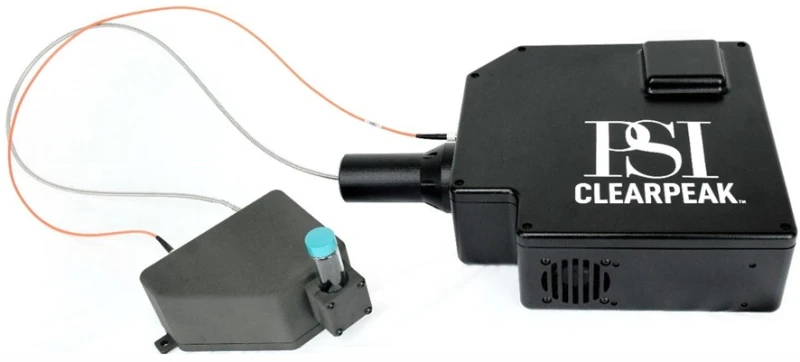
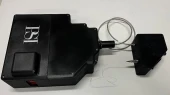
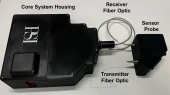
The ClearPeak is a portable, small form factor Raman spectroscopy system built around a high–optical throughput interferometer that delivers exceptional sensitivity and high spectral resolution. The core spectral engine is a Spatial Heterodyne Spectrometer (SHS) that enables simultaneous acquisition of the full spectral range with no moving parts.
The ClearPeak architecture provides exceptional mechanical stability and repeatable performance with optical throughput up to 100× higher than conventional slit-based spectrometers at comparable spectral resolution. The increased throughput directly improves signal collection efficiency, enabling high spectral SNR, fast integration times and low detection limits for trace components in complex mixtures. ClearPeak is ideally suited for both solid and liquid samples across demanding applications—from real-time process monitoring to rapid material identification.
ClearPeak Raman System
Specifications
| Excitation Wavelength: | 830 nm |
|---|---|
| Laser Power: | 450 mW |
| Raman Shift Range: | 100 – 1800 cm^-1 |
| Spectral Resolution: | 13 cm^-1 |
| Special Attributes: | High Throughput |
| Connectivity: | Not Specified |
| Weight: | 12 kg |
| Certification: | Not Specified |
| Electrical Power Source: | External AC |
| Laser Wavelength: | 830 nm (785 nm and 532 nm are also available) |
| Laser Power At Sample: | 450 mW max (variable under software control) |
| Etendue: | 6.5e-3 cm² sr |
| Detector: | Sony IMX428 CMOS (-5°C to -10°C) |
| Interrogation Area Diameter: | Narrow FOV: 1.4 mm; Wide FOV: 14 mm |
| Illumination Diameter: | Narrow FOV: 0.25 mm; Wide FOV: 2 mm |
| Working Distance: | Narrow FOV: 12.5 mm; Wide FOV: 50 mm |
| Typical Integration Times: | 1 sec to 60 sec |
| Signal-to-Noise Ratio: | Liquid: 1,500; Solid: 1,000 |
| Chemical Container Types: | Cuvettes, clear or opaque glass containers, plastic bags, plastic bottles |
| Dimensions: | Main body: 14×11×4.5 cu. in.; Fiber attachment: 5.9×6.4×4.5 cu. in. |
| Weight: | 12 lbs. |
| Power: | Universal AC single-phase input power; 100-240 V AC; line frequency 50–60 Hz; 37 watts |
Got questions about specs? Use the inquiry form to ask.
 Download Data Sheet

Features
- High Optical Throughput (SHS Architecture): Utilizes Spatial Heterodyne Spectroscopy (SHS) for up to 100× higher photon collection efficiency compared to traditional slit-based Raman systems, ensuring superior signal strength and data quality.
- Full Spectral Range Acquisition with No Moving Parts: Interferometric spectral engine enables simultaneous capture of the entire Raman spectrum, enhancing reliability and mechanical stability for repeatable measurements.
- Exceptional Sensitivity & Low Detection Limits: High spectral signal-to-noise ratio (SNR) supports detection of low-concentration and trace components in complex mixtures, ideal for both laboratory and industrial applications.
- Fast Measurement Speed: Efficient signal collection allows for shorter integration times (as low as 1 second), increasing throughput without compromising data integrity.
- Versatile Through-Container Measurement: Wide field-of-view (FOV) sampling enables non-destructive analysis through opaque and scattering containers, including plastic (up to ~3 mm thick) and paper barriers.
- Representative Sampling of Heterogeneous Materials: Reduces microheterogeneity-driven variability, ensuring accurate analysis of powders, blends, and turbid samples.
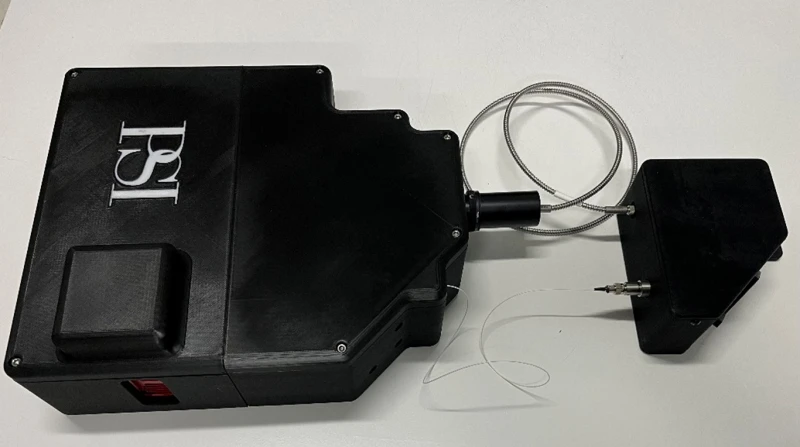
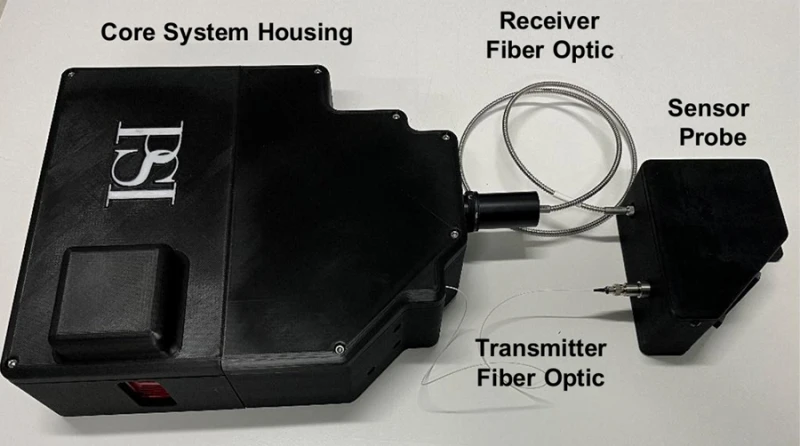
- Compact, Portable, and Fiber-Coupled Design: Lightweight (12 lbs) and small footprint (14×11×4.5 in.) with flexible probe for in situ measurements in fume hoods, process lines, and remote locations.
- Integrated, User-Friendly System: Includes excitation laser (830 nm standard; 785 nm and 532 nm available), optical filters, sensor probe head, and acquisition software on a Windows 12 single-board computer for immediate operation.
- Adjustable Field of View: Easily switch between narrow (1.4 mm) and wide (14 mm) FOV for targeted or bulk sampling, with corresponding illumination diameters and working distances.
- Stable, Robust, and Ready to Deploy: No moving parts, high mechanical stability, and universal AC power input (100-240 V, 50–60 Hz) for reliable, maintenance-free operation in diverse environments.
- Wide Range of Compatible Sample Containers: Supports cuvettes, clear or opaque glass, plastic bags, and bottles for maximum application flexibility.
- Advanced Detector Technology: Equipped with a Sony IMX428 CMOS sensor (operating at -5°C to -10°C) for enhanced sensitivity and low noise performance.
- Customizable Laser Options: Standard 830 nm laser with up to
Applications
- Pharmaceutical Process Monitoring and Quality Control
Real-time analysis of active pharmaceutical ingredients (APIs), excipients, and blends for in-process monitoring, endpoint determination, and verification of content uniformity in tablets and powders. - Chemical Reaction Monitoring
In situ tracking of chemical reactions in laboratory and industrial environments, enabling rapid identification of intermediates, reaction endpoints, and process optimization. - Polymer and Plastics Identification
Rapid, non-destructive identification and characterization of polymers, plastics, and blends, including through opaque or colored containers and packaging. - Food and Beverage Quality Assurance
Detection of adulterants, contaminants, and compositional analysis in food powders, liquids, and packaged goods, even through plastic or paper barriers. - Forensic and Security Applications
Identification of illicit substances, explosives, and hazardous materials in the field or laboratory, including analysis through packaging or containers. - Environmental Monitoring
Detection and quantification of pollutants, toxins, and trace chemicals in water, soil, and air samples, supporting environmental compliance and safety. - Material Science and Research
Characterization of advanced materials, nanomaterials, and composites for research and development, including studies of crystallinity, phase transitions, and molecular structure. - Biological and Biomedical Analysis
Non-invasive analysis of biological tissues, cells, and biofluids for research and diagnostic applications, including detection of biomarkers and disease states. - Industrial Process Control
Inline and at-line monitoring of manufacturing processes, including blending, mixing, and formulation in chemical, pharmaceutical, and food industries. - Quality Assurance in Manufacturing
Verification of raw materials, intermediates, and finished products for identity, purity, and consistency, reducing batch-to-batch variability. - Gemstone and Mineral Identification
Rapid, non-destructive identification and authentication of gemstones, minerals, and geological samples in the field or laboratory. - Education and Academic Research
Hands-on teaching tool for spectroscopy, analytical chemistry, and materials science courses, as well as advanced research projects. - Art and Cultural Heritage Analysis
Non-destructive investigation of pigments, binders, and restoration materials in artworks and historical artifacts, even through protective coverings.
Frequently Asked Questions
What is the ClearPeak TM?
How does the ClearPeak TM achieve high optical throughput?
What applications is the ClearPeak TM suitable for?
What are the advantages of using the ClearPeak TM?
What components are included with the ClearPeak TM system?
Can the ClearPeak TM be used for in-process monitoring?
Does the ClearPeak TM require any additional equipment to start working?
Got more questions? Use the inquiry form to ask the supplier directly.
Similar Products

Your inquiry has been received.
Create an account by adding a password
Why create an account?
- Auto-complete inquiry forms
- View and manage all your past messages
- Save products to your favorites
- Close your account anytime — no hassle