
Description
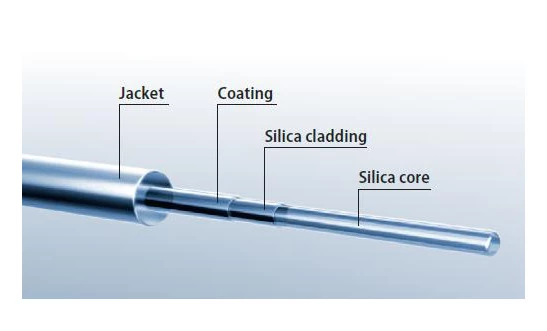
Leoni Fiber Optics offers high-quality glass fibers designed for infrared applications, featuring a core made from pure fused silica glass. These fibers are characterized by a low OH content and a uniform refractive index across their entire diameter, ensuring optimal performance. The fibers operate effectively within a wavelength range of 400 nm to 2400 nm, encompassing both visible and infrared spectrums (VIS-IR).
Advantages of Silicone-Coated and Tefzel®-Jacketed Optical Fibers
Silicone-coated multimode optical fibers with Tefzel® jackets are designed for demanding industrial and photonics environments requiring enhanced thermal stability, chemical resistance, and mechanical durability. The silicone coating improves flexibility and performance under elevated temperatures, while the Tefzel® outer jacket provides additional protection against abrasion, moisture, chemicals, and harsh environmental exposure. This combination makes these fibers particularly suitable for industrial sensing, spectroscopy, process monitoring, laser delivery, and harsh-environment optical transmission systems.
High-Temperature Optical Transmission Performance
FiberTech multimode optical fibers with silicone coating and Tefzel® jackets are engineered for stable optical transmission in elevated-temperature environments up to 150 °C. Their enhanced thermal durability makes them suitable for industrial automation, process monitoring, spectroscopy, and sensing systems operating in demanding thermal and mechanical conditions where conventional optical fiber assemblies may experience reduced reliability.
Rugged Jacket Materials for Industrial Optical Systems
Tefzel® jacketed optical fibers provide enhanced environmental resistance for industrial photonics systems exposed to chemicals, abrasion, moisture, and mechanical stress. Combined with flexible silicone coatings, these multimode fibers support reliable long-term operation in harsh industrial, laboratory, and outdoor environments requiring durable optical transmission performance.
Flexible Fiber Routing and Mechanical Reliability
The fiber design supports defined short-term and long-term bending radius specifications to improve installation flexibility and reduce mechanical stress during routing in industrial systems. This enables reliable integration into compact instrumentation, automation equipment, sensing networks, and photonics platforms requiring stable optical performance under repeated handling and constrained routing conditions.
FiberTech Tefzel Jacketed Multimode Optical Fiber 84810121N
Specifications
| Core Diameter: | 1000 um |
|---|---|
| Wavelength Range: | 400 – 2400 nm |
| Cable Length: | Not Specified |
| Fiber Core Material: | Silica |
| Fiber Length: | Custom |
| Clad Diameter: | 1100 um |
| Coating Diameter (single Acrylate): | 1300 um |
| Jacket Diameter (acrylate/jacket-Nylon): | 1600 um |
| Jacket Diameter (acrylate/jacket-Tefzel): | 1500 um |
Got questions about specs? Use the inquiry form to ask.
 Download Data Sheet

Features
- High-Performance Glass Fibers: Made from pure fused silica glass with low OH content, ensuring a uniform refractive index across the entire diameter.
- Wide Wavelength Range: Operates effectively within 400 nm to 2400 nm (VIS-IR), suitable for various applications.
- Versatile Applications: Ideal for optical data transmission, sensor technology, spectroscopy, medical technology, and laser applications.
- Step-Index Multimode Fibers: Available core diameters ranging from 40 µm to 200 µm, with corresponding clad diameters.
- Various Coating Options: Choose from single acrylate, dual acrylate, or polyimide coatings, each offering different numerical apertures and temperature ranges.
- Temperature Resistance: Coatings withstand temperatures from -190 °C to 385 °C, depending on the material.
- Optional Jacket Materials: Available with Nylon® or Tefzel® jackets, offering additional protection and color options.
- Bending Radius: Short-term bending radius is 100 times the clad radius, while long-term is 600 times, ensuring flexibility and durability.
- Color Variants: Jackets available in black, blue, transparent, yellow, red, and white for customization.
- Specialty Coatings: ORMOCER® coating available for continuous use at 200 °C, enhancing fiber longevity.
Applications
- Industrial Process Monitoring: Optical transmission for sensing and monitoring systems operating in demanding industrial environments.
- High-Temperature Sensing: Suitable for optical sensing systems exposed to elevated temperatures and harsh operating conditions.
- Spectroscopy Systems: Stable optical transmission for industrial and laboratory spectroscopy instrumentation.
- Industrial Automation: Fiber integration for automation, control, and machine monitoring applications.
- Laser Energy Delivery: Delivery of optical power in industrial photonics and laser-based processing systems.
- Aerospace and Defense Systems: Ruggedized optical transmission for aerospace, avionics, and defense-related photonics applications.
- Environmental Monitoring: Integration into distributed sensing and environmental measurement systems.
- Machine Vision and Imaging: Optical connectivity for industrial imaging and machine vision platforms.
- Photonics Research and Development: Suitable for experimental photonics systems and optical characterization setups.
- Chemical and Harsh-Environment Applications: Tefzel® jacket construction supports operation in chemically demanding and mechanically challenging environments.
Frequently Asked Questions
What is Tefzel Silicone-Jacket Coated Multimode Fiber?
What are the applications of Tefzel Silicone-Jacket Coated Multimode Fiber?
What is the numerical aperture of Tefzel Silicone-Jacket Coated Multimode Fiber?
What is the short-term bending radius of Tefzel Silicone-Jacket Coated Multimode Fiber?
What is the temperature range of Tefzel Silicone-Jacket Coated Multimode Fiber?
What is the advantage of Tefzel® jackets in optical fibers?
Why are silicone coatings used in multimode optical fibers?
What applications require ruggedized multimode optical fibers?
What temperature range is supported by silicone-coated fibers?
Why is bending radius important in optical fiber systems?
Got more questions? Use the RFQ form to ask the supplier directly.
Similar Products
Need pricing for this product? Send a quick inquiry
Your inquiry has been received.
Create an account by adding a password
Why create an account?
- Auto-complete inquiry forms
- View and manage all your past messages
- Save products to your favorites
- Close your account anytime — no hassle