
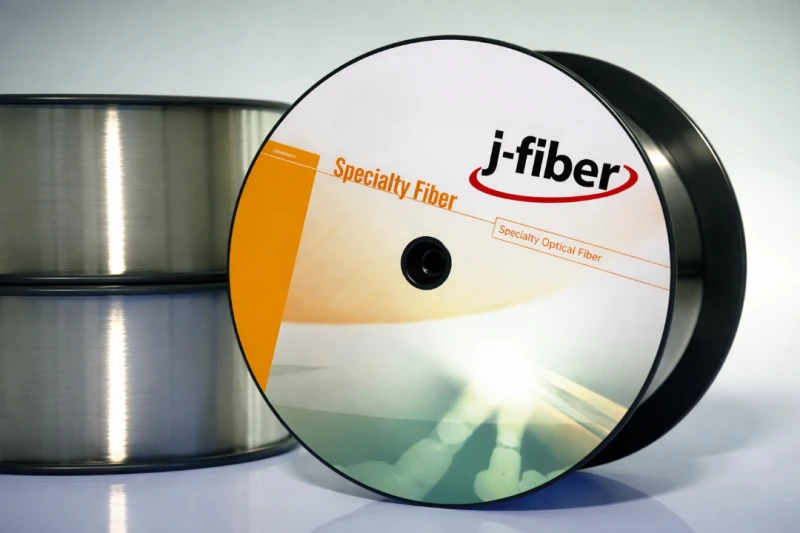
Description
Introducing the BIMMF 50/125, a cutting-edge multimode fiber designed specifically for sensing applications. This fiber stands out due to its low spectral attenuation across a broad wavelength range from 850nm to 1600nm, ensuring optimal performance in various environments. With its high bandwidth capabilities, it is engineered to support high data rates, making it an ideal choice for demanding applications that require reliable and fast data transmission.
The BIMMF 50/125 fiber is crafted with low OH-content, which enhances its durability and performance over time. Its design allows for easy handling and excellent splicing performance, ensuring that installation and maintenance are straightforward and efficient. The fiber's characteristics and measurements adhere to the rigorous standards set by IEC 60793-2-10 and ITU G651.1, guaranteeing quality and consistency in every application.
This fiber is available in performance classes OM2+, OM3, and OM4, each offering varying levels of bandwidth and effective modal bandwidth to suit different needs. The optical characteristics of the BIMMF 50/125, including its attenuation coefficients and macrobending loss, are optimized to deliver superior performance in diverse conditions. Its geometrical characteristics, such as core diameter and cladding diameter, are precisely controlled to ensure compatibility with a wide range of systems and applications.
For those interested in ordering the BIMMF 50/125 for sensing applications, please contact us with your specific requirements, including fiber type, performance class, and quantity. Our team is ready to assist you in selecting the right configuration to meet your needs. For additional information about our multimode fiber and other j-fiber products and services, please reach out to us at j-fiber GmbH, located in Jena, Germany.
BIMMF 50/125 Multimode Fiber for Sensing Applications
Specifications
| Core Diameter: | 50 um |
|---|---|
| Wavelength Range: | 850 – 1600 nm |
| Cable Length: | 1100 m |
| Fiber Core Material: | Not Specified |
| Numerical Aperture: | 0.200 ± 0.015 |
| Bandwidth (Overfilled Launch) 850nm OM2+: | ≥ 750 MHz.km |
| Core Non-Circularity: | ≤ 2.5 % |
| Core Diameter: | 50 ± 2 µm |
| Effective Group Index Of Refraction 1300nm: | 1.478 |
| Effective Group Index Of Refraction 850nm: | 1.483 |
| Macrobending Loss 2 Turns, Radius 7.5mm 1300nm: | ≤ 0.5 dB |
| Macrobending Loss 2 Turns, Radius 15mm 1300nm: | ≤ 0.3 dB |
| Macrobending Loss 100 Turns, Radius 37.5mm 1300nm: | ≤ 0.5 dB |
| Macrobending Loss 2 Turns, Radius 7.5mm 850nm: | ≤ 0.2 dB |
| Macrobending Loss 2 Turns, Radius 15mm 850nm: | ≤ 0.1 dB |
| Macrobending Loss 100 Turns, Radius 37.5mm 850nm: | ≤ 0.5 dB |
| Bandwidth (Overfilled Launch) 1300nm OM2+: | ≥ 500 MHz.km |
| Att. Discontinuities (OTDR 1300nm): | ≤ 0.1 dB |
| Attenuation Coefficient 1550nm: | ≤ 0.3 dB/km |
| Attenuation Coefficient 1300nm: | ≤ 0.6 dB/km |
| Attenuation 850nm: | ≤ 2.4 dB/km |
| Effective Modal Bandwidth 850nm OM4: | ≥ 4700 |
| Effective Modal Bandwidth 850nm OM3: | ≥ 2000 |
| Effective Modal Bandwidth 850nm OM2+: | ≥ 1000 |
| Bandwidth (Overfilled Launch) 1300nm OM4: | ≥ 500 MHz.km |
| Bandwidth (Overfilled Launch) 850nm OM4: | ≥ 3500 MHz.km |
| Bandwidth (Overfilled Launch) 1300nm OM3: | ≥ 500 MHz.km |
| Bandwidth (Overfilled Launch) 850nm OM3: | ≥ 1500 MHz.km |
Got questions about specs? Use the inquiry form to ask.
 Download Data Sheet

Features
- Low Spectral Attenuation: Optimized for wavelength range from 850nm up to 1600nm, ensuring minimal signal loss.
- High Bandwidth: Designed for high data rates, supporting advanced communication needs.
- Low OH-Content: Reduces water peak losses, enhancing performance.
- Easy Handling and Splicing: Offers excellent splicing performance for efficient installation and maintenance.
- Compliance with Standards: Fiber characteristics and measurements adhere to IEC 60793-2-10 & ITU G651.1 standards.
Applications
- Telecommunications: Ideal for high-speed data transmission over long distances due to its low spectral attenuation and high bandwidth capabilities.
- Data Centers: Suitable for high data rate applications, ensuring efficient data handling and excellent splicing performance.
- Industrial Sensing: The fiber's low OH-content and robust performance make it suitable for various industrial sensing applications.
- Medical Imaging: The fiber's optical characteristics and low attenuation make it a good choice for medical imaging technologies.
- Research and Development: The fiber's compliance with IEC 60793-2-10 & ITU G651.1 standards makes it suitable for R&D purposes in optical technologies.
- Military and Aerospace: The fiber's durability and performance under various conditions make it suitable for military and aerospace applications.
Frequently Asked Questions
What is the wavelength range for low spectral attenuation?
What are the performance classes available for this fiber?
What is the effective modal bandwidth at 850nm for OM4?
What is the attenuation coefficient at 1300nm?
What is the core diameter specification?
What is the contact information for j-fiber GmbH?
Got more questions? Use the RFQ form to ask the supplier directly.
Similar Products
Need pricing for this product? Send a quick inquiry
Your inquiry has been received.
Create an account by adding a password
Why create an account?
- Auto-complete inquiry forms
- View and manage all your past messages
- Save products to your favorites
- Close your account anytime — no hassle