
Description
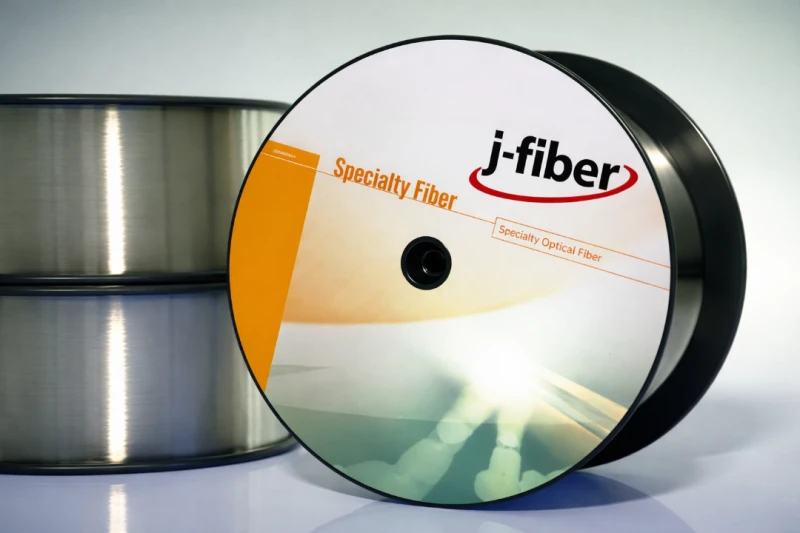
The MMF 50/125/245µm MIL-Spec Radiation Hard Multimode Fiber (PIN MIL-PRF-49291/1-01) is a premium product from j-fiber’s series of radiation hard multimode fibers. These fibers have been rigorously qualified and approved by the Defense Logistic Agency (DLA) in accordance with the U.S. Military MIL-PRF-49291 standard. Designed to endure the challenges of radiation-threatened and harsh environments, these fibers are ideal for military and aerospace applications where reliability and performance are critical.
j-fiber's MIL-Spec Radiation Hard Multimode fibers are available in graded index configurations, offering core sizes of 50µm and 62.5µm. These fibers are engineered to provide the lowest attenuation changes under radiation exposure, ensuring high bandwidth capabilities suitable for high data rates. The fibers are also designed for easy handling and splicing, making them a practical choice for demanding environments.
In compliance with MIL-PRF-49291/1-01 standards, the MMF 50/125/245 fiber is classified as a Type I, Class I, Size III multimode fiber composed of glass and glass silica. It operates efficiently at wavelengths of 850nm and 1300nm, providing consistent performance with specified attenuation and bandwidth parameters. The fiber's optical characteristics, such as attenuation and bandwidth, are optimized for superior performance, ensuring minimal signal loss and high data transmission rates.
The geometrical characteristics of the fiber, including core diameter, core non-circularity, and core/clad concentricity error, are meticulously controlled to meet stringent specifications. This precision ensures that the fiber maintains its integrity and performance in the most demanding conditions. With a coating diameter of 245µm, the fiber is robust and durable, further enhancing its suitability for challenging environments.
For ordering and further inquiries, j-fiber provides comprehensive support to ensure that customers receive the right product tailored to their specific needs. With a commitment to quality and performance, j-fiber’s MIL-Spec Radiation Hard Multimode Fiber is an exceptional choice for applications requiring resilience and reliability in radiation-prone environments.
MIL-Spec Radiation Hard Multimode Fiber 50/125/245µm
Specifications
| Core Diameter: | 50 um |
|---|---|
| Wavelength Range: | 850 – 1300 nm |
| Cable Length: | 1100 m |
| Fiber Core Material: | Silica |
| Core Diameter: | 50 ± 3 µm |
| Clad Diameter: | 125 ± 1 µm |
| Coating Diameter: | 245 ± 10 µm |
| Attenuation @ 850/1300nm: | 3.5/1.0 dB/km |
| OFL Bandwidth @ 850/1300nm: | 500/500 MHz·km |
| Numerical Aperture @ 850nm: | 0.200 ± 0.015 |
| Zero Dispersion Wavelength: | 1295 ≤ λ0 ≤ 1330 nm |
| Zero Dispersion Slope S0: | ≤ 0.11 ps/nm²·km |
Got questions about specs? Use the inquiry form to ask.
 Download Data Sheet

Features
- Radiation Hard Design: Specifically engineered to withstand radiation exposure, making it ideal for military and aerospace applications.
- Compliance with MIL-Spec Standards: Qualified and approved by the Defense Logistic Agency (DLA) in accordance with MIL-PRF-49291/1-01 standards.
- Low Attenuation Changes: Exhibits the lowest attenuation changes under radiation exposure, ensuring reliable performance.
- High Bandwidth Capability: Supports high data rates with an OFL bandwidth of 500 MHz·km at both 850nm and 1300nm wavelengths.
- Easy Handling and Splicing: Designed for ease of use in various applications, facilitating installation and maintenance.
- Geometrical Precision: Core diameter of 50 ± 3 µm with minimal non-circularity and concentricity errors, ensuring consistent performance.
- Optical Performance: Attenuation of 3.5/1.0 dB/km at 850/1300nm with excellent uniformity and transient attenuation characteristics.
- Durable Coating: Coating diameter of 245 ± 10 µm with a high overall coating concentricity ratio (OCCR) of ≥ 0.70.
- Zero Dispersion Wavelength: Maintains zero dispersion between 1295nm and 1330nm, optimizing signal integrity.
- Macrobending Resistance: Low macrobending attenuation at 1300nm, ensuring durability in challenging environments.
Applications
- Military Applications: Designed to meet the rigorous demands of military environments, these fibers are ideal for use in communication systems where radiation exposure is a concern.
- Aerospace Applications: Suitable for aerospace environments, providing reliable data transmission in high-radiation areas.
- Harsh Environment Communications: Withstand extreme conditions, making them perfect for use in harsh environments where standard fibers may fail.
- High Data Rate Transmission: High bandwidth capabilities make these fibers suitable for applications requiring fast data transmission.
- Radiation-Hardened Systems: Specifically engineered for systems that must remain operational in radiation-prone areas.
- Secure Communications: Ensures secure and reliable communication in critical applications where data integrity is paramount.
- Splicing and Handling: Easy handling and splicing characteristics make installation and maintenance straightforward.
Frequently Asked Questions
What is the MMF 50/125/245µm MIL-Spec Radiation Hard Multimode Fiber designed for?
What are the core sizes available for j-fiber's MIL-Spec Radiation Hard Multimode fibers?
What are the key features of the MIL-Spec Radiation Hard Multimode Fiber?
What is the attenuation at 850nm and 1300nm for the MMF 50/125/245µm fiber?
What is the numerical aperture of the fiber at 850nm?
How can I order the j-fiber MIL-Spec Radiation Hard Multimode Fiber?
Got more questions? Use the RFQ form to ask the supplier directly.
Similar Products
Need pricing for this product? Send a quick inquiry
Your inquiry has been received.
Create an account by adding a password
Why create an account?
- Auto-complete inquiry forms
- View and manage all your past messages
- Save products to your favorites
- Close your account anytime — no hassle