
Description
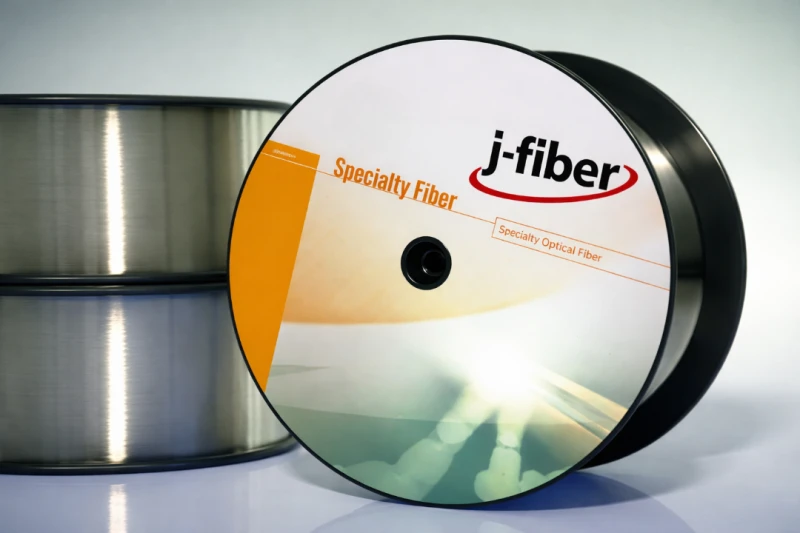
The PSHC – Low OH fiber is designed with a large core diameter, making it exceptionally easy to handle and ensuring high coupling efficiency with both LED and laser sources. This fiber is engineered with a unique low-index polymer cladding that provides remarkable temperature stability. This feature allows it to be used with crimp & cleave technology, facilitating quick and straightforward connectorization. Additionally, the j-fiber PSHC fiber can be optionally equipped with a protective fluorine-doped silica layer around the core glass, enabling its deployment across a broad wavelength range.
One of the standout characteristics of the PSHC fiber is its large core, which is optimized for efficient light launch and coupling. This design is available in two attenuation classes: ultra and standard, catering to different performance needs. The optional F-doped silica layer enhances the fiber's capability by providing a high laser damage threshold and reducing attenuation, particularly in the ultra type. Furthermore, the enlarged optical window design of the fiber allows it to be compatible with a wide array of light sources, making it a versatile choice for various applications.
The PSHC 200/230 series is a robust solution for those seeking reliable fiber performance in demanding environments. It is constructed with low OH synthetic silica for the core and a low-index acrylate for the cladding, ensuring durability and performance. The fiber maintains its integrity across a wide operating temperature range from -40 to +85°C, with a maximum short-term temperature tolerance of +125°C. This resilience, combined with a proof-test of 0.7 GPa, makes the PSHC fiber a dependable choice for high-stress applications.
PSHC 200/230 Low OH Fiber for Laser and LED Applications
Specifications
| Core Diameter: | 200 um |
|---|---|
| Wavelength Range: | 600 – 1600 nm |
| Fiber Core Material: | Synthetic Silica |
| Core Diameter: | 200 ± 4 µm |
| Cladding Diameter: | 230 ± 5 µm |
| Core/Clad Offset: | ≤ 5 µm |
| Attenuation At 650nm (ultra): | ≤ 10 dB/km |
| Attenuation At 650nm (standard): | ≤ 15 dB/km |
| Attenuation At 850nm: | ≤ 8 dB/km |
| Attenuation At 940nm (ultra): | ≤ 10 dB/km |
| Attenuation At 940nm (standard): | ≤ 15 dB/km |
| Attenuation At 1300nm (ultra): | ≤ 10 dB/km |
| Attenuation At 1300nm (standard): | ≤ 20 dB/km |
| Numerical Aperture: | 0.37 ± 0.02 |
| Operating Temperature Range: | -40 to +85 °C |
| Max. Temperature (short Term): | +125 °C |
| Proof-test: | 0.7 GPa |
| Bending Radius (Short-term): | 10 mm |
| Bending Radius (Long-term): | 30 mm |
Got questions about specs? Use the inquiry form to ask.
 Download Data Sheet

Features
- Large Core Diameter: Ensures easy handling and high coupling efficiency to LED and laser sources.
- Low-Index Polymer Cladding: Provides high temperature stability and is compatible with crimp & cleave technology for fast and easy connectorization.
- Optional Fluorine-Doped Silica Layer: Offers a high laser damage threshold and low attenuation, especially in the ultra type.
- Wide Wavelength Range: The enlarged optical window design allows the use of a wide range of light sources.
- Two Attenuation Classes: Available in ultra and standard to suit different application needs.
Applications
- Laser power transmission
- Medical application (laser and sensor technology)
- Factory automation
- Near-IR spectroscopy
- Optical pyrometry
Frequently Asked Questions
What is the core material of the PSHC fiber?
What are the available attenuation classes for the PSHC fiber?
What is the numerical aperture of the PSHC fiber?
What is the operating temperature range for the PSHC fiber?
What applications are suitable for the PSHC fiber?
What is the maximum short-term temperature the PSHC fiber can withstand?
Got more questions? Use the RFQ form to ask the supplier directly.
Similar Products
Need pricing for this product? Send a quick inquiry
Your inquiry has been received.
Create an account by adding a password
Why create an account?
- Auto-complete inquiry forms
- View and manage all your past messages
- Save products to your favorites
- Close your account anytime — no hassle