
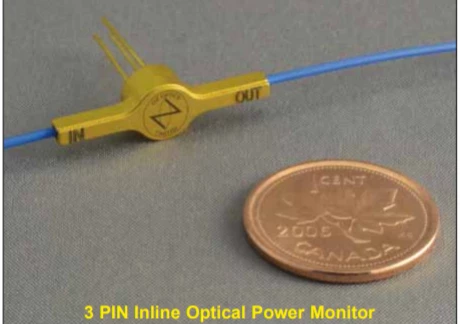
Description
The 3‑Pin Inline Optical Power Monitor is a compact, high‑performance solution for real‑time optical power measurement and control in fiber optic networks and photonic systems. Built on patented directional tap technology, this device enables precise monitoring of optical signals directly within the fiber path, without disturbing signal integrity or requiring bulky, discrete assemblies. Its miniaturized housing and 3‑pin electrical interface make it ideal for integration into OEM subsystems, optical modules, and test and measurement platforms where reliability, stability, and long‑term performance are critical.
Unlike conventional fused coupler based monitors that divert light into a separate fiber leg, this inline power monitor extracts a carefully controlled fraction of the guided signal at the fiber core–cladding interface and directs it onto an integrated photodiode. Because the fiber geometry is not bent or distorted, the main transmission path remains essentially undisturbed, resulting in low insertion loss, low back‑reflection, and minimal polarization dependence. This approach provides high directivity and a large dynamic range, enabling stable and repeatable power measurements across a broad range of operating conditions and signal levels.
The device is available in configurations optimized for wavelengths from approximately 400 nm to 2100 nm, covering key windows for telecom, datacom, industrial, biomedical, and sensing applications. It can be matched to standard single‑mode telecom fibers, polarization‑maintaining fibers, multimode fibers, photonic crystal fibers, and other specialty fiber types. In polarization‑maintaining versions, high extinction ratios are supported, making the monitor well suited for coherent optical systems, precision interferometry, and polarization‑sensitive instrumentation. Broadband response options allow a single monitor to serve multi‑wavelength and swept‑source systems, reducing complexity in advanced test setups.
The mechanical design supports flexible fiber pigtails with typical outer diameters of 250 µm, 400 µm, or 900 µm in rugged, flexible Hytrel tubing, enabling straightforward routing within densely populated racks or benchtop instruments. The compact 3‑pin package provides clear anode, cathode, and case connections, simplifying electrical design and grounding strategies. High power handling capability, combined with low polarization dependent loss and low return loss, ensures accurate monitoring even in systems with high optical power levels, tunable lasers, or dynamic gain elements.
This inline power monitor is an excellent fit for power stabilization loops, channel balancing in wavelength division multiplexing (WDM) networks, and dynamic gain control in optical amplifiers. It supports continuous monitoring in FTTH networks, data center interconnects, and metro or long‑haul links, where network operators need non‑intrusive, inline diagnostics. The device is equally useful in laboratory environments for real‑time test and measurement, optical coherence tomography (OCT) systems, and diverse fiber optic sensor architectures, where accurate feedback on signal amplitude is essential for calibration, closed‑loop control, or safety interlocks.
In comparison to traditional coupler‑plus‑photodiode assemblies commonly found in telecom monitoring modules and bench instruments, this 3‑pin directional tap/photodiode module offers a more integrated, space‑efficient, and cost‑effective solution. It can be incorporated directly into other optical components or modules through automated manufacturing processes, allowing OEM designers to reduce the overall component count and assembly time while improving long‑term stability. Multiple‑channel versions are available for systems that require simultaneous monitoring of several fibers, such as multiport amplifiers, WDM nodes, or parallel sensing arrays.
For applications that require remote supervision, the underlying technology is compatible with modules featuring local and remote control, including USB or RS‑232 connectivity, enabling easy integration into existing monitoring frameworks and network management systems. Robust, Telcordia‑qualified construction supports deployment in demanding field environments as well as in high‑reliability industrial and medical systems. Overall, the 3‑Pin Inline Optical Power Monitor delivers a compact, high‑accuracy, and scalable platform for directional fiber optic power monitoring across a wide range of wavelengths, fiber types, and photonic applications.
Directional Fiber Optic Power Monitors
Specifications
| Wavelength Range: | 320 – 2100 nm |
|---|---|
| Tap Ratio (average): | 0.5 % |
| Tap Efficiency (typical): | 0.65 |
| Insertion Loss (max): | 0.3 dB |
| Return Loss (min): | 70 dB |
| Power Handling: | 2000 mW |
| Product Type: | 3-pin inline optical power monitor (directional fiber optic power monitor / tap with photodiode) |
| Fiber Type Options: | Standard telecommunication fibers, polarization maintaining fibers, multimode fibers, photonic crystal fibers, specialty fibers |
| Tubing Type: | Flexible Hytrel tubing |
| Fiber Coating Diameter 1: | 250 µm |
| Fiber Coating Diameter 2: | 400 µm |
| Fiber Coating Diameter 3: | 900 µm |
| Package Feature: | Miniaturized inline package; maintains fiber continuity without interrupting optical path |
| Communication Interfaces: | USB, RS232 |
| Photodiode Option: | Available with or without integrated photodiode |
| Number Of Channels: | Available in versions for multiple channels |
| Qualification: | Telcordia GR-468 qualified |
| Control Modes: | Remotely and locally controllable |
| Tap Angle: | 45.0° (direction of light extraction from fiber) |
Got questions about specs? Use the inquiry form to ask.
 Download Data Sheet

Features
- Telcordia GR-468 Qualified Reliability – Fully compliant with Telcordia GR‑468 core reliability standard for long‑term stable performance in demanding telecom and industrial environments.
- Ultra‑Broad Wavelength Coverage (400–2100 nm) – Available for visible, near‑IR, and telecom bands, including 400–700 nm, 850 nm, 980 nm, 1064 nm, 1310 nm, 1550 nm and up to 2100 nm, enabling use in WDM, fiber lasers, EDFAs, and OCT systems.
- Low Insertion Loss & Low Back Reflection – Optimized tap structure delivers low insertion loss, low return loss, and low polarization dependent loss (PDL), minimizing impact on the main optical signal path.
- High Directivity & Large Dynamic Range – Directional tap design ensures excellent directivity and a large measurement dynamic range, suitable for precise monitoring of weak to high‑power optical signals.
- Broadband, Flat Spectral Response – Engineered for broadband operation with consistent tap ratio over a wide wavelength range for accurate multi‑wavelength and WDM channel monitoring.
- High Optical Power Handling – Robust construction supports high optical power levels, making it suitable for amplifier output monitoring, high‑power fiber lasers, and test systems.
- Polarization Maintaining (PM) Options with High Extinction Ratio – Available in PM fiber versions with high extinction ratios, ideal for polarization‑sensitive applications such as coherent systems and precision sensing.
- Patented Inline TAP Technology – Utilizes OZ Optics’ patented core‑to‑cladding tapping technology to extract a controlled fraction of light directly from the fiber core without bending or distorting the fiber.
- True Inline Integration – No Fiber Path Interruption – Maintains full fiber continuity; the tap is integrated directly into the fiber line, avoiding discrete coupler assemblies and preserving original system functionality.
- Miniaturized 3‑Pin Package – Compact 3‑pin inline optical power monitor design supports easy integration into densely packed modules, rack systems, and OEM equipment.
- Available With or Without Integrated Photodiode – Select versions with an integrated photodiode for a complete power monitoring solution, or tap‑only versions for use with external detectors.
- Remote & Local Control Capability – Designed for systems that require both local control and remote monitoring, enabling seamless integration into automated control loops and network management systems.
- USB and RS‑232 Communication Interfaces – Compatible with standard USB and RS‑232 control interfaces (when used in monitor modules), simplifying connection to PCs, controllers, and test equipment.
- Supports a Wide Range of Fiber Types – Available for standard single‑mode telecom fibers, polarization maintaining fibers, multimode fibers, photonic crystal fibers, and other specialty fibers.
- Multi‑Channel Configurations – Offered in single‑channel and multi‑channel versions, enabling simultaneous monitoring of multiple fibers or WDM channels in compact platforms.
- Automated Assembly Integration – Can be integrated within other optical components and modules using automated processes, ideal for high‑volume OEM and manufacturing environments.
- High Measurement Accuracy & Stability – Stable tap ratio and low temperature dependence deliver accurate, repeatable power readings over time and varying environmental conditions.
- Low‑Cost, High‑Performance Solution – Combines advanced patented technology with cost‑effective manufacturing to provide a low‑cost alternative to bulky fused‑coupler based power monitors.
- Ideal for Real‑Time Inline Monitoring – Perfect for real‑time power monitoring, feedback control, FTTH network supervision, amplifier gain control, and live test and measurement without disconnecting the fiber.
- Suitable for Diverse Applications – Optimized for power monitoring, dynamic optical power control, channel balancing in WDM systems, amplifier gain monitoring, FTTH network monitoring, OCT systems, and fiber optic sensing.
- Proven, Patented Design – Protected by international patents (Canada 2,494,133; USA 7,095,931 and 7,295,731; China 1672073; Europe 03766088.3 / EP1527363), reflecting a field‑proven, mature technology platform.
Applications
- Real-Time Optical Power Monitoring in WDM and DWDM Networks
Ideal for in-line, non-intrusive power monitoring in dense and coarse Wavelength Division Multiplexing systems, enabling continuous supervision of individual channels and aggregate traffic without disrupting live data transmission. - Dynamic Optical Amplifier Gain Control (EDFA, Raman, SOA)
Used inside erbium-doped fiber amplifiers and other optical amplifiers for closed-loop gain stabilization, automatic level control, and transient suppression by providing accurate, directional power readings at amplifier input and output ports. - Channel Balancing and Equalization in High-Capacity Optical Links
Supports precise channel power balancing across multiple wavelengths to minimize crosstalk, optimize OSNR, and extend reach in long-haul, metro, and data center interconnect networks. - FTTH / FTTx Network Monitoring and Service Assurance
Deployed in Fiber-To-The-Home (FTTH), Fiber-To-The-Building (FTTB), and Passive Optical Networks (PON) for continuous monitoring of downstream and upstream signals, fault localization, and proactive maintenance without service interruption. - Inline Test and Measurement in Production and Laboratory Setups
Integrated into test benches and automated production lines for real-time tracking of insertion loss, return loss, and power stability in fiber optic components, modules, and subsystems. - Optical Power Control Devices and Variable Optical Attenuators
Embedded in feedback loops for variable optical attenuators and dynamic equalizers, allowing precise closed-loop power control over wide wavelength ranges from 400 nm to 2100 nm. - Optical Performance Monitoring in Telecommunication Systems
Supports network operators in monitoring key performance indicators such as power levels, drift, and degradation, improving reliability and uptime for core, metro, and access networks. - Polarization Maintaining (PM) Systems and Coherent Links
Suitable for high-extinction-ratio, polarization maintaining configurations used in coherent communication systems, advanced modulation formats, and polarization-sensitive applications. - Fiber Optic Sensor Interrogation and Structural Health Monitoring
Integrated in distributed and point fiber optic sensor systems (FBG, interferometric, intensity-based) to track signal strength, sensor response, and system stability in civil, aerospace, oil and gas, energy, and industrial monitoring. - Optical Coherence Tomography (OCT) and Biomedical Imaging
Used in medical OCT systems and imaging instruments to monitor reference and sample arm power, maintain optimal imaging conditions, and protect sensitive detectors and samples from overexposure. - Laser Power Monitoring and Stabilization
Provides in-line feedback for continuous-wave and pulsed lasers in R&D, manufacturing, and medical setups, enabling automatic power stabilization and long-term drift compensation without interrupting the beam path. - High-Power Fiber Laser and Amplifier Safety Interlocks
Used in high-power fiber laser systems to monitor output and back-reflected power, implement safety interlocks, and prevent damage to gain media, connectors, and downstream optics. - Optical Module and Subassembly Integration
Miniaturized form factor and inline fiber continuity allow seamless integration into optical transceivers, ROADM blocks, multiplexers/demultiplexers, and custom photonic modules for embedded diagnostics. - Photonics Crystal Fiber and Specialty Fiber Monitoring
Compatible with photonic crystal fibers, specialty single-mode, multimode, and polarization maintaining fibers, enabling power monitoring in niche photonics research and advanced industrial systems. - Multi-Channel Optical Monitoring Platforms
Available in multi-channel versions for parallel monitoring of several fibers or wavelength paths in complex optical subsystems, test racks, and network monitoring platforms. - Remote Network and System Supervision via USB / RS232
USB and RS232 interfaces allow local or remote configuration and data acquisition, making the device suitable for centralized network management, remote diagnostics, and unattended installations. - Feedback Control in Reconfigurable Optical Add-Drop Multiplexers (ROADMs)
Provides precise tap signals used in dynamic equalization and power leveling across reconfigurable paths in ROADMs and wavelength-selective switch modules.
Frequently Asked Questions
What is the OZ Optics 3‑pin inline optical power monitor (directional fiber optic tap/photodiode)?
How does the directional fiber optic power monitor work compared to traditional fused coupler taps?
What wavelength ranges, fiber types, and configurations are available for this optical power monitor?
What are typical applications for OZ Optics directional fiber optic power monitors and taps?
What are the key performance advantages of this TAP‑based power monitor (insertion loss, directivity, dynamic range, and power handling)?
How is the power monitor controlled and integrated into a system (USB, RS‑232, and inline installation)?
Is this optical TAP technology available for licensing or OEM integration, and can it be customized?
Got more questions? Use the inquiry form to ask the supplier directly.
Your inquiry has been received.
Create an account by adding a password
Why create an account?
- Auto-complete inquiry forms
- View and manage all your past messages
- Save products to your favorites
- Close your account anytime — no hassle