
Description
U-V(ZN)11Y 12x Eurolens (HMA) Expanded Beam Cable Assembly – IP67 Ruggedized Fiber Link
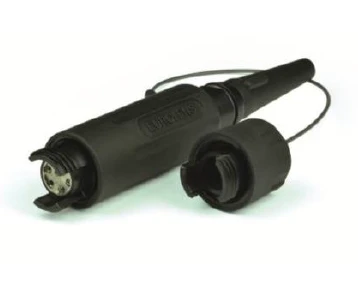
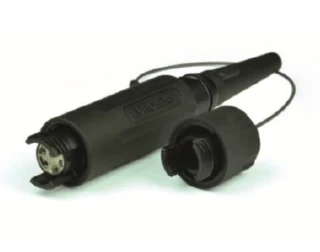
The U-V(ZN)11Y 12x cable assembly with Eurolens (HMA) expanded beam connectors is a high‑performance, pre-terminated fiber optic solution engineered for demanding military and industrial environments. Built around a robust, gel‑free military distribution cable and paired with MIL-DTL-83526/20 and /21 compatible Eurolens plugs on both ends, this assembly delivers reliable optical connectivity where shock, vibration, dust, and moisture routinely compromise conventional ferrule-based connectors. With a compact 30 mm diameter connector body and polyurethane-jacketed cable, it is designed to combine mechanical toughness with deployment flexibility in the field.
Unlike traditional physical-contact connectors, the Eurolens expanded beam interface enlarges and collimates the optical signal before coupling, making the system significantly more tolerant to dirt, misalignment, and mechanical stress. This design is particularly advantageous in mobile tactical networks, temporary field links, outdoor broadcasting, mining, offshore platforms, and heavy industrial automation, where frequent mating and de‑mating are required and contamination cannot be fully controlled. The mated interface achieves IP67 protection, safeguarding the optical path against water and dust ingress, and supporting consistent performance under harsh environmental conditions.
The assembly is available with 12 multimode (50/125 μm or 62.5/125 μm) or singlemode (9/125 μm) fibers, color‑coded in accordance with TIA/EIA‑598 for straightforward identification and management. The tight-buffered 0.9 mm fibers are housed within a fully dielectric, aramid-reinforced construction that resists tensile and crush loads commonly encountered during field deployment, storage, and retrieval. With a typical insertion loss of ≤ 0.50 dB for multimode and ≤ 1.50 dB for singlemode per mated pair, the U‑V(ZN)11Y delivers optical performance comparable to other premium expanded beam systems used in defense communications, outside broadcast, and emergency response networks.
Mechanically, the cable is based on a military distribution design inspired by the requirements of MIL‑C‑85045, featuring a black polyurethane outer jacket for abrasion resistance, flexibility, and long-term weatherability. The construction is gel‑free, simplifying handling, termination, and maintenance compared to traditional loose tube designs with filling compounds. An aramid yarn strength member provides high tensile capability, allowing the assembly to withstand installation loads up to 1,250 N and operational loads up to 700 N, while the connector-level strain relief is rated at ≥ 1,500 N to protect terminations when cables are pulled or snagged. The cable diameter of approximately 7.0 mm enables an attractive balance between ruggedness and ease of winding on drums or reels.
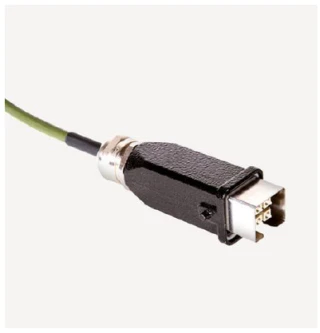
The Eurolens HMA connector hardware itself is optimized for extended service life and field handling. Its cylindrical body (Ø 30 mm × 158 mm including bend protection) is compact enough for use in dense patching environments and mobile systems, yet robust enough for repeated deployment. With a typical mating cycle rating of around 3,000 operations, it stands in line with other high-end expanded beam connector families deployed in tactical networks and outdoor event production, where repeated connects and disconnects are standard. This durability helps lower total cost of ownership by reducing the need for frequent connector replacement or re-termination.
Environmental performance is tailored to all‑weather, all‑season operation. The assembly is specified for a temperature range of −40 °C to +70 °C, covering most ground-based military and industrial installation scenarios, including cold climate deployments and high‑temperature operational environments around machinery or equipment shelters. A minimum static bend radius of 20 times the outer diameter (approximately 140 mm) supports flexible routing without compromising fiber integrity, similar to many modern tactical fiber solutions used in mobile command posts and temporary network infrastructures.
For network architects and system integrators, the 12‑fiber configuration simplifies the implementation of high‑bandwidth links such as trunk connections for multiplexed video streams, sensor data, and control channels. In multimode deployments, it is well suited to short- and medium‑distance links common in campus-style or event-based networks, while the singlemode option supports longer reach applications with tighter loss budgets. Both variants align with contemporary field-deployable expanded beam offerings, providing a familiar interface that can be integrated into existing MIL‑DTL‑83526/20 and /21 based infrastructures without requiring specialized tools or unconventional handling procedures.
Amphenol Sachsenkabel 12 Fiber Eurolens HMA Military Distribution Cable IP67
Specifications
| Product Type: | Cable assembly |
|---|---|
| Connector Type: | Expanded beam – HMA/Eurolens |
| Connector Gender: | Plug |
| Fiber Count: | 12 channels |
| Fiber Mode: | Single-mode, Multimode |
| Insertion Loss (max Per Mated Pair): | 1.5 dB |
| Ingress Protection: | IP67 |
| Operating Temperature (min / Max): | -40 – 70 °C |
| Mating Cycles: | 3000 cycles |
| Standards Compliance: | MIL-C-85045 |
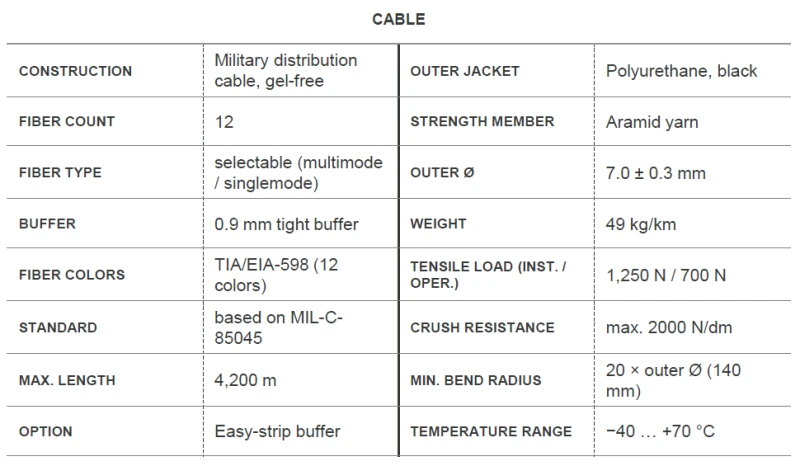
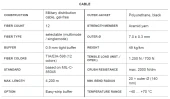
| Outer Jacket: | Polyurethane, black |
| Option: | Easy-strip buffer |
| Min. Bend Radius: | 20 × outer Ø (140 mm) |
| Max. Length: | 4,200 m |
| Crush Resistance: | max. 2000 N/dm |
| Tensile Load (Installation / Operation): | 1,250 N / 700 N |
| Fiber Colors: | TIA/EIA-598 (12 colors) |
| Weight: | 49 kg/km |
| Buffer: | 0.9 mm tight buffer |
| Outer Diameter: | 7.0 ± 0.3 mm |
| Strength Member: | Aramid yarn |
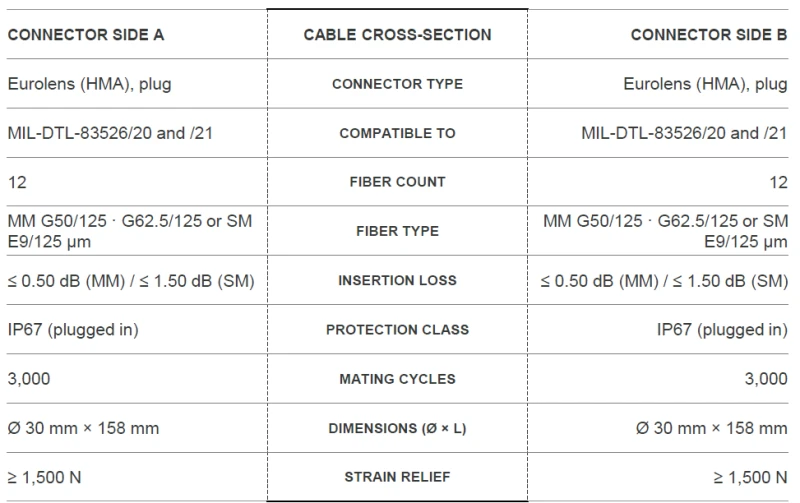
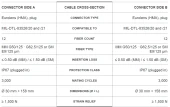
| Connector Type Side A: | Eurolens (HMA), plug |
| Cable Construction: | Military distribution cable, gel-free |
| Strain Relief: | ≥ 1,500 N |
| Connector Dimensions (Ø × L): | Ø 30 mm × 158 mm |
| Mating Cycles: | 3,000 |
| Insertion Loss (SM): | ≤ 1.50 dB per mated pair |
| Insertion Loss (MM): | ≤ 0.50 dB per mated pair |
| Fiber Type: | MM G50/125 · G62.5/125 or SM E9/125 µm |
| Compatibility: | MIL-DTL-83526/20 and /21 |
| Connector Type Side B: | Eurolens (HMA), plug |
Got questions about specs? Use the inquiry form to ask.
 Download Data Sheet

Features
- Rugged Eurolens (HMA) Expanded Beam Technology – Uses Eurolens (HMA) expanded beam connectors on both ends, compatible with MIL‑DTL‑83526/20 and /21 interfaces for reliable optical performance in demanding military and industrial environments.
- 12‑Fiber Pre‑Assembled Distribution Cable – Factory‑terminated 12‑fiber solution reduces installation time and field termination errors; ideal for rapid deployment communication links and mobile tactical networks.
- Multimode and Singlemode Options – Supports MM 50/125 µm, MM 62.5/125 µm, and SM 9/125 µm fibers, allowing you to choose the optimal configuration for short‑range, high‑bandwidth, or long‑distance applications.
- Low Insertion Loss – Typical performance of ≤ 0.50 dB (MM) and ≤ 1.50 dB (SM) per mated pair provides stable optical links and sufficient power budget even in complex network topologies.
- High‑Durability Mechanical Design – Rated for up to 3,000 mating cycles, making this assembly suitable for frequent connect/disconnect scenarios such as mobile broadcast systems, field test equipment, or deployable military networks.
- IP67 Protection When Mated – Fully sealed, dust‑tight and water‑resistant interface (IP67 plugged in), engineered for outdoor use in rain, mud, dust, or wash‑down conditions.
- Military‑Grade Cable Construction – Gel‑free, compact military distribution cable with polyurethane (PU) black outer jacket provides excellent abrasion, cut, and chemical resistance in harsh environments.
- Robust Strain Relief and Pull Strength – Integrated strain relief rated at ≥ 1,500 N on the connector side and cable tensile rating of 1,250 N (installation) / 700 N (operation) help protect the fibers during deployment and retrieval.
- Compact Connector Form Factor – Each connector measures approximately Ø 30 mm × 158 mm (including bend protection), offering a good balance between ruggedness and portability for field cases, drums, and panels.
- Flexible, Fully Dielectric Design – Aramid yarn strength members and a metal‑free, fully dielectric structure minimize weight and electromagnetic interference, making the assembly suitable near sensitive electronics or RF equipment.
- Small Cable Diameter and Light Weight – Outer cable diameter of 7.0 ± 0.3 mm and weight of approx. 49 kg/km enable easy handling, drum storage, and fast manual deployment even over longer distances.
- Optimized for Repeated Bending – Minimum bend radius of 20 × outer Ø (≈ 140 mm) ensures reliable performance during coiling, deployment, and retrieval in mobile and temporary installations.
- High Crush Resistance – Withstands up to 2000 N/dm crush force, supporting use in high‑traffic or vehicle‑exposed areas such as camps, staging grounds, or event venues.
- Wide Operating Temperature Range – Designed for operation from −40 °C to +70 °C, suitable for extreme outdoor climates, defense applications, and unconditioned storage.
- Standardized Fiber Color Coding – 12‑fiber color scheme according to TIA/EIA‑598 simplifies identification, testing, and documentation in the field and in the lab.
- Easy‑Strip Buffer Option – Optional easy‑strip 0.9 mm tight buffer reduces preparation time for splicing and re‑termination when modifications or repairs are needed.
- Compliant with Military Fiber Standards – Cable design based on MIL‑C‑85045 and connectors compatible with MIL‑DTL‑83526 ensure interoperability with many standard military and harsh‑environment systems.
- Field‑Proven IP67 Expanded Beam Alternative – In contrast to standard physical‑contact connectors, the expanded beam interface is less sensitive to contamination, making it ideal for dusty, muddy, or sandy locations where cleaning opportunities are limited.
- Customizable Lengths and Connector Configurations – Supplied with cable length on request and available in alternative housing colors by special order, allowing adaptation to specific deployment, marking, and concealment requirements.
Applications
- Mobile tactical communications – Deploy in military field networks, command posts, and rapidly relocatable communication nodes requiring ruggedized, high‑density fiber links.
- Battlefield communications and C4ISR – Connect radios, encryption devices, and C4ISR systems with secure, low‑loss optical links that withstand shock, dust, moisture, and mud under IP67 conditions.
- Harsh‑environment data links – Provide robust point‑to‑point fiber connections between shelters, vehicles, and outdoor equipment in extreme temperatures from −40 to +70 °C.
- Deployable military fiber reels – Use as pre‑terminated cable on tactical drum systems for rapid field deployment and retrieval in training areas and operational theaters.
- Defense vehicle and naval platforms – Integrate as external or inter‑bay jumpers on ground vehicles, ships, and submarines where vibration, saline atmosphere, and mechanical stress are present.
- Radar, EW, and sensor backbones – Link distributed radar heads, electronic warfare modules, and sensor arrays using stable multimode or singlemode optical paths with low insertion loss.
- Outdoor broadcast and OB vans – Support mobile broadcast units and OB trucks with reliable fiber connectivity for camera, audio, and data signals in stadiums, events, and temporary sets.
- Temporary event networks – Build high‑bandwidth network backbones for concerts, festivals, trade shows, and sports events where fast setup and tear‑down are essential.
- Industrial automation and process plants – Connect field control cabinets, PLCs, and monitoring stations in refineries, chemical plants, and heavy industry with EMI‑immune fiber links.
- Mining and tunneling operations – Enable robust communications and video/monitoring links in underground mines, tunnels, and drilling sites with high crush resistance and strain relief.
- Oil, gas, and offshore applications – Use on rigs, platforms, and pipeline monitoring systems where salt spray, humidity, and mechanical stress demand IP67 fiber connectors.
- Railway and wayside communications – Deploy along tracks, in depots, and in signaling and control systems requiring vibration‑resistant, gel‑free fiber assemblies.
- Emergency response and disaster recovery – Rapidly establish temporary high‑speed communication links for fire brigades, civil protection, police, and rescue teams in crisis zones.
- Mobile command centers – Interconnect shelters, trailers, and command vehicles with pre‑assembled fiber cables that are easy to roll out and recover.
- Outdoor test and measurement setups – Provide low‑loss optical links between test equipment and field devices during qualification, commissioning, and diagnostic campaigns.
- Secure government and border control networks – Implement tamper‑resistant, high‑reliability connections for surveillance systems, border checkpoints, and critical infrastructure.
- Temporary campus and remote site networking – Bridge buildings, containers, and remote stations with plug‑and‑play fiber where fixed infrastructure is unavailable or impractical.
- Broadcast, theatre, and touring productions – Use for touring stage productions and rental systems that require repeated mating cycles (up to 3,000) with consistent optical performance.
- Outdoor video surveillance and security – Connect high‑resolution IP cameras, monitoring stations, and control rooms across large outdoor sites, terminals, and industrial complexes.
- Airport, seaport, and transportation hubs – Create resilient backbone links for operations, security, and passenger information systems in exposed outdoor areas.
- Military training ranges – Network scoring systems, target mechanisms, and observation posts over long distances with ruggedized fiber that resists crushing and tensile loads.
- Temporary lab and test field networks – Establish flexible, reconfigurable high‑bandwidth links in test fields for vehicles, UAVs, radar systems, or wireless infrastructure trials.
- High‑EMI environments – Replace copper cables in areas with strong electromagnetic interference, such as near high‑power RF transmitters, generators, and heavy machinery.
- Long‑distance outdoor fiber runs – Utilize maximum cable lengths up to 4,200 m to connect distributed nodes in campuses, depots, and large industrial or military sites.
Frequently Asked Questions
What is the U‑V(ZN)11Y 12x Eurolens (IP67) fiber optic cable assembly and what are its key specifications?
What are typical applications for this 12‑fiber Eurolens (HMA) IP67 military distribution cable?
How rugged is the U‑V(ZN)11Y 12x Eurolens cable in terms of tensile strength, crush resistance and bending?
Is the Eurolens (HMA) connector assembly waterproof, and what does the IP67 rating mean in practice?
Which fiber types and standards are supported by this 12‑fiber Eurolens (HMA) cable?
What cable lengths and options (such as easy‑strip buffer or housing colors) are available?
How should this IP67 Eurolens (HMA) tactical fiber cable be handled, deployed and stored?
Got more questions? Use the inquiry form to ask the supplier directly.
Similar Products
Your inquiry has been received.
Create an account by adding a password
Why create an account?
- Auto-complete inquiry forms
- View and manage all your past messages
- Save products to your favorites
- Close your account anytime — no hassle