


Description
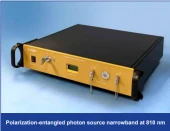
The EPS-1000-3U3U-810-5/125 polarization-entangled photon source from OZ Optics is a compact, turnkey system designed for high-performance quantum optics experiments at 810 nm. Implementing two periodically poled type-2 nonlinear crystals inside a Mach–Zehnder interferometer, this source delivers high-fidelity polarization-entangled photon pairs with excellent stability under continuous-wave operation. The design is inspired by widely adopted architectures in academic and industrial quantum laboratories, while integrating these concepts into a robust, field-ready platform suitable for both research and advanced development environments.
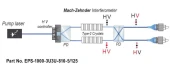
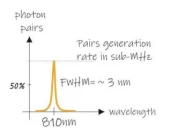
At its core, the source exploits spontaneous parametric down-conversion (SPDC) to generate degenerate signal and idler photons centered at 810 nm with a narrow full-width at half-maximum (FWHM) bandwidth of approximately 3 nm. Multiple polarization displacers (PDs) are used to realize a Mach–Zehnder interferometric configuration that coherently combines photon pairs emitted from each crystal. This arrangement supports the generation of highly pure polarization-entangled Bell states, with fidelity and two-photon interference visibility both exceeding 98% under typical operating conditions. Such performance is comparable to state-of-the-art laboratory sources tailored for quantum information processing and precision quantum metrology.
The EPS-1000-3U3U-810-5/125 is fully equipped with an integrated, wavelength-stabilized pump laser, a variable optical attenuator, and an advanced temperature controller. This combination allows precise tuning of phase-matching conditions within the periodically poled crystals, enabling users to optimize pair-generation efficiency and spectral characteristics without external hardware. The pump power can be finely adjusted from near-zero up to 12 mW, offering direct control over the photon pair-generation rate, which typically exceeds 1 × 10⁵ pairs per second, depending on pump settings and detection efficiencies. By controlling the accidental coincidence rate through pump attenuation and spectral filtering, users can balance brightness against noise for different experimental use cases, such as quantum key distribution or multi-photon interference studies.
A rotatable half-wave plate (HWP) is integrated into the interferometric path to control the relative contribution of photon pairs generated in each crystal. By adjusting this HWP, the polarization reference basis can be conveniently set and the distribution of entanglement between polarization and energy-time degrees of freedom can be tailored. This flexibility is particularly valuable for quantum information science experiments that require rapid switching between measurement bases, or for exploring hybrid entanglement schemes where polarization and temporal/spectral modes are jointly engineered. The high-quality state preparation capabilities make the source ideal for fundamental tests of quantum mechanics, Bell inequality violations, and demonstrations of entanglement swapping or teleportation protocols.
For practical integration into optical benches and quantum testbeds, the source is housed in a compact, rack-friendly enclosure with approximate dimensions of 39 cm (W) × 34.4 cm (D) × 8.6 cm (H) and a weight of about 4 kg. The system operates at room temperature, with a preferred operating range between 15 °C and 25 °C and relative humidity from 5% to 60%. These moderate environmental requirements simplify installation in standard laboratory conditions without the need for specialized cooling or environmental control infrastructure. A distinctive yellow/gold front panel provides intuitive access to the two output ports where the separated entangled photon pairs are delivered, making alignment and integration with downstream optics straightforward.
Thanks to its combination of narrowband spectral output, high entanglement fidelity, and turnkey operation, this 810 nm entangled photon source is well suited for a wide range of quantum technologies. Typical applications include quantum information science experiments, quantum key distribution testbeds, quantum metrology schemes exploiting entangled states for enhanced phase or timing resolution, and proof-of-principle demonstrations in quantum computing and quantum communication. The integrated pump, stabilization electronics, and user-adjustable controls provide a reliable platform for researchers and system developers who require repeatable, high-quality entanglement without the overhead of building and maintaining a custom SPDC source from discrete components.
OZ Optics EPS1000 Polarization Entangled Photon Source Narrowband 810 nm
Specifications
| Operating Wavelength: | 810 nm |
|---|---|
| Wavelength Stability: | -0.5 – 0.5 nm |
| Pump Laser Power: | 0 – 12 mW |
| Preferred Operating Temperature Range: | 15–25 °C |
| Operating Wavelength Band: | Narrowband around 810 nm |
| Entanglement Type: | Polarization-entangled, type-2 SPDC |
| Front Panel Color: | Yellow/Gold |
| Weight: | ~4 kg |
| Dimensions (W × D × H): | 39 × 34.4 × 8.6 cm |
| Storage Relative Humidity: | 0–90 %RH |
| Storage Temperature Range: | 0–40 °C |
| Operating Relative Humidity: | 5–60 %RH |
| Part Number: | EPS-1000-3U3U-810-5/125 |
| Operation Mode: | Continuous-wave (CW) |
| Pump Laser Output Power: | 0–12 mW, variable |
| Two-photon Interference Visibility: | >98% |
| Fidelity To |Ψ⟩=(|HV⟩+|VH⟩)/√2: | >98% |
| Pair-generation Rate: | >1×10^5 pairs/second |
| Photon Pairs Bandwidth (FWHM): | ~3 nm |
| Wavelength Accuracy: | ±1 nm |
| Central Wavelength (signal/idler Degeneracy): | 810 nm |
Got questions about specs? Use the inquiry form to ask.
 Download Data Sheet

Features
- Narrowband 810 nm polarization-entangled photon source – Generates high-quality polarization-entangled photon pairs centered precisely at 810 nm, ideal for quantum optics experiments and integration with silicon-based single-photon detectors.
- High fidelity entanglement (>98%) – Delivers quantum states with fidelity greater than 98% to the Bell state |Ψ⟩=(|HV⟩+|VH⟩)/√2, supporting demanding quantum information science and quantum communication protocols.
- Excellent two-photon interference visibility – Achieves >98% two-photon interference visibility, enabling high-contrast Hong-Ou-Mandel (HOM) and Bell-type experiments with minimal decoherence.
- Turn-key, room-temperature operation – Fully integrated, alignment-free system designed for continuous-wave (CW) operation at room temperature, minimizing setup time and simplifying use in both labs and teaching environments.
- Integrated wavelength-stabilized pump laser – Built-in pump laser with variable output power from 0 to 12 mW (via internal attenuator) ensures stable SPDC operation and precise control of photon pair generation rate.
- Engineered for narrow spectral bandwidth (~3 nm FWHM) – Photon pairs feature a ~3 nm full-width at half-maximum bandwidth, suitable for experiments requiring spectral purity and compatibility with narrowband filters and quantum memories.
- Robust Mach–Zehnder interferometer architecture – Utilizes a pair of periodically poled type-2 nonlinear crystals embedded in a Mach–Zehnder interferometer, providing stable phase control and reliable generation of polarization-entangled states.
- Multiple polarization displacers (PDs) – Integrated polarization displacers separate the orthogonally polarized signal and idler photons into two well-defined output ports, simplifying fiber or free-space collection and routing.
- Rotatable half-wave plate (HWP) for state control – Built-in adjustable HWP lets users tune the relative photon-pair generation in each crystal, providing flexible control of the polarization basis and enabling switching and tuning between polarization- and energy-entanglement regimes.
- Temperature-stabilized phase matching – Onboard precision temperature controller maintains optimal phase-matching conditions, ensuring long-term stability of wavelength, brightness, and entanglement quality.
- Controllable photon-pair and accidentals rate – Combination of variable pump power, internal optical attenuator, and noise-suppression filters allows the user to optimize coincidence counts versus accidental rates for specific experimental requirements.
- Built-in noise-suppression and filtering – Integrated optical filters and noise-suppression optics reduce pump leakage and background photons, enhancing signal-to-noise ratio in single-photon detection systems.
- High pair generation rate – Supports photon-pair generation rates on the order of >1 × 10⁵ pairs/second (pump-dependent), offering sufficient brightness for quantum key distribution, quantum imaging, and multi-photon interference experiments.
- Compact, benchtop form factor – Space-saving enclosure with dimensions of approximately 39 × 34.4 × 8.6 cm and weight around 4 kg, optimized for standard optical tables and 19" rack-compatible environments.
- Stable operation under typical lab conditions – Designed for reliable performance in standard laboratory environments with 15–25 °C operating temperature and 5–60% relative humidity, ensuring consistent output over extended runs.
- Ready for integration into quantum systems – Output ports and control interfaces are tailored for easy interfacing with single-photon detectors, coincidence electronics, polarization analyzers, and fiber-based quantum networks.
- Ideal for cutting-edge quantum applications – Optimized for quantum information science, quantum metrology, quantum key distribution (QKD), and quantum computing / information processing, providing a reliable entangled photon source for advanced R&D.
- Low-maintenance, alignment-free operation – Factory-aligned internal optics and robust mechanical design minimize the need for user alignment, improving uptime and repeatability compared with bulk-SPDC breadboard setups.
- Designed for research and educat
Applications
- Quantum Information Science Experiments
Ideal source for generating high-fidelity polarization-entangled photon pairs at 810 nm for fundamental quantum information studies, including Bell inequality tests, entanglement swapping, and state tomography in university and industrial research laboratories. - Quantum Key Distribution (QKD)
Supports entanglement-based QKD protocols (such as Ekert E91 and BBM92) over free-space or fiber links, enabling secure key generation with polarization encoding and narrowband photons compatible with standard Si-SPAD single-photon detectors. - Quantum Computing and Information Processing
Provides a stable entangled photon source for photonic quantum gates, cluster-state generation, linear optical quantum computing (LOQC) schemes, and small-scale quantum processors using polarization qubits. - Quantum Metrology and Sensing
Enables precision phase and interferometric measurements using entangled photon pairs, supporting quantum-enhanced metrology, sub-shot-noise measurements, and characterization of optical components with high-visibility two-photon interference. - Quantum Communication and Networking
Serves as a node source for quantum repeaters and quantum networks, providing polarization-entangled photons for entanglement distribution, teleportation experiments, and multi-node quantum internet testbeds. - Quantum State Tomography and Entanglement Characterization
Facilitates complete characterization of two-photon polarization states, enabling high-fidelity reconstruction of quantum states and benchmarking of entanglement using adjustable polarization bases and controllable pair-generation rates. - Fundamental Tests of Quantum Mechanics
Suitable for laboratory demonstrations and high-precision tests such as Bell tests, Leggett-type non-locality experiments, contextuality tests, and studies of quantum nonlocality using polarization-entangled photon pairs. - Education and Training in Quantum Optics
Turn-key, room-temperature operation makes it well suited for advanced teaching laboratories, graduate training, and hands-on courses in quantum optics, quantum engineering, and photonics, where robust and stable entanglement sources are required. - Integrated Photonics and Waveguide Testing
Can be used as an entangled photon input for testing and characterizing integrated photonic chips, waveguides, and polarization-maintaining components operating around 800–850 nm, including coupling to on-chip beam splitters and interferometers. - Free-Space Quantum Optics Experiments
Narrowband 810 nm output is compatible with standard free-space optical components, making it suitable for long-path interferometry, atmospheric propagation tests, and free-space quantum communication demonstrations. - Quantum Imaging and Ghost Imaging
Provides entangled pairs for quantum imaging schemes, ghost imaging, and correlation-based imaging experiments, taking advantage of high-quality spatial and polarization correlations at 810 nm. - Calibration and Benchmarking of Single-Photon Detectors
Useful as a reference source for characterizing and calibrating Si single-photon avalanche diodes (SPADs), superconducting nanowire detectors, and time-tagging electronics through coincidence counting and efficiency measurements. - Polarization Control and Compensation Studies
The integrated half-wave plate and Mach–Zehnder configuration support experiments on polarization control, polarization-mode dispersion compensation, and polarization-maintaining fiber testing using entangled photon pairs. - Time–Energy vs. Polarization Entanglement Research
The ability to switch and tune between polarization and energy-domain entanglement enables studies of hybrid entanglement, decoherence mechanisms, and cross-domain encoding strategies for advanced quantum protocols. - Prototype Development for Quantum Technologies
Suitable for OEMs and R&D teams developing next-generation quantum communication, sensing, and computation platforms that require a reliable, narrowband, polarization-entangled source around 810 nm for prototyping and system integration.
Frequently Asked Questions
What is the OZ Optics EPS-1000 polarization-entangled photon source and how does it work?
What are the key specifications of this 810 nm entangled photon pair source?
What applications is the OZ Optics 810 nm polarization-entangled photon source suitable for?
How is the photon pair generation rate controlled and what affects it?
How do I tune or switch the entanglement and polarization bases in this source?
What are the physical dimensions, form factor, and operating conditions of the EPS-1000 source?
What components are integrated in the OZ Optics narrowband entangled photon source and what external equipment is needed?
Got more questions? Use the inquiry form to ask the supplier directly.
Similar Products

Your inquiry has been received.
Create an account by adding a password
Why create an account?
- Auto-complete inquiry forms
- View and manage all your past messages
- Save products to your favorites
- Close your account anytime — no hassle