


Description
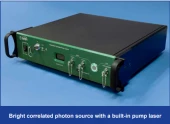
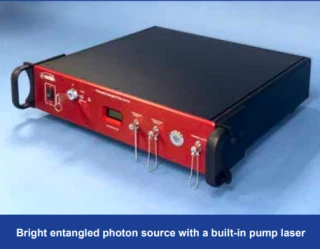
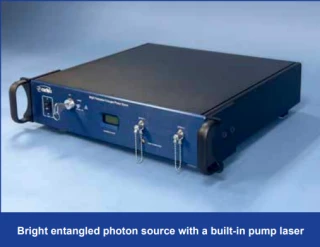
The bright correlated photon source is a fully integrated, fiber-coupled solution for generating high-quality time/energy entangled photon pairs via spontaneous parametric down conversion (SPDC). Designed for demanding quantum optics and quantum information experiments, this source combines a stabilized pump laser, thermally controlled nonlinear waveguide, and optimized optical filtering in a single, compact 3U enclosure. It delivers turn-key operation at room temperature, removing the traditional complexity of free-space alignment, external pump lasers, and bulk filtering optics commonly associated with custom SPDC setups.
At the core of the system is an SPDC medium that is actively temperature stabilized to maintain ideal phase matching conditions. This thermal control ensures high and repeatable photon-pair generation efficiency over extended operating times. After down-conversion, residual pump photons are strongly suppressed using built-in low-noise optical filters, yielding a clean output with a high signal-to-noise ratio. The internal architecture is realized entirely in fiber, providing excellent robustness against mechanical vibrations and environmental fluctuations while preserving optical alignment over the device’s lifetime.
The integrated pump laser offers up to 12 mW of variable output power, controlled through an internal variable optical attenuator. This enables users to conveniently tune the pair-generation rate to match the requirements of different experiments, from low-flux, single-photon regime measurements to higher-count applications where bright sources are essential. Under continuous-wave operation, the broadband configuration typically achieves pair-generation rates on the order of 10×106 pairs per second, while the narrowband configuration provides about 2×10⁶ pairs per second, both measured in the low-power regime. These performance levels place the source among the brighter commercial SPDC systems used in research laboratories and pilot quantum technology testbeds.
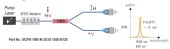
Two standard spectral configurations are available to address different use cases. The broadband model is optimized around a degeneracy wavelength of 1550 nm, covering an approximate full width at half maximum (FWHM) bandwidth of 80 nm across the C and L telecommunication bands. In this configuration, signal and idler photons are separated using a wavelength-division multiplexer (WDM), providing two output ports suitable for fiber-based quantum communication, quantum networking, and telecom-compatible quantum key distribution. This wide spectral coverage is particularly attractive for wavelength-multiplexed experiments and for interfacing with standard telecom components such as DWDM filters, low-loss single-mode fibers, and InGaAs-based single-photon detectors.
For applications that require tighter spectral control or compatibility with silicon and free-space detectors, a narrowband configuration is offered. In this version, photon pairs are generated at two main wavelengths near 1550 nm and 810 nm, each within a few nanometers of bandwidth. A polarizing beam splitter (PBS) is used to separate the photons into two output ports, resulting in a polarization-correlated (or polarization-entangled, depending on the setup) pair source that is well suited for quantum metrology, fundamental tests of quantum mechanics, and hybrid quantum systems that link near-infrared and telecom platforms. The dual-wavelength architecture allows one photon to be efficiently detected with high-performance silicon avalanche photodiodes at 810 nm, while its partner is compatible with long-distance low-loss transmission at 1550 nm.
The system achieves typical noise suppression levels around 75 dB for the pump light, which significantly reduces accidental counts and enhances heralding efficiency. This high level of pump rejection is critical for experiments requiring precise timing correlations, such as heralded single-photon generation, entanglement distribution, and quantum interference measurements. In comparison to many laboratory-built SPDC sources that rely on separate pump lasers and bulk optics, this integrated unit streamlines the experimental setup, shortens configuration time, and improves overall repeatability of results from one session to the next.
With a signal/idler degeneracy wavelength accuracy on the order of 0.5 nm, the source offers reliable spectral positioning, which is important when interfacing with narrowband filters, optical cavities, or pre-existing fiber infrastructure. This level of precision supports experiments that require long-term stability of the photon wavelength, such as quantum memory interfacing, high-visibility Hong–Ou–Mandel interference, and advanced quantum communication protocols. The ability to customize wavelength and bandwidth for volume orders further extends the source’s ap&
OZ Optics Bright Correlated Photon Pair Source with Built-in Pump Laser
Specifications
| Operating Wavelength: | 1550 nm |
|---|---|
| Wavelength Stability: | -0.25 – 0.25 nm |
| Pump Laser Power: | 0 – 12 mW |
| Fiber Type (signal/idler): | 9/125 μm |
| Photon Pair Separation (narrowband): | Polarizing beam splitter (PBS) |
| Photon Pair Separation (broadband): | WDM splitter |
| SPDC Type (narrowband): | Type-2 waveguide |
| SPDC Type (broadband): | Type-0 waveguide |
| Operating Temperature: | Room temperature |
| Design: | Rugged, alignment-free, all-in-fiber |
| Front Panel Color: | Green |
| Weight: | ~4 kg |
| Height: | 8.6 cm |
| Depth: | 34.4 cm |
| Width: | 39 cm |
| Product Type: | Bright correlated photon pair source with built-in pump laser |
| Pump Laser Output Power Range: | 0–12 mW (variable) |
| Pair-generation Rate (narrow Bandwidth): | 2×10^6 pairs/second |
| Pair-generation Rate (broad Bandwidth): | 1×10^7 pairs/second |
| Noise Suppression: | 75 dB |
| Photon Pairs Bandwidth FWHM (narrowband): | ~3 nm |
| Photon Pairs Bandwidth FWHM (broadband): | ~80 nm |
| Signal/Idler Wavelength Accuracy: | 0.5 nm |
| Signal/Idler Degeneracy Wavelength (narrowband): | 1550 nm and 810 nm |
| Signal/Idler Degeneracy Wavelength (broadband): | 1550 nm |
| Operation Mode: | Continuous-wave (CW) |
| Part Numbers: | BCPS-1000-B-3U3U-1550-9/125; BCPS-1000-N-3U3U-1550-9/125 |
Got questions about specs? Use the inquiry form to ask.
 Download Data Sheet

Features
- Integrated Bright Correlated Photon Source – All-in-one SPDC platform with built-in stabilized pump laser and optical filtering, eliminating the need for external pump lasers or bulk optics.
- High Heralding Efficiency – Optimized waveguide SPDC design and low‑loss fiber coupling provide strong signal–idler correlations and high single‑photon heralding efficiency for demanding quantum experiments.
- All‑Fiber, Alignment‑Free Architecture – Fully fiber‑coupled input and outputs remove the need for realignment, increasing long‑term stability and reducing setup and maintenance time.
- Turn‑Key, Room‑Temperature Operation – Factory‑aligned and pre‑calibrated system runs at room temperature with no user alignment required, ideal for both laboratory research and teaching labs.
- Thermally Stabilized SPDC Medium – Built‑in temperature control preserves phase‑matching conditions and maximizes photon conversion efficiency and long‑term wavelength stability.
- Built‑In Pump Laser with Power Control – Integrated CW pump (up to 12 mW) with internal variable optical attenuator enables precise control of pair‑generation rate without external components.
- Advanced Noise‑Suppression Filters – On‑board optical filters efficiently remove residual pump light and out‑of‑band noise, providing up to 75 dB noise suppression for cleaner quantum states.
- Selectable Broadband or Narrowband Operation – Available as:
- Broadband source: Centered at 1550 nm with ~80 nm FWHM bandwidth across C‑ and L‑bands.
- Narrowband source: Photon pairs at 1550 nm and 810 nm with ~3 nm bandwidth.
- High Pair‑Generation Rates – Delivers up to 1 × 10⁷ pairs/s (broadband) and 2 × 10⁶ pairs/s (narrowband) under low pump power, suitable for quantum communication and multi‑photon experiments.
- Flexible Photon Pair Separation – Choice of wavelength‑division multiplexer (WDM) or polarizing beam splitter (PBS) to separate signal and idler photons, depending on spectral bandwidth and application.
- Telecom‑Band and Visible/IR Support – Operation at 1550 nm for low‑loss fiber‑optic quantum links and at 810 nm for compatibility with common Si‑APDs and free‑space optics setups.
- Accurate Degeneracy Wavelength Control – Signal/idler degeneracy wavelength accuracy of approximately ±0.5 nm for reproducible experimental conditions and easy integration into existing setups.
- Compact 3U Form Factor – Space‑saving desktop unit (~39 × 34.4 × 8.6 cm, ~4 kg) that fits standard optics tables and racks, simplifying integration in crowded laboratories.
- Highly Stable Long‑Term Operation – Robust enclosure and active stabilization ensure consistent pair rates and spectral properties over extended measurement times.
- Customizable Wavelengths and Specifications – Center wavelengths, bandwidth, count rates, and output configuration can be customized for volume orders to match specific quantum network or metrology requirements.
- Ideal for Quantum Information Applications – Designed for:
- Fundamental quantum information science experiments
- Quantum key distribution (QKD) and secure quantum communication
- Quantum computing and photonic logic tests
- Quantum metrology and precision timing or sensing
Applications
- Fundamental Quantum Optics Research
Ideal for laboratory experiments involving tests of quantum mechanics, nonlocality, and Bell inequality violations using bright, time/energy entangled photon pairs. - Quantum Key Distribution (QKD)
Used as a stable source of entangled photons for entanglement-based QKD protocols (e.g., Ekert E91, BBM92) over fiber in the C- and L-bands around 1550 nm. - Quantum Communication over Telecom Fiber
Generation of entangled photon pairs at 1550 nm optimized for low-loss transmission in standard telecom fibers for metropolitan and long-distance quantum links. - Heralded Single-Photon Sources
Exploits high heralding efficiency: detection of one photon of the pair heralds the presence of its partner, enabling pseudo-on-demand single-photon generation. - Quantum Repeaters and Quantum Networks
Acts as the entangled-photon engine for elementary links in quantum repeater architectures and multi-node quantum networks requiring bright, stable sources. - Quantum Computing and Photonic Quantum Logic
Supplies correlated photon pairs for linear-optical quantum computing experiments, two-photon interference, entangling gates, and cluster-state generation. - Quantum Metrology and Sensing
Supports experiments in quantum-enhanced interferometry, phase estimation, super-resolution, and precision timing using energy-time entangled photons. - Characterization of Quantum Devices and Components
Provides a reliable test source for quantum-compatible components such as single-photon detectors, SNSPDs, beam splitters, WDMs, PBSs, filters, and integrated photonic chips. - Calibration and Benchmarking of Single-Photon Detectors
Used to determine detector efficiencies, dark-count rates, timing jitter, and afterpulsing via coincidence and heralding measurements with well-defined photon-pair statistics. - Quantum State Tomography
Serves as a stable entangled source for full state reconstruction (density matrix) of two-photon states, enabling benchmarking of quantum protocols and devices. - Two-Photon Interference and Hong–Ou–Mandel (HOM) Experiments
Enables high-visibility HOM interference and indistinguishability tests for photons in fiber-based and free-space interferometers. - Integrated Quantum Photonics Testing
Acts as a fiber-coupled entangled source to inject photon pairs into on-chip waveguides, interferometers, and quantum PICs operating at 1550 nm or 810 nm. - Time-Bin and Energy-Time Entanglement Experiments
Suited for long-distance time-bin entanglement schemes using unbalanced interferometers and for studies of dispersion and phase stability in fibers. - Quantum Imaging and Ghost Imaging
Provides correlated photon pairs for ghost imaging and quantum illumination experiments where one photon probes the object and the other is detected separately. - Quantum Random Number Generation (QRNG)
Enables high-quality randomness extraction from fundamentally unpredictable photon-pair detection events, especially in entanglement-based QRNG schemes. - Nonlinear and SPDC Process Characterization
Used to study and validate SPDC characteristics in waveguides and bulk crystals, including phase matching, bandwidth, and conversion efficiency under thermal control. - Educational and Training Platforms in Quantum Technologies
Turn-key, alignment-free system that lowers the barrier to hands-on teaching labs in universities and training centers for quantum optics and quantum information. - Field and Industrial Prototyping of Quantum Systems
Rugged, all-in-fiber, room-temperature operation makes it suitable for early-stage field trials and demonstrators of quantum communication or sensing products. - Multichannel and Multiplexed Photon-Pair Experiments
Broadband version (≈80 nm) supports wavelength-division multiplexing of entangled pairs across the C- and L-bands for multi-user or high-throughput quantum links. - Hybrid 810/1550 nm Quantum Interfaces
Narrowband 810/1550 nm configuration allows interfacing between free-space (often 800 nm range) quantum memories/systems and telecom-fiber-based channels. - Stabilized Pump-Laser Based Experiments
Internal, power-adjustable pump laser with built-in filters simplifies experiments that require long-term stability, low noise, and reproducible photon-pair flux.
Frequently Asked Questions
What is the OZ Optics bright correlated photon source and how does it work?
What are the main differences between the broadband and narrowband correlated photon sources?
What are the key optical and performance specifications of this correlated photon pair source?
What physical form factor, fiber type, and connectivity does the OZ Optics photon pair source provide?
What are typical applications for this bright correlated photon pair source in quantum technologies?
How is the pump laser controlled and stabilized, and why does that matter for experiments?
Can the wavelengths, bandwidth, or configuration of the OZ Optics correlated photon source be customized?
Got more questions? Use the inquiry form to ask the supplier directly.
Similar Products

Your inquiry has been received.
Create an account by adding a password
Why create an account?
- Auto-complete inquiry forms
- View and manage all your past messages
- Save products to your favorites
- Close your account anytime — no hassle