


Description
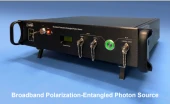
The EPS-1000 broadband polarization-entangled photon source is a compact, fiber‑integrated platform designed for demanding quantum optics and quantum information experiments. Built on periodically‑poled silica fiber (PPSF) technology, this source delivers high‑quality polarization and frequency entanglement at telecom wavelengths, with a broad biphoton bandwidth that comfortably covers both the C‑ and L‑bands. In contrast to bulk‑crystal entanglement sources that require continuous alignment and environmental isolation, the EPS‑1000 uses an all‑fiber, alignment‑free architecture that is optimized for long‑term stability and practical deployment outside of the traditional optics lab.
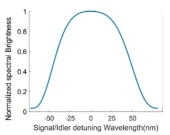
Operating at a degeneracy wavelength around 1566 nm (tunable within the typical 1530–1580 nm range), the source produces broadband entangled photon pairs with a 3 dB biphoton bandwidth of approximately 80 nm and more than 120 nm possible under certain configurations. This broad spectral coverage enables simultaneous access to multiple wavelength channels, making the source particularly suitable for wavelength‑division‑multiplexed quantum key distribution (QKD) and multi‑channel quantum networking. The sum‑frequency bandwidth of the signal and idler photons is engineered to be very narrow (on the order of 0.1–0.4 nm), providing strong energy‑time correlations while preserving high‑quality polarization entanglement.
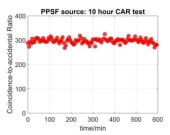
The EPS‑1000 is engineered for high pair‑generation efficiency and excellent signal‑to‑noise performance. Under continuous‑wave pump conditions, the typical pair generation rate is on the order of 2 × 10⁶ pairs per second, with specified operation in the 1 × 10⁶ to 4 × 10⁶ pairs‑per‑second range depending on pump parameters and collection conditions. Coincidence‑to‑accidental ratios around 1000 (with a minimum of 100 in less‑ideal conditions) ensure that the produced entangled pairs are clean and well separated from noise, which is crucial for high‑fidelity quantum communication and precision metrology experiments. The entangled state fidelity to the Bell state |Ψ⟩ = (|HV⟩ + |VH⟩)/√2 is typically around 98–99.5%, with matching two‑photon interference visibilities in both HV and diagonal bases, indicating extremely robust polarization correlations.
A key advantage of this source is its integrated optical routing and spectral management. The device incorporates a built‑in optical switch that allows users to choose between a single, common output port or separated signal and idler outputs. When the internal wavelength division multiplexer (WDM) is engaged, the signal and idler photons are directed to two distinct output ports, pre‑separated in wavelength for straightforward connection to downstream instruments, such as single‑photon detectors, analyzers, or quantum memories. This integrated functionality reduces the need for external components, minimizes optical losses, and simplifies system integration for multi‑channel experiments or deployed quantum links.
The EPS‑1000 is purpose‑built for real‑world deployment scenarios where stability, compactness, and ease of use are more important than laboratory‑style adjustability. It offers turn‑key, room‑temperature operation with low power consumption, making it suitable for continuous use in field environments, rack‑mounted systems, or mobile platforms. The all‑fiber, fusion‑spliced design is inherently rugged and mechanically stable, with no free‑space optics or moving alignment stages that could drift over time. As a result, the system is attractive for space‑constrained environments, including satellite payloads, airborne platforms, and remote quantum network nodes where long‑term unattended operation is required.
In terms of physical packaging, the unit comes in a compact enclosure with approximate dimensions of 39 cm (width) × 34.4 cm (depth) × 8.6 cm (height) and a weight of about 4 kg. This footprint is well suited for benchtop use as well as integration into 19‑inch rack systems or custom instrumentation chassis. Fiber pigtails or panel‑mounted connectors (depending on configuration) provide straightforward interfacing with standard single‑mode telecom fibers, enabling direct connection to existing fiber networks, testbeds, or quantum communication setups without extensive optical realignment.
The performance level and architectural choices of this broadband polarization‑entangled source position it competitively among modern entanglement generators used in quantum technology laboratories worldwide. Compared to traditional periodically‑poled lithium niobate or bulk BBO‑based systems, the PPSF‑based EPS‑1000 shows superior environmental robustness, reduced sensitivity to temperature and vibration, and significantly simplified operation, especially at telecom wavelengths. Users working in quantum imaging, quantum metrolo<
OZ Optics Broadband Polarization Entangled Photon Source Telecom Quantum PPSF
Specifications
| Operating Wavelength: | 1566 nm |
|---|---|
| Wavelength Stability: | -2 – 2 nm |
| Coincidence-to-accidental Ratio Min: | 100 |
| Biphoton Bandwidth Coverage: | >80 nm |
| Photon Pair Wavelength Band: | Telecom C- and L-bands |
| Operating Temperature: | Room temperature |
| Fiber Type: | Periodically-poled silica fiber (PPSF) |
| Operation Mode: | Continuous-wave (CW) |
| Weight: | ~4 kg |
| Height: | 8.6 cm |
| Depth: | 34.4 cm |
| Width: | 39 cm |
| Two-photon Interference Visibility Max: | 99.5% |
| Two-photon Interference Visibility Min: | 97% |
| Two-photon Interference Visibility Typical: | 98% |
| Fidelity To |Ψ⟩=(|HV⟩+|VH⟩)/√2 Max: | 99.5% |
| Fidelity To |Ψ⟩=(|HV⟩+|VH⟩)/√2 Min: | 97% |
| Fidelity To |Ψ⟩=(|HV⟩+|VH⟩)/√2 Typical: | 98% |
| Part Number: | EPS-1000-3A3A3A-1566-9/125-S |
| Coincidence-to-accidental Ratio Typical: | 1000 |
| Pair-generation Rate Max: | 4×10^6 pairs/second |
| Pair-generation Rate Min: | 1×10^6 pairs/second |
| Pair-generation Rate Typical: | 2×10^6 pairs/second |
| Signal/Idler Sum Frequency Bandwidth (3 DB) Max: | 0.4 nm |
| Signal/Idler Sum Frequency Bandwidth (3 DB) Min: | 0.1 nm |
| Signal/Idler Sum Frequency Bandwidth (3 DB) Typical: | 0.2 nm |
| Biphoton Bandwidth (3 DB) Max: | >120 nm |
| Biphoton Bandwidth (3 DB) Min: | 60 nm |
| Biphoton Bandwidth (3 DB) Typical: | 80 nm |
| Signal/Idler Degeneracy Wavelength Accuracy: | ±2 nm |
| Signal/Idler Degeneracy Wavelength (max): | 1580 nm |
| Signal/Idler Degeneracy Wavelength (min): | 1530 nm |
| Signal/Idler Degeneracy Wavelength: | 1566 ±2 nm |
Got questions about specs? Use the inquiry form to ask.
 Download Data Sheet

Features
- Broadband Polarization-Entangled Photon Pairs – Generates high-quality polarization-entangled photon pairs with >80 nm usable bandwidth (3 dB bandwidth typically ~80 nm, >120 nm max), ideal for dense quantum information protocols and WDM-based systems.
- Telecom-Wavelength Operation (C- & L-Bands) – Signal/Idler degeneracy centered at 1566 nm (±2 nm), conveniently spanning the C- and L-band region (1530–1580 nm), compatible with standard fiber-optic components, DWDM/WDM infrastructure, and long-distance fiber transmission.
- Fiber-Based PPSF (Periodically-Poled Silica Fiber) Technology – Uses quasi-phase-matched PPSF for efficient spontaneous parametric down-conversion, providing stable, alignment-free entanglement generation directly in standard 9/125 µm single-mode fiber.
- High Pair-Generation Rate – Delivers a typical entangled pair generation rate of 2 × 10⁶ pairs/second (up to 4 × 10⁶ pairs/second max) under CW pumping, enabling high data-rate quantum communication and fast coincidence measurements.
- Exceptional Entanglement Quality – Offers high-fidelity polarization entanglement to the Bell state |Ψ⟩ = (|HV⟩ + |VH⟩)/√2 with typical fidelity of 98–99.5% and two-photon interference visibility of 98–99.5% (no accidental subtraction), supporting demanding quantum information and metrology experiments.
- Excellent Coincidence-to-Accidental Ratio (CAR) – Provides a typical CAR of ~1000 (min. 100) measured over 16 nm FWHM signal/idler bandwidths, ensuring clean quantum correlations and low noise for high-precision quantum measurements.
- Built-In Optical Switch and Wavelength-Division Multiplexer – Integrated optical switch routes output either to a common port or through a built-in WDM that separates Signal and Idler photons into two dedicated output ports, allowing flexible use in single-path or dual-path configurations.
- Turn-Key, Room-Temperature Operation – Fully integrated source with no user alignment required; operates at room temperature with low power consumption, simplifying deployment in laboratories, field systems, and OEM platforms.
- Rugged, All-Fiber, Alignment-Free Design – Entire optical path is fiber-based, delivering excellent long-term stability against vibration, temperature drifts, and mechanical shocks—well suited for challenging environments, including space-based and mobile quantum instruments.
- Environmentally Stable & Low-Maintenance – No free-space bulk optics or moving alignment stages; stability of polarization and phase is inherently maintained in fiber, reducing recalibration needs and total cost of ownership compared with bulk-crystal entangled photon sources.
- Compact & Lightweight Platform – Enclosed unit with approximate dimensions of 39 × 34.4 × 8.6 cm and ~4 kg weight, enabling easy integration into standard racks, optical tables, portable quantum testbeds, and space-/weight-constrained systems.
- Optimized for Quantum Networking & QKD – Broadband output around telecom bands supports wavelength-division-multiplexed quantum key distribution, multi-channel entanglement distribution, and integration with existing fiber networks, similar to leading entangled sources used in metropolitan-scale quantum links.
- Ideal for Advanced Quantum Applications – Tailored for quantum imaging, quantum metrology/sensing, quantum key distribution networks, quantum computing, and general quantum information processing, providing a reliable entanglement resource out of the box.
- Customizable Degeneracy Wavelength – Degeneracy wavelength can be customized within the 1530–1580 nm range on request, allowing optimization for specific DWDM grids or experimental requirements.
- Narrow Sum-Frequency Bandwidth – Offers a signal/idler sum-frequency (pump) bandwidth of 0.1–0.4 nm (3 dB), beneficial for high spectral purity biphoton generation and enhanced performance in quantum interference and time-bin-sensitive protocols.
Applications
- Quantum Key Distribution (QKD) Networks – Deployment as a high‑quality entangled photon source for fiber‑based QKD protocols (BBM92, E91, entanglement‑based decoy‑state schemes) over C‑ and L‑band telecom fibers.
- WDM‑Based Quantum Communication – Multi‑channel entanglement distribution using the broad (>80 nm) bandwidth to populate many wavelength‑division‑multiplexed channels in metropolitan and long‑haul quantum networks.
- Quantum Repeaters and Entanglement Swapping – Use as a stable entanglement source for elementary links in quantum repeater nodes, entanglement swapping experiments, and quantum memory interfacing at telecom wavelengths.
- Multi‑User Quantum Networks – Support of star and mesh quantum network architectures, enabling simultaneous entanglement delivery to multiple users over standard DWDM/CWDM infrastructure.
- Quantum Teleportation Experiments – Generation of high‑fidelity polarization‑entangled photon pairs for laboratory and field‑deployed quantum state teleportation over installed telecom fiber.
- Device and Protocol Benchmarking – Characterization and stress‑testing of quantum receivers, entanglement‑based protocols, and error‑correction schemes using a bright, stable, and alignment‑free entangled source.
- Quantum Computing and Photonic Quantum Processors – Entanglement resource for linear‑optical quantum computing experiments, small‑scale cluster‑state generation, and photonic quantum logic gates in integrated platforms.
- Entanglement‑Based Quantum Simulators – Implementation of small photonic quantum simulators of many‑body systems, quantum walks, and spin models requiring high‑visibility two‑photon interference.
- Quantum Information Processing Education – Turn‑key entanglement source for university laboratories and training centers teaching quantum information, allowing rapid setup of advanced experiments with minimal alignment.
- Fundamental Tests of Quantum Mechanics – Bell‑inequality violations, tests of non‑locality, contextuality, and Leggett‑type inequalities using polarization‑entangled photons with high coincidence‑to‑accidental ratio.
- Quantum State and Process Tomography – Precise characterization of quantum states and operations in fiber‑based and integrated‑optical systems, leveraging high fidelity to |Ψ⟩ = (|HV⟩ + |VH⟩)/√2.
- Two‑Photon Interference and Hong–Ou–Mandel Experiments – High‑visibility interference measurements in telecom fiber networks and photonic chips for alignment, calibration, and performance validation.
- Quantum Imaging and Ghost Imaging – Non‑classical imaging schemes, ghost imaging, and sub‑shot‑noise imaging using broadband entangled photon pairs for improved spatial resolution and sensitivity.
- Quantum Metrology and Sensing – Phase‑sensitive and time‑correlated measurements for precision metrology, dispersion characterization, and non‑linear response studies at single‑photon levels.
- Entanglement‑Enhanced Interferometry – Fiber‑based interferometric setups exploiting polarization and frequency entanglement to achieve higher sensitivity than classical light in sensing applications.
- Characterization of Telecom Components – Evaluation of WDMs, filters, polarizers, beam splitters, and integrated photonic circuits via entanglement visibility and coincidence measurements across C‑ and L‑bands.
- Integrated Quantum Photonics Testing – Feeding on‑chip interferometers, directional couplers, and phase shifters with entangled photons for wafer‑level and packaged‑device characterization.
- Time‑Bin and Hybrid Entanglement Schemes – Generation and analysis of hybrid polarization–time‑bin or polarization–frequency entangled states for robust long‑distance communication in deployed fibers.
- Satellite and Space‑Based Quantum Links – Use in environmentally demanding platforms (e.g., satellite payload breadboards, stratospheric balloons) where rugged, alignment‑free all‑fiber design is critical.
- Field Trials of Quantum Networks – Mobile or rack‑mounted deployment in real‑world testbeds, demonstrating entanglement distribution, synchronization, and long‑term stability over existing telecom infrastructure.
- Quantum Random Number Generation (QRNG) – Entanglement‑based randomness extraction from measurement outcomes in complementary polarization bases for high‑quality, certifiable random bit streams.
Frequently Asked Questions
What is the OZ Optics Broadband Polarization‑Entangled Photon Source and what makes it different from crystal‑based sources?
What are the key optical specifications of this entangled photon source (wavelength, bandwidth, and pair generation rate)?
How high is the entanglement quality (fidelity, visibility, and CAR) and how are these values measured?
How does the built‑in optical switch and wavelength division multiplexer (WDM) work and what output configurations are available?
What are the physical characteristics and environmental advantages of this all‑fiber PPSF entangled photon source?
What applications is the broadband polarization‑entangled photon source best suited for?
Can the degeneracy wavelength or operating band be customized, and how does this affect integration with telecom systems?
Got more questions? Use the inquiry form to ask the supplier directly.
Similar Products

Your inquiry has been received.
Create an account by adding a password
Why create an account?
- Auto-complete inquiry forms
- View and manage all your past messages
- Save products to your favorites
- Close your account anytime — no hassle