

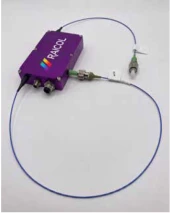
Description
The fiber-coupled ppKTP waveguide module is a compact, high-brightness quantum light source designed for demanding nonlinear optical and quantum photonics applications. By integrating precision laser-written periodically poled KTP (ppKTP) waveguides into a robust, fiber-coupled package, this module delivers stable, high-efficiency generation of correlated and entangled photon pairs as well as efficient frequency conversion. The design focuses on long-term reliability, excellent optical mode quality, and ease of use, making it an ideal building block for both laboratory experiments and deployable quantum systems.
Engineered around type-0 spontaneous parametric down-conversion (SPDC) at 775 nm → 1550 nm, the module achieves a collected pair rate enhancement of approximately 37× compared to bulk crystal configurations, with measured heralding efficiencies around 20% and a spectral bandwidth on the order of 125 nm. These performance improvements stem from the tightly confined guided mode and optimized quasi-phase-matching in the ppKTP waveguide, which significantly increase nonlinear interaction strength and brightness per milliwatt of pump power. Such characteristics are essential for applications that require high photon flux, low multi-pair noise, and efficient collection into single-mode fibers.
The module supports several widely used nonlinear wavelength configurations, including 405 nm → 810 nm, 532 nm → 1064 nm, and 775 nm → 1550 nm, covering key bands for quantum communication, metrology, and interface with telecom infrastructure. A crystal length of 20 mm provides a practical balance between conversion efficiency, spectral bandwidth, and dispersion management. For specialized applications, custom wavelengths and aperiodic poling patterns can be implemented to tailor the phase-matching response, enabling engineered joint spectral amplitudes, narrowband or broadband photon-pair emission, and compatibility with specific quantum memories or detectors.
Designed for straightforward integration, the module features polarization-maintaining (PM) fiber connections at both input and output frequencies. The fibers have an outer diameter of 900 µm with standard FC/APC connectors, supporting low back-reflection and stable polarization alignment. This fiber-coupled architecture minimizes alignment overhead and ensures that the generated photons are directly available in guided single-mode formats, reducing coupling losses and improving overall system efficiency. The form factor of approximately 12 cm × 4 cm × 1.8 cm is well suited for dense optical racks, portable testbeds, and embedded photonic platforms.
Thermal stability is crucial for maintaining phase-matching and spectral performance in periodically poled materials. The ppKTP waveguide module is designed for operation in the 20–28 °C range and includes TEC and thermistor connections for precise temperature control. This allows users to finely tune the phase-matching condition, compensate for environmental drifts, and optimize wavelength alignment with external lasers and detectors. Stable thermal control translates directly into reproducible photon-pair spectra, consistent heralding efficiency, and long-term operational reliability in both laboratory and field environments.
With support for both SPDC and second-harmonic generation (SHG), this ppKTP waveguide platform offers a versatile foundation for a broad range of quantum and classical nonlinear optical functions. It is particularly well suited for entangled photon generation, correlated photon-pair production, and entanglement-based quantum communication in both free-space and fiber-based channels. The module’s telecom-band output at 1550 nm makes it compatible with standard fiber networks and low-loss long-distance links, enabling experiments and systems in quantum key distribution, quantum repeater nodes, and satellite-to-ground quantum communication. Additionally, its brightness and stability are beneficial for quantum sensing, ghost imaging, and high-resolution quantum-enhanced metrology.
Compared with typical bulk ppKTP crystals and non-guided solutions, this fiber-coupled waveguide module offers a significantly higher brightness per unit pump power, improved mode matching to fiber networks, and reduced alignment complexity. These advantages reduce system setup time, simplify scaling to multi-channel architectures, and improve repeatability across experiments or commercial units. Whether serving as a turnkey source in research laboratories or as a core component in next-generation quantum technologies, the fiber-coupled ppKTP waveguide module provides a high-performance, space- and power-efficient platform for state-of-the-art nonlinear and quantum optical systems.
Fiber Coupled ppKTP Waveguide Module for Quantum Light and Frequency Conversion
Specifications
| Custom Wavelengths: | Custom processes and aperiodic poling available upon request |
|---|---|
| Nonlinear Process Type: | Type-0 SPDC, 775 → 1550 nm |
| Available Waveguide Lengths: | 5, 10, 20 mm |
| Temperature Control: | TEC and Thermistor module connections |
| Fiber Type: | Polarization-maintaining (PM) fibers at input and output frequencies |
| Fiber Outer Diameter: | 900 µm |
| Fiber Connectors: | FC/APC |
| Module Dimensions (LxWxH): | 12 x 4 x 1.8 cm |
| Bulk Heralding Efficiency: | 20% |
| Module Heralding Efficiency: | 19.6 ± 0.8% |
| Spectral Bandwidth: | 125 nm |
| Collected Pair Rate (Module): | ~ 37 MHz/mW |
| Waveguide Improvement Factor: | 37x |
| Waveguide Availability: | Fiber coupled |
Got questions about specs? Use the inquiry form to ask.
 Download Data Sheet

Features
- High-Brightness Quantum Light Source – Laser-written ppKTP waveguides integrated into a compact fiber-coupled module deliver a bright and stable source of single photons and photon pairs, ideal for demanding quantum optics and nonlinear applications.
- Efficient Fiber-Coupled Design – Input and output are coupled to polarization-maintaining (PM) fibers with 900 µm outer diameter and FC/APC connectors, enabling low-loss interfacing with standard telecom and laboratory fiber networks.
- Optimized for SPDC and SHG – Engineered for Type-0 SPDC (775 → 1550 nm) with waveguides offering substantial enhancement over bulk crystals, and suitable for second-harmonic generation (SHG) in multiple wavelength bands.
- Available Wavelength Configurations – Standard frequency conversion processes include:
- 405 → 810 nm (e.g., near-IR photon generation from blue pump)
- 532 → 1064 nm (green to IR conversion, common in laser systems)
- 775 → 1550 nm (telecom-band photon-pair generation)
- Custom wavelengths and aperiodic poling are available on request for user-specific quantum and nonlinear optical schemes.
- Waveguide-Enhanced Performance vs Bulk – Compared to a 20 mm bulk ppKTP crystal, the integrated waveguide module delivers:
- ~37× improvement in collected photon-pair rate (~37 MHz/mW vs 1 MHz/mW in bulk)
- High heralding efficiency around 20% (19.6 ± 0.8% on evaluated modules)
- Broad spectral bandwidth of approximately 125 nm, beneficial for high-throughput quantum communication and ultrafast quantum optics.
- Quantum Communication Ready – Telecom-band (1550 nm) output, high coupling efficiency, and compact form factor make the module suitable for satellite-based quantum communication, long-distance fiber links, and integrated quantum networks.
- Compact, Space- and Power-Efficient Module – The mechanically robust package (approx. 12 × 4 × 1.8 cm) is engineered for easy integration into portable, field-deployable or space-constrained systems with low electrical power requirements for temperature control.
- Integrated Temperature Stabilization – Built-in TEC and thermistor connections enable precise temperature control in the range of 20–28 °C, ensuring stable phase matching, long-term drift reduction, and reproducible quantum state generation.
- Polarization-Maintaining Architecture – PM fiber coupling and Type-0 configuration (all interacting waves with the same polarization) support high polarization stability, crucial for entanglement-based protocols and polarization-sensitive measurements.
- Multiple Waveguide Lengths – Available crystal and waveguide lengths (typically 5, 10, and 20 mm options, with 20 mm as standard) allow users to balance spectral bandwidth, conversion efficiency, and interaction length for specific experiments.
- Designed for Entangled and Correlated Photon Sources – Suitable for:
- Entangled photon generation in the near-IR and telecom bands
- Correlated photon-pair generation for heralded single-photon sources
- Entanglement-based quantum communication over free-space and fiber links
- Quantum sensing and imaging (e.g., quantum illumination, ghost imaging)
- Low-Noise, Stable Operation – ppKTP waveguides are known for low photorefractive damage, wide transparency window, and strong nonlinearity, supporting stable long-term operation even at elevated powers compared to many competing nonlinear platforms.
- Turnkey Integration into Nonlinear Optical Setups – The fiber-coupled, temperature-controlled design eliminates complex free-space alignment, allowing fast plug-and-play integration into existing quantum optics benches and industrial nonlinear optical systems.
- Future-Proof Customization – Custom poling periods, aperiodic poling, and non-standard wavelength combinations are available to match emerging quantum protocols, frequency-conversion interfaces, and integration with solid-state or atomic quantum memories.
- Ideal for Laboratory, Industrial, and Space-Oriented Systems – The rugged, compact module and PM fiber architecture support use in:
- Academic and industrial R&D in quantum optics and photonics
- Prototype and deployed quantum key distribution (QKD) systems
- Frequency conversion interfaces between quantum devices and telecom networks
- Entangled Photon Pair Sources for Quantum Communication
Ideal for generating polarization-entangled photon pairs via Type‑0 or Type‑II SPDC at 775 → 1550 nm, supporting fiber-based quantum key distribution (QKD) schemes such as BB84, E91, and device-independent protocols over long-distance telecom networks. - Correlated Photon-Pair Generation for Heralded Single-Photon Sources
High heralding efficiency and bright collected pair rates enable low-noise heralded single-photon sources for quantum information processing, quantum repeaters, and quantum teleportation experiments. - Entanglement-Based Quantum Communication and Quantum Networks
Suited for multi-node quantum networks, entanglement swapping, and quantum memory interfaces where stable, fiber-coupled entangled photons at telecom wavelengths are required for scalable architectures. - Satellite-Based Quantum Communication Links
Compact, rugged, and power-efficient design makes the module suitable for space-borne payloads enabling quantum-secure communication between ground stations and low-Earth-orbit satellites using entangled or correlated photon pairs. - Quantum Key Distribution (QKD) at Telecom Wavelengths
Optimized for 1550 nm operation in standard single-mode telecom fibers, enabling high‑security QKD links that leverage low fiber attenuation and compatibility with existing optical infrastructure. - Quantum Sensing and Quantum-Enhanced Metrology
Provides nonclassical light for sub-shot-noise measurements, phase-sensitive interferometry, and precision timing experiments where squeezed or correlated states of light improve measurement sensitivity. - Quantum Imaging and Ghost Imaging
Correlated photon pairs in the visible and near‑infrared enable ghost imaging, quantum microscopy, and non-invasive imaging techniques using spatial, temporal, or spectral correlations. - Quantum Optical Coherence Tomography (Q‑OCT)
Broadband SPDC bandwidth around 775 → 1550 nm and 405 → 810 nm can be used to implement quantum OCT systems with improved axial resolution and dispersion cancellation compared to classical OCT. - Frequency Conversion for Quantum Interfaces
Enables efficient quantum frequency conversion between common quantum system wavelengths (e.g., 810 nm, 775 nm, 532 nm, or visible-region photons) and low-loss telecom bands around 1550 nm for interfacing trapped ions, atoms, or solid-state qubits with fiber networks. - Second-Harmonic Generation (SHG) for Laser Wavelength Conversion
Supports high-efficiency SHG processes such as 810 → 405 nm and 1064 → 532 nm, providing compact sources for laser cooling, spectroscopy, bio-imaging, and alignment beams in quantum labs. - Time-Bin and Energy-Time Entanglement Experiments
Stable fiber-coupling and broadband SPDC bandwidth are well suited for time-bin entangled photon generation used in long-distance quantum communication and dispersion-tolerant entanglement distribution over standard fiber networks. - Quantum Random Number Generation (QRNG)
SPDC-based photon statistics and detection events can be exploited in high-quality QRNG systems for cryptographic applications requiring provably quantum entropy sources. - Integrated Quantum Photonics Testbeds
Acts as a bright quantum light source feeding integrated photonic chips, enabling characterization of on-chip beam splitters, interferometers, and reconfigurable quantum optical circuits. - Calibration of Single-Photon Detectors and SNSPD Systems
Known pair production rates and heralding efficiencies are useful for calibrating single-photon avalanche diodes (SPADs), superconducting nanowire single-photon detectors (SNSPDs), and detector arrays. - Nonlinear Optics Research and Education
Provides a turnkey platform for laboratory demonstrations of SPDC, SHG, quasi-phase matching, group-velocity matching, and waveguide-enhanced nonlinearities in university and R&D environments. - High-Brightness Quantum Light Sources for Multiphoton Experiments
Waveguide-enhanced interaction (up to ~37× improvement over bulk) supports high-brightness photon-pair production needed for multi-photon interference, boson sampling, and small-scale quantum computing experiments. - Telecom-Compatible Quantum Test and Measurement Systems
Fiber-coupled telecom outputs integrate directly with standard DWDM components, optical switches, and programmable filters, enabling flexible quantum testbeds in existing telecom laboratories.
Applications
Applications of Fiber-Coupled ppKTP Waveguide Module
Frequently Asked Questions
What is the Fiber Coupled ppKTP Waveguide Module and what does it do?
What wavelength combinations and nonlinear processes are supported by this ppKTP waveguide module?
How efficient is the photon‑pair generation compared to bulk ppKTP crystals?
What are the fiber and connector options, and how easy is it to integrate into my setup?
What temperature control and operating conditions are required for phase‑matching?
Is this ppKTP waveguide module suitable for satellite‑based quantum communication and field deployment?
Can I request custom designs, such as different wavelengths or aperiodic poling patterns?
Got more questions? Use the inquiry form to ask the supplier directly.
Similar Products

Your inquiry has been received.
Create an account by adding a password
Why create an account?
- Auto-complete inquiry forms
- View and manage all your past messages
- Save products to your favorites
- Close your account anytime — no hassle