

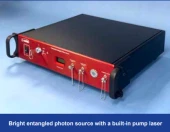
Description
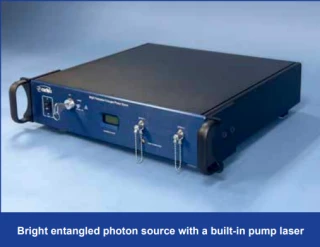
This bright polarization‑entangled photon source is engineered for demanding quantum optics experiments and quantum technology development, delivering exceptionally high photon‑pair brightness and stability in the telecom C‑band. Based on a periodically poled lithium niobate (PPLN) type‑0 waveguide configured inside a fiber‑based Sagnac loop, the system exploits strong optical confinement in a periodically poled nonlinear waveguide (PPNW) to generate abundant, high‑quality photon pairs via spontaneous parametric down‑conversion (SPDC). Compared with conventional bulk‑crystal SPDC sources or free‑space interferometers, this integrated, all‑fiber platform offers dramatically improved efficiency, ruggedness, and long‑term phase stability, making it suitable both for lab‑scale R&D and for integration into larger quantum communication subsystems.
At the heart of the source is a thermally stabilized PPLN waveguide that maintains precise quasi‑phase‑matching conditions, ensuring consistent pair production over extended operating periods. The device is pumped by a built‑in single‑frequency external‑cavity laser at 775 nm with an ultra‑narrow linewidth, providing the spectral purity and coherence required for high‑fidelity entanglement. The generated polarization‑entangled photon pairs are centered at 1550 nm, covering a broad ∼80 nm bandwidth across the telecom C‑band, which simplifies interfacing with standard fiber‑optic components and long‑distance telecom‑grade links. This wide spectral coverage is particularly advantageous for wavelength‑multiplexed quantum key distribution, multi‑channel quantum networks, and parallel quantum information processing experiments.
A distinguishing feature of this source is its built‑in noise management and routing architecture. Immediately after SPDC, the residual pump photons and fluorescence noise are removed by an integrated set of optical filters, substantially reducing accidental counts and elevating the signal‑to‑noise ratio. The standard configuration incorporates an internal optical switch, allowing users either to direct the entangled photon pairs to a single common output fiber or to separate the signal and idler photons into two independent output ports using an internal wavelength splitter. This flexibility supports a wide range of experimental layouts, from simple coincidence measurements and heralded single‑photon generation to more complex multi‑node quantum network demonstrations.
To give researchers precise control over source performance, the unit integrates a variable optical attenuator on the pump path, enabling fine adjustment of the pump power, pair production rate, and associated accidental background. A rotatable half‑wave plate (HWP) is included inside the Sagnac interferometer to control the distribution of photon pairs between the two interferometric paths. By tuning this internal degree of freedom, users can set the desired polarization reference bases and effectively switch the nature of the entanglement between predominantly polarization and energy‑time regimes. This level of on‑board configurability is typically found only in advanced custom lab setups, yet here it is delivered in a compact, turnkey form factor.
The all‑fiber Sagnac interferometer configuration provides automatic phase self‑compensation, which is key to the source’s long‑term stability and alignment‑free operation. Unlike free‑space arrangements that are sensitive to temperature drift, vibration, and mechanical misalignment, the interferometric paths in this design share the same fiber environment, resulting in inherently robust phase locking. Combined with room‑temperature operation and integrated pump laser control, the system offers true turnkey functionality: once installed, it can run continuously with minimal user intervention while maintaining excellent heralding efficiency, high coincidence rates, and entanglement fidelity suitable for state‑of‑the‑art quantum information protocols.
Designed to meet and exceed the performance of many existing commercial entangled photon sources, this broadband telecom solution is an ideal workhorse for quantum key distribution testbeds, quantum computing and information processing platforms, quantum LIDAR experiments, and general quantum photonics research. Its combination of high brightness, low noise, telecom‑band compatibility, and rugged, alignment‑free construction enables researchers and system integrators to focus on protocol development and system‑level innovation rather than source stabilization and maintenance, accelerating progress in next‑generation quantum technologies.
Bright Polarization Entangled Photon Source for Broadband Telecom Applications
Specifications
| Operating Wavelength: | 1550 nm |
|---|---|
| Wavelength Stability: | -0.6 – 0.6 nm |
| Pump Laser Power: | 0 – 12 mW |
| Phase Matching Control: | Thermally stabilized PPNW |
| Fidelity: | Excellent (qualitative) |
| Heralding Efficiency: | High (qualitative) |
| Noise Characteristics: | Low-noise with built-in noise-suppression filters |
| Entanglement Type: | Polarization-entangled photon pairs; switchable between polarization and energy domains |
| Polarization Control Element: | Rotatable half-wave plate (HWP) |
| Variable Optical Attenuator: | Built-in, controls pump power |
| Optical Filters: | Built-in, remove pump photons and fluorescence noise |
| Optical Switch: | Built-in, routes pairs to common or split outputs |
| Output Configuration: | Common output port or two output ports via internal wavelength splitter |
| Pump Laser Wavelength: | 775 nm |
| Interferometer Type: | Fiber-based Sagnac loop / all-in-fiber Sagnac interferometer |
| Spectral Region: | Telecom C-band |
| Spectral Bandwidth: | 80 nm |
| Signal/Idler Center Wavelength: | 1550 nm |
| Operation Temperature: | Room temperature |
| Waveguide Type: | Periodically poled nonlinear waveguide (PPNW), type-0 |
| Nonlinear Medium: | Periodically poled lithium niobate (PPLN) |
| Pump Laser Linewidth: | Ultra-narrow (single-frequency ECL) |
| Pump Laser Type: | Single frequency external cavity laser |
Got questions about specs? Use the inquiry form to ask.
 Download Data Sheet

Features
- Bright, High-Rate Entangled Photon Generation – Periodically poled nonlinear waveguide (PPLN type‑0) delivers one of the highest single counts and coincidence rates available, ideal for demanding quantum optics experiments.
- Telecom C‑Band Operation (1550 nm) – Polarization‑entangled photon pairs centered at 1550 nm with an ~80 nm broadband spectrum, perfectly suited for low‑loss transmission over standard SMF‑28 telecom fiber.
- Integrated 775 nm Ultra‑Narrow Linewidth Pump Laser – Built‑in single‑frequency external cavity laser at 775 nm provides a spectrally pure, stable pump, removing the need for a separate laser source and complex optical alignment.
- All‑Fiber Sagnac Interferometer Design – Fiber‑based Sagnac loop with self‑compensation for phase drift ensures exceptional stability, long‑term interferometric visibility, and reduced sensitivity to environmental disturbances.
- Room‑Temperature, Turn‑Key Operation – Fully integrated solution with rugged, alignment‑free architecture and no cryogenics required, enabling reliable, continuous operation in laboratory and field environments.
- Thermally Stabilized Nonlinear Waveguide – Temperature‑controlled PPLN waveguide maintains optimal phase matching, ensuring consistent brightness, spectrum, and entanglement quality over time.
- Built‑In Optical Filtering and Noise Suppression – Internal filter set completely removes pump photons and associated fluorescence noise, providing low background counts, reduced accidentals, and high signal‑to‑noise ratio.
- Configurable Output via Internal Optical Switch – Integrated optical switch allows users to route entangled photon pairs to:
- a single common output port for co‑propagating entangled pairs, or
- two separate output ports using an internal wavelength splitter to divide Signal and Idler photons.
- Signal/Idler Wavelength Separation – Internal wavelength division allows clean channel separation of Signal and Idler photons, simplifying integration into coincidence setups, quantum key distribution links, and multiplexed systems.
- Variable Pump Attenuation and Brightness Control – Built‑in variable optical attenuator on the pump path lets users precisely tune pair generation rate, accidentals, and noise floor to match detector dynamic range and protocol requirements.
- Integrated Rotatable Half‑Wave Plate (HWP) – Internal HWP enables control of photon pair generation in the two interferometric paths, supporting tuning of polarization bases and flexible manipulation of entanglement properties.
- Switchable Polarization vs. Energy‑Time Entanglement – Design allows switching between polarization and energy‑domain (time‑bin) entanglement, making the source highly versatile for different quantum communication and computing protocols.
- High Heralding Efficiency & Excellent Fidelity – Optimized coupling, waveguide design, and integrated filtering deliver strong heralding efficiency and high‑fidelity polarization entangled states suitable for advanced quantum information experiments.
- Broadband Quantum Resource for R&D – The wide spectral bandwidth and high brightness provide a powerful platform for quantum optics research, multi‑channel experiments, and exploration of high‑dimensional encoding.
- Rugged, Alignment‑Free Fiber-Coupled Package – All‑fiber implementation and proprietary packaging offer mechanical robustness, easy deployment, and stable long‑term performance compared with bulk‑optic SPDC setups.
- Subsystem‑Ready for Quantum Networks – Designed for straightforward integration into larger quantum communication and computing systems, including QKD, quantum repeaters, and entanglement‑based testbeds.
- Customizable Configurations – Options available for custom wavelength ranges, output port configuration, connectorization, and control interfaces to match specific lab setups or commercial quantum system requirements.
- Ideal for Multiple Quantum Applications – Engineered for:
- Quantum key distribution (QKD) over standard telecom fiber
- Quantum computing and information processing testbeds
Applications
- Quantum Key Distribution (QKD) – Generation of polarization-entangled photon pairs at 1550 nm for secure key exchange in fiber-based and free-space QKD systems (BBM92, E91 and entanglement-based network protocols).
- Quantum Communication Networks – Integration of the bright entangled photon source as a subsystem in metropolitan and long-haul quantum communication links, trusted-node networks, and entanglement distribution over existing telecom fiber infrastructure.
- Quantum Repeaters and Entanglement Swapping – Use in quantum repeater nodes for entanglement swapping, purification and multiplexed distribution, leveraging the broadband C-band spectrum and high heralding efficiency.
- Quantum Computing and Information Processing – Source of high-rate polarization-entangled photons for linear optical quantum computing (LOQC), cluster-state generation, boson sampling and photonic quantum logic gate experiments.
- Quantum Simulation – Implementation of photonic quantum simulators using entangled photons to model complex quantum systems, many-body interactions and topological phases.
- Quantum Metrology and Sensing – Enhanced phase, timing and displacement measurements using entangled states to surpass classical limits in precision metrology and interferometric sensing.
- Quantum LIDAR and Quantum Ranging – Deployment in quantum-enhanced LIDAR systems for improved detection sensitivity, target recognition and low-signature ranging in noisy or low-light environments.
- Quantum Imaging and Ghost Imaging – Utilization of correlated photon pairs for non-classical imaging schemes, ghost imaging, sub-shot-noise imaging and imaging through scattering or turbid media.
- Heralded Single-Photon Sources – Operation as a high-brightness heralded single-photon source by detecting one photon of the pair (signal or idler) to herald the presence of a single photon in the other arm.
- Time-Bin and Energy-Time Entanglement Experiments – Switching entanglement between polarization and energy domains for time-bin encoding, dispersion studies and long-distance quantum communication protocols.
- Fundamental Tests of Quantum Mechanics – Bell inequality violations, CHSH tests, Leggett–Garg inequalities and contextuality experiments using high-fidelity entangled photon pairs.
- Quantum State Tomography and Benchmarking – Complete characterization of two-photon polarization states, channel tomography and device benchmarking for quantum components and systems.
- Quantum Random Number Generation (QRNG) – Use of entangled photon correlations and measurement outcomes to implement high-entropy, device-characterized quantum random number generators.
- Entanglement Distribution in Fiber Networks – Field trials and demonstrations of entanglement distribution over standard single-mode telecom fibers, WDM-based quantum networking and coexistence with classical channels.
- Satellite and Free-Space Quantum Links (C-band) – Research on free-space or ground-to-satellite quantum communication using 1550 nm for eye-safe, low-loss atmospheric transmission experiments.
- Component and System Characterization – Testing of quantum receivers, superconducting nanowire single-photon detectors (SNSPDs), InGaAs SPADs, interferometers and polarization controllers under realistic entangled-photon conditions.
- Education and Training in Quantum Optics – Turn-key entangled photon source for university laboratories and training centers to teach quantum optics, quantum information and photonics engineering.
- Integrated Photonics and On-Chip Quantum Circuits – Coupling entangled photons into integrated waveguide circuits, photonic chips and hybrid quantum systems for scalable quantum photonic platforms.
- Multi-User Quantum Testbeds – Use in shared quantum network testbeds and living labs to support multi-protocol experimentation and rapid prototyping of quantum internet applications.
Frequently Asked Questions
What is the OZ Optics bright polarization‑entangled photon source and how does it work?
What makes this entangled photon source brighter and lower‑noise than typical PPLN or bulk‑crystal SPDC sources?
What wavelength range and bandwidth does this broadband telecom entangled photon source cover?
How are the signal and idler photons routed, and what output configuration options are available?
How can I control the brightness, noise level, and type of entanglement produced by the source?
What are the main applications of this bright polarization‑entangled photon source?
How does the all‑fiber Sagnac interferometer and thermal stabilization improve stability and ease of use?
Got more questions? Use the inquiry form to ask the supplier directly.
Similar Products

Your inquiry has been received.
Create an account by adding a password
Why create an account?
- Auto-complete inquiry forms
- View and manage all your past messages
- Save products to your favorites
- Close your account anytime — no hassle