



Description
The OPTOMAN PCV-R300-UVFS-76.2-ET12.7-UBBHR38 is a high-performance plano-concave spherical mirror designed for ultrafast laser multipass cell (MPC) applications. Manufactured from UVFS (JGS1) optical glass and featuring an advanced IBS high-reflectivity coating, this mirror delivers exceptional reflection efficiency, ultra-low absorption, and precise beam control for demanding femtosecond and picosecond laser systems.
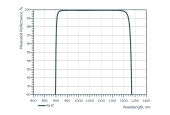
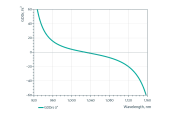
With a 76.2 mm diameter, -300 mm radius of curvature, and optimized operation from 925–1170 nm, this OPTOMAN mirror provides reliable performance in high-power near-infrared laser environments. The UBBHR38 coating offers reflectivity above 99.9% at normal incidence while maintaining extremely low group delay dispersion, making it suitable for applications requiring minimal pulse distortion and maximum optical efficiency.
PCV-R300-UVFS-76.2-ET12.7-UBBHR38 Plano Concave Laser Mirror 925-1170nm
Specifications
| Substrate Material: | UVFS |
|---|---|
| Diameter: | 76.2 mm |
| Edge Thickness: | 12.7 mm |
| S1 Surface: | Concave |
| S2 Surface: | Flat |
| Radius Of Curvature, S1: | -300 mm |
| Radius Of Curvature, S2: | Not Specified |
| Angle Of Incidence (AOI): | 0 – 0 deg |
| Surface Quality, S1 (scratch-dig): | 20-10 |
| Surface Quality, S2 (scratch-dig): | Unspecified |
| Surface Irregularity, S1/S2 (@ 633nm Over CA Or Per Manufacturer): | <= Lambda/10 |
| Max Centration Error: | 3 arcmin |
| Reflectance (@ Peak Wavelength Range, @ AOI): | 99.9 % |
| GDD R: | 50 fs^2 |
| Manufacturer Part Number (MPN): | PCV-R300-UVFS-76.2-ET12.7-UBBHR38 |
| FindLight SKU: | FL-24600 |
Got questions about specs? Use the inquiry form to ask.
 Download Data Sheet

Features
- Precision plano-concave spherical mirror with -300 mm radius of curvature for accurate laser beam focusing and shaping
- Optimized for ultrafast laser multipass cell systems operating at 925–1170 nm
- UVFS (JGS1) substrate provides excellent optical stability and transmission performance
- IBS coating with reflectivity higher than 99.9% for efficient laser beam management
- Ultra-low absorption below 1 ppm minimizes thermal effects in high-power laser applications
- Low group delay dispersion design with <50 fs² performance from 950–1150 nm
- High surface quality of MIL 20/10 scratch-dig and surface irregularity below λ/10 at 633 nm
- Clear aperture of minimum 61 mm for efficient beam utilization
- Low centration error below 3 arcmin for precise optical alignment
- Designed for high-repetition-rate and high-energy ultrafast laser systems
Applications
- Multipass cell (MPC) laser systems for spectral broadening and pulse compression
- Femtosecond and picosecond ultrafast laser amplifiers
- High-power fiber laser and chirped pulse amplification (CPA) systems
- Nonlinear optics and frequency conversion experiments
- Advanced scientific research requiring low-loss reflective optics
- Precision laser beam shaping, focusing, and optical path control
- Industrial ultrafast laser processing systems
- Photonics laboratories and high-energy laser research platforms
Export & Trade Information
| ECCN: | EAR99 |
|---|---|
| HTS Code: | 9001.90.6000 |
| Estimated US Tariff: | 10% |
Frequently Asked Questions
What type of optical component is the OPTOMAN PCV-R300-UVFS-76.2-ET12.7-UBBHR38?
What wavelength range is this mirror optimized for?
What coating is used on the PCV-R300-UVFS-76.2-ET12.7-UBBHR38 mirror?
Why is this mirror suitable for ultrafast laser applications?
What are the main benefits of using an MPC mirror in laser systems?
Got more questions? Use the inquiry form to ask the supplier directly.
Similar Products












Your inquiry has been received.
Create an account by adding a password
Why create an account?
- Auto-complete inquiry forms
- View and manage all your past messages
- Save products to your favorites
- Close your account anytime — no hassle