


Description
The Polarization Entanglement Tomography Analyzer is a cost‑effective, turnkey solution for high‑precision characterization of polarization‑entangled photon pairs using only two single‑photon detectors. Designed for quantum optics and quantum information laboratories, it dramatically simplifies the traditionally complex task of entanglement analysis by integrating precision optomechanics, closed‑loop motor control, and an intuitive software interface into a compact platform. Compared with typical free‑space bulk optical setups assembled from discrete wave plates and polarizers, this analyzer offers higher repeatability, automated scanning, and reduced alignment time, while maintaining state‑of‑the‑art measurement accuracy.
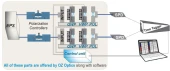
At the core of the system are two motorized rotation stages, each equipped with a rotatable quarter‑wave plate (QWP), a rotatable half‑wave plate (HWP), and a fixed polarizer. This combination enables projection of each photon onto any arbitrary single‑qubit polarization basis. The analyzer is factory configured to perform a complete set of 36 standard polarization measurements in the canonical basis {H, V, D, A, R, L} ⊗ {H, V, D, A, R, L}, which is commonly used for full quantum state tomography of two‑photon polarization states. By automating these projections, the system streamlines the process of reconstructing the density matrix of entangled states such as Bell pairs, partially entangled states, and mixed polarization states, without the need for manual wave plate adjustments.
The analyzer’s high angular precision is enabled by integrated encoders and closed‑loop motor control on each rotation stage. This ensures sub‑degree accuracy in setting the QWP and HWP angles, which is critical for achieving reliable coincidence statistics and reproducible polarization measurements. In contrast to open‑loop motorized stages or manual mounts, the closed‑loop design maintains target angles over extended measurement sequences and environmental drifts, so users can confidently perform long acquisition runs and advanced quantum state reconstructions. This architecture is comparable in capability to advanced quantum polarization analyzers used in leading quantum communication and quantum computing research systems worldwide.
The system’s optical layout is optimized for efficient coupling of photon pairs between source and detectors. The standard configuration provides fiber‑pigtail input and output ports, with options for singlemode, multimode, or polarization‑maintaining fibers to match a wide range of entangled photon sources and detector modules. High coupling efficiency minimizes insertion loss and preserves heralding efficiency, allowing users to fully exploit the brightness and quality of their entangled photon sources. For setups requiring different interfacing schemes, versions with connector receptacles or collimators for free‑space coupling can be supplied, giving flexibility for integration into existing quantum optics benches or fiber‑based platforms.
A dedicated controller unit, USB connectivity, and customized software with a graphical user interface make the analyzer highly accessible for both experienced researchers and newcomers to quantum optics. Through the GUI, users can define arbitrary wave plate rotation sequences, execute standard tomography routines, and automate multi‑polarization state analysis with minimal scripting. This plug‑and‑play approach reduces setup and training time and helps eliminate user‑induced errors that are common in manual polarization analysis. In many quantum optics laboratories, such integrated solutions have become essential tools for routine state characterization, device calibration, and educational demonstrations of entanglement and quantum measurement.
By combining compact form factor, precise polarization control, and robust fiber and free‑space interfacing options, the Polarization Entanglement Tomography Analyzer serves as a versatile platform for polarization state tomography, automated multi‑state analysis, and benchmarking of entangled photon sources. It is well‑suited for research in quantum communications, quantum key distribution testbeds, and quantum information processing, as well as for the development and verification of integrated photonic quantum circuits. Wherever accurate and repeatable polarization entanglement characterization is required, this analyzer delivers a practical balance of performance, usability, and cost.
Polarization Entanglement Tomography Analyzer
Specifications
| Optical Insertion Loss: | 0.75 dB |
|---|---|
| Wavelength: | 1550 nm |
| Repeatability: | 0.1 deg |
| DC Voltage Input: | 5 V |
| Operational Temperature Range: | 15 – 40 degC |
| Rotation Stages: | 2 motorized rotation stages |
| Wave Plates Per Stage: | 1 rotatable QWP + 1 rotatable HWP + 1 fixed polarizer (or PBS) |
| Polarization Rotation Precision: | Sub-degree precision |
| Operation Mode: | Closed-loop with built-in encoders |
| Number Of Default Measurements: | 36 in basis {H,V,D,A,R,L}⊗{H,V,D,A,R,L} |
| Detectors Supported: | Two single-photon detectors |
| Input/output Coupling: | Fiber pigtails (receptacles or free-space collimators optional |
Got questions about specs? Use the inquiry form to ask.
 Download Data Sheet

Features
- Complete Polarization Entanglement Tomography Solution – Integrated system with two motorized rotation stages, control unit, power supply, and USB connectivity for turnkey quantum polarization state analysis.
- Optimized for Two-Detector Polarization Entanglement Analysis – Designed to perform one of the most precise two-qubit polarization measurements using only two single-photon detectors and a time-tagging unit.
- Automated Wave Plate Control with Intuitive GUI – Dedicated software with a user-friendly graphical interface enables fully automated wave plate rotation, measurement sequence control, and data acquisition.
- Pre-Configured 36-State Tomography Basis – Default measurement set in the canonical polarization basis {H, V, D, A, R, L} ⊗ {H, V, D, A, R, L} supports standard quantum state tomography workflows out of the box.
- High-Precision Polarization State Rotation – Motorized stages with built-in encoders provide sub-degree angular resolution and closed-loop feedback for repeatable and accurate polarization projection.
- Dual Motorized Polarization Analysis Stages – Each arm includes a rotatable quarter-wave plate (QWP), half-wave plate (HWP), and fixed polarizer for complete single-qubit projection control in arbitrary polarization bases.
- Configurable Polarization Optics – Fixed polarizers can be replaced with polarizing beam splitters (PBS) on request, allowing adaptation to different experimental layouts and detection schemes.
- Fiber-Coupled Architecture for High Stability – Input and output ports use fiber pigtails to ensure robust alignment, mechanical stability, and ease of integration with fiber-based entangled photon sources and detectors.
- Multiple Fiber Interface Options – Available with singlemode, multimode, or polarization-maintaining fiber types at the input and output to match a wide range of optical setups and wavelength regimes.
- High Coupling Efficiency and Low Optical Loss – Carefully engineered fiber coupling preserves heralding efficiency and coincidence rates by minimizing insertion loss between the source and detectors.
- Excellent Coincidence Rate Repeatability – High-precision angular control and stable fiber coupling ensure consistent coincidence counts, improving reliability of reconstructed quantum states over repeated measurements.
- Compact, Laboratory-Friendly Footprint – Small, integrated platform consolidates polarization optics, mechanics, and electronics into a space-efficient unit suitable for crowded optical tables and racks.
- Plug-and-Play Setup – Delivered as a ready-to-use system with controller, pre-configured software, and standard interfaces, significantly reducing installation time and integration complexity.
- Supports Rapid, Automated Measurement Sequences – Motorized, software-controlled rotation stages enable fast switching between measurement settings, reducing total tomography acquisition time.
- Flexible Input/Output Configurations – Systems can be supplied with connector receptacles or free-space collimators instead of bare pigtails, facilitating hybrid fiber/free-space experiments.
- Designed for Quantum Optics and Quantum Communication Labs – Ideal for entangled photon characterization, polarization state tomography, and automated multi-polarization analysis in research and advanced education environments.
- Cost-Effective Alternative to Custom-Built Setups – Integrates precision optomechanics, electronics, and software into a single commercial instrument, reducing engineering effort and total system cost compared to bespoke solutions.
- Scalable and Upgradable Platform – Architecture supports customization of wavelength range, fiber type, and polarization components, allowing adaptation to new sources, detectors, and experimental protocols.
Applications
- Quantum state tomography of polarization-entangled photon pairs
Complete reconstruction of two-photon polarization density matrices in laboratories developing and characterizing entangled photon sources. - Automation of multi-basis polarization measurements
Replacement of manual wave-plate and polarizer rotations with fully motorized, software-controlled scans over standard bases {H, V, D, A, R, L}⊗{H, V, D, A, R, L}. - Characterization of SPDC and entangled-photon sources
Routine testing of spontaneous parametric down-conversion (SPDC) and integrated quantum light sources for entanglement visibility, Bell-state fidelity, and state purity. - Bell inequality and CHSH-type experiments
Precise, repeatable setting of polarization angles for violation of Bell inequalities, enabling studies of nonlocal correlations and fundamental tests of quantum mechanics. - Quantum communication and QKD link evaluation
Validation of polarization-entangled channels in quantum key distribution (QKD) and other quantum communication protocols through accurate state analysis at the receiver nodes. - Performance verification of polarization-maintaining components
Testing and calibration of polarization-maintaining (PM) fibers, connectors, couplers, and integrated photonic circuits by mapping their effect on two-photon polarization states. - Optimization and monitoring of heralding efficiency
Fine-tuning coupling conditions between source and detectors to maintain high heralding efficiency with minimal polarization-dependent loss. - Quantum gate and quantum circuit characterization
Tomographic benchmarking of two-qubit quantum logic operations implemented in bulk optics or photonic chips by analyzing input–output polarization-entangled states. - Stability studies of long-term quantum experiments
Continuous or periodic polarization tomography to monitor drift, decoherence, and environmental effects in extended-duration quantum optics experiments. - Calibration of polarization analyzers and time-tagging setups
Use as a reference analyzer for verifying detector alignment, time-tagging synchronization, and coincidence-counting accuracy. - Development of free-space and fiber-based quantum links
End-to-end evaluation of polarization integrity in satellite-ground, free-space, and fiber quantum channels using fiber-coupled or collimated input/output options. - Educational and training tool in quantum optics
Hands-on teaching of quantum state tomography, Bloch sphere representations, and entanglement characterization in advanced university laboratories. - Benchmarking polarization entanglement sources for OEM integration
Factory and R&D quality control of commercial entangled-photon sources, including OEM modules, by providing objective entanglement metrics. - Metrology of polarization-dependent optical elements
Measuring the impact of wave plates, polarizers, PBSs, and other birefringent components on entangled states for precision optical metrology. - Protocol development for quantum networking
Rapid prototyping and testing of polarization-encoded entanglement distribution, entanglement swapping, and quantum repeater schemes. - Characterization of multiplexed or multi-wavelength entangled sources
State analysis of polarization entanglement at different operating wavelengths (W) and fiber types (singlemode, multimode, PM) for wavelength-division and spatial multiplexing. - Verification of polarization compensation schemes
Testing active or passive polarization control and compensation systems by tomographically confirming recovery of target entangled states after transmission. - Research on decoherence, noise, and quantum error models
Controlled introduction of noise processes and subsequent tomography to model decoherence channels and validate quantum error mitigation strategies. - Integration with time-correlated single-photon counting (TCSPC) setups
Coincidence-based polarization analysis in time-resolved experiments for studying temporal dynamics of entangled photon generation and detection.
Frequently Asked Questions
What is a Polarization Entanglement Tomography Analyzer and what does this model do?
How does the analyzer perform quantum polarization state tomography of entangled photons?
What are the main features and advantages of this polarization state analyzer compared to custom lab setups?
Which applications and experiments is this quantum polarization analyzer best suited for?
What fiber and wavelength options are available for the Polarization Entanglement Tomography Analyzer?
How is the system controlled and what software or GUI is provided?
How does the analyzer preserve heralding efficiency and minimize optical loss in entangled photon experiments?
Got more questions? Use the inquiry form to ask the supplier directly.
Your inquiry has been received.
Create an account by adding a password
Why create an account?
- Auto-complete inquiry forms
- View and manage all your past messages
- Save products to your favorites
- Close your account anytime — no hassle