


Description
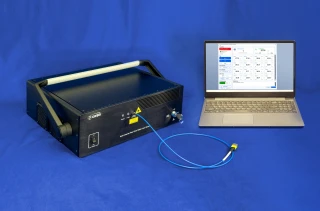
The iOSNRG‑1000 Intelligent Optical Signal-to-Noise Ratio Generator is a high‑performance benchtop instrument engineered for precise OSNR conditioning in advanced fiber‑optic networks. Designed for demanding DWDM and coherent communication environments, it enables users to inject a programmable level of amplified spontaneous emission (ASE) noise into an optical signal and accurately set the resulting signal‑to‑noise ratio over a wide dynamic range. This makes the unit ideal for characterizing the tolerance of optical transmission systems, modules, and components to degraded OSNR in real‑world scenarios.
Covering the 1529–1561.5 nm C‑band window, the iOSNRG‑1000 supports ITU‑T 50 GHz grid channels as well as wider spacings of 100, 200, and 400 GHz. A built‑in tunable optical filter with adjustable bandwidth allows users to precisely select and shape the test channel, providing fine control over both wavelength and spectral characteristics. Unlike basic noise sources or fixed‑filter solutions, this integrated approach simplifies setup and reduces external hardware needs, resulting in a cleaner optical layout and more reproducible measurements for DWDM and submarine link testing, BER testing, and eye‑diagram quality analysis.
The instrument offers a programmable OSNR range from 5 dB to 38 dB with a typical setting accuracy of ±0.5 dB, supporting rigorous quantitative evaluation of 50G, 100G, 200G, and 400G transmission formats. With an optical input power capability of greater than −10 dBm and an output power of at least +8 dBm, the iOSNRG‑1000 is suitable for testing both discrete devices and full system links. Users can choose between a direct output from the tunable filter or an EDFA‑amplified output, making it possible to emulate a broad variety of link conditions, from short‑reach to long‑haul and submarine networks, within a single test platform.
For efficient integration into modern automated test environments, the iOSNRG‑1000 is equipped with GPIB, USB, and Ethernet interfaces, allowing full remote control from test scripts or centralized lab management systems. This level of connectivity is particularly valuable for repetitive validation tasks such as vendor qualification, regression testing of transponders, or manufacturing‑line verification of DWDM modules. The unit also includes a dedicated optical port for connection to an external optical spectrum analyzer, enabling real‑time monitoring and fine‑tuning of OSNR and spectral profiles as test conditions are varied.
In addition to remote operation, the iOSNRG‑1000 functions as a stand‑alone test instrument, featuring an intuitive touch‑screen front panel for local configuration of wavelength, OSNR set point, and output power. Users can quickly define test scenarios, store preferred configurations, and adjust filter bandwidth without reliance on a host computer. Combined with support for standard single‑mode fiber (9/125 µm) and popular connector options such as FC/APC, FC/UPC, SC/PC, and SC/APC, the unit is straightforward to deploy across diverse lab benches and field test setups.
With a compact 390 mm × 344 mm × 86 mm enclosure and a weight of 7.5 kg, the iOSNRG‑1000 is optimized for both benchtop and rack‑mount installations. Optional 19″ 2U rack hardware and an available carrying handle provide flexibility for permanent integration in test racks or transport between labs. Operating from a universal 110–220 VAC supply at 47–63 Hz and consuming up to 80 W, the unit fits seamlessly into standard laboratory power infrastructures. Taken together, these attributes position the iOSNRG‑1000 as a robust, versatile OSNR generator for engineers and researchers engaged in fiber‑optic network development, performance validation, and reliability qualification across terrestrial and submarine DWDM systems.
iOSNRG-1000 Intelligent Optical Signal-to-Noise Ratio Generator
Specifications
| Wavelength Range (Optical Modulator): | 1529 – 1561.5 nm |
|---|---|
| RF Bandwidth (Minimum): | 400 GHz |
| OSNR Range: | 5–38 dB |
| OSNR Setting Accuracy: | ±0.5 dB |
| Optical Input Power: | >-10 dBm |
| Optical Output Power: | +8 dBm |
| Fiber Core/cladding: | 9-125 (μm |
| Electrical Power: | 80 W |
| Interface: | GPIB, USB, and Ethernet |
| Voltage (VAC): | 110-220 V |
| Line Frequency: | 47–63 Hz |
| Mechanical Dimensions: | 390 x 344 x 86 mm |
| Weight: | 7.5 kg |
Got questions about specs? Use the inquiry form to ask.
 Download Data Sheet

Features
- Precision OSNR Generation (5–38 dB Range)
Create repeatable, precisely defined optical signal-to-noise ratios from 5 to 38 dB with ±0.5 dB setting accuracy, ideal for stress testing high‑capacity transmission systems and validating DWDM network performance. - Wide C‑Band Wavelength Coverage: 1529–1561.5 nm
Covers the key C‑band DWDM window, allowing you to test any channel within the ITU 50 GHz grid (and other ITU grids) across 1529–1561.5 nm for metro, long‑haul, and submarine links. - Integrated Tunable Optical Filter with Adjustable Bandwidth
Built‑in bandwidth‑adjustable tunable filter enables flexible channel selection and noise shaping without additional external instruments, improving setup simplicity and test throughput. - Programmable Optical Output Power (≥ +8 dBm)
User‑settable output power up to at least +8 dBm supports realistic link conditions, power‑budget emulation, and stress testing of receivers and amplifiers in advanced optical networks. - Direct or Amplified Output with EDFA
Choose between direct output from the tunable filter or EDFA‑amplified output, providing optimal OSNR and power levels for different test scenarios, from component characterization to full network emulation. - Supports 50G/100G/200G/400G High‑Speed Applications
Purpose‑built for next‑generation coherent and high‑bit‑rate systems, making it suitable for BER testing, eye diagram analysis, and receiver sensitivity characterization up to 400G and beyond. - Ideal for DWDM, Submarine, and Long‑Haul Network Testing
Optimized for DWDM signal and submarine network testing, enabling realistic OSNR conditions to validate system margins, FEC performance, and long‑haul link robustness. - Dedicated Port for External Optical Spectrum Analyzer (OSA)
Integrated optical port for connecting an external OSA simplifies OSNR verification, spectral analysis, and in‑depth troubleshooting without reconfiguring the test setup. - Provision for External Optical Filters
Easily insert external filters into the signal path to emulate network elements or custom spectral shapes, extending capability beyond the built‑in tunable filter. - Stand‑Alone Benchtop Operation with Touchscreen Control
Intuitive front‑panel touch screen provides complete local control of OSNR, wavelength, bandwidth, and power, reducing setup time and operator training requirements. - Full Remote Control via GPIB, USB, and Ethernet
Standard GPIB, USB, and Ethernet interfaces support LabVIEW, Python, and other automation environments for integration into production lines, R&D labs, and long‑term reliability test setups. - Automated Test System Integration
Designed for easy incorporation into automated optical test platforms, enabling repeatable OSNR sweeps, regression testing, and high‑volume component or system qualification. - Optimized for BER and Eye Diagram Quality Testing
Precisely control noise injection to correlate OSNR with BER, Q‑factor, and eye opening, helping engineers establish performance thresholds for transceivers and line systems. - Single‑Mode Fiber Compatibility (9/125 µm)
Uses standard 9/125 µm single‑mode fiber for seamless connection to most telecom‑grade components, test instruments, and live network environments. - Flexible Connector Options (FC/APC, FC/UPC, SC/PC, SC/APC)
Available with multiple industry‑standard connector types (3A, 3U, SC, SCA) to match existing lab infrastructure and minimize insertion loss and reflection issues. - Compact Benchtop Footprint with Optional 19" 2U Rack Mount
Space‑efficient 390 mm x 344 mm x 86 mm design (approx. 2U high) fits easily on crowded benches or in standard 19" racks for production and field‑deployed test systems. - Robust, Field‑Ready Power and Reliability
Operates from 110–220 VAC, 47–63 Hz with up to 80 W power consumption, ensuring compatibility with global mains standards and reliable performance in lab, production, or field environments. - Engineered for Demanding Optical R&D and Production Environments
Combines high OSNR accuracy, flexible control, and broad interface support, making it an excellent choice for telecom carriers, system vendors, component manufacturers, and research institutions.
Applications
Applications of the iOSNRG-1000 Benchtop Intelligent Optical Signal-to-Noise Ratio Generator (OSNR)
The OZ Optics iOSNRG-1000-TUN-XX-1529/1561.5 OSNR Generator is a precision instrument designed to inject a programmable amount of noise into an optical signal, enabling accurate, repeatable optical signal-to-noise ratio (OSNR) control in advanced fiber optic systems. Its combination of a built-in tunable filter, adjustable bandwidth, and computer-controlled interfaces makes it ideal for lab, production, and field environments across a wide spectrum of optical communication applications.
1. Fiber Optic Network Performance Testing and Troubleshooting
- Generate controlled OSNR degradation to evaluate the robustness of backbone and access networks under realistic noise conditions.
- Stress-test point-to-point and point-to-multipoint fiber links to identify OSNR margins and performance thresholds.
- Validate the impact of span length, amplifiers, and passive components on network OSNR performance.
- Support acceptance testing and commissioning of new fiber deployments by emulating worst-case OSNR scenarios.
2. DWDM (Dense Wavelength Division Multiplexing) System Testing
- Characterize multi-channel DWDM transmission systems in the C-band (1529–1561.5 nm) with precise OSNR control per wavelength.
- Use the integrated tunable filter with 50/100/200/400 GHz channel spacing to align with standard ITU-T DWDM grids.
- Evaluate channel tolerance to OSNR variations in long-haul, metro, and regional DWDM networks.
- Optimize amplifier settings, gain equalization, and wavelength planning using controlled noise injection.
3. BER (Bit Error Rate) and FEC Margin Testing
- Perform BER vs. OSNR characterization for 10G, 40G, 100G, 200G, and 400G coherent and direct-detection systems.
- Quantify forward error correction (FEC) gain and determine required OSNR thresholds to meet specific error performance levels.
- Emulate realistic noisy transmission environments to qualify transponders, coherent receivers, and line cards.
- Support R&D validation of new modulation formats such as QPSK, 16QAM, and higher-order QAM under varying OSNR conditions.
4. Eye Diagram and Signal Quality Analysis
- Inject programmable noise to observe eye diagram closure and quantify signal quality metrics like Q-factor and eye opening.
- Correlate visual eye diagram degradation with specific OSNR values for design and debugging purposes.
- Benchmark transmitter performance and receiver resilience in the presence of ASE-like noise.
- Support characterization of optical modulators, drivers, and high-speed photonic integrated circuits.
5. Submarine and Ultra-Long-Haul Network Simulation
- Emulate OSNR conditions found in transoceanic and ultra-long-haul submarine cable systems.
- Validate submarine line terminal equipment (SLTE) design margins and equalization strategies.
- Test the impact of cascaded EDFAs and Raman amplifiers on OSNR and system reach.
- Perform regression and reliability testing of undersea network components under degraded OSNR conditions.
6. Amplifier (EDFA/Raman) Evaluation and Characterization
- Characterize the performance of EDFAs and hybrid EDFA/Raman amplifiers by analyzing OSNR at the amplifier output.
- Use the direct output or EDFA-amplified output modes to compare pre- and post-amplification OSNR behavior.
- Measure noise figure, gain tilt, and saturation effects on overall system OSNR.
- Support design optimization of in-line, booster, and pre-amplifier stages in DWDM networks.
7. Transceiver, Transponder, and Coherent Receiver Testing
- Qualify the OSNR tolerance of pluggable modules (e.g., QSFP28, CFP2, CFP4, QSFP-DD, OSFP) used in high-speed data center interconnects and carrier networks.
- Test the performance of coherent receivers across different modulation formats at controlled OSNR levels.
- Generate OSNR vs. error vector magnitude (EVM) and OSNR vs. constellation quality curves for coherent systems.
- Validate interoperability and vendor comparison of transceivers under standardized OSNR test conditions.
8. Optical Component and Subsystem Qualification
- Evaluate OSNR impact of passive components such as WDM multiplexers, demultiplexers, ROADMs, filters, and optical switches.
- Test the contribution of connectors, splices, and patch panels to signal degradation when combined with controlled noise injection.
- Qualify integrated photonic devices, silicon photonics modules, and PIC-based subsystems for OSNR p
Frequently Asked Questions
What is the OZ Optics iOSNRG-1000 Intelligent Optical Signal-to-Noise Ratio Generator and what is it used for?
What OSNR range and accuracy does the iOSNRG-1000 provide?
What wavelength range, channel spacing, and data rates are supported by the iOSNRG-1000?
How do I control and integrate the iOSNRG-1000 into automated test setups?
What are the optical input and output power specifications and how should I connect my system?
Does the iOSNRG-1000 include a tunable filter and EDFA, and can I use external filters or analyzers?
What are the power, size, and mounting options for the iOSNRG-1000 in a lab or rack environment?
Got more questions? Use the inquiry form to ask the supplier directly.
Similar Products
Your inquiry has been received.
Create an account by adding a password
Why create an account?
- Auto-complete inquiry forms
- View and manage all your past messages
- Save products to your favorites
- Close your account anytime — no hassle