
Description
Phelos helps researchers move beyond forward-only emission measurements by capturing the full angular, spectral, and polarization behaviour of OLEDs, PeLEDs, quantum-dot LEDs, and emissive thin films.
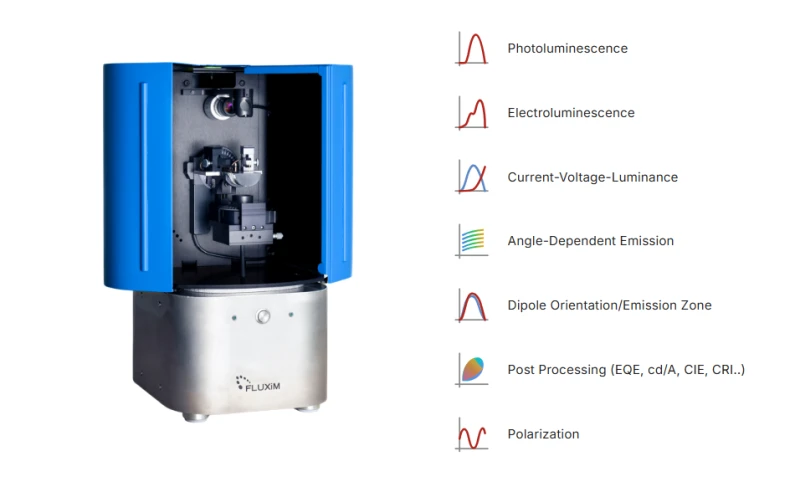
Why angle-resolved EL and PL matterThin-film LEDs rarely emit as ideal Lambertian sources. OLEDs, PeLEDs, and quantum-dot LEDs can show strong angular changes in intensity, spectrum, color, and polarization. A forward luminance measurement alone may therefore miss important optical information.With Phelos, researchers can measure:
-
angular emission profiles
-
spectral shift with viewing angle
-
s- and p-polarized emission
-
dipole orientation in emissive thin films
-
IVL, EQE-related quantities, luminous efficacy, CIE coordinates, CRI, and color temperature
-
datasets for optical modelling and Setfos parameter extraction
Trusted by industry and academic researchers, Phelos measurements have substantially contributed to numerous scientific publications.
Customer Review
Phelos angle-dependent photoluminescence (PL)/electroluminescence (EL) spectrometer along with Setfos package is a great combination of hardware and software to characterize the orientation of emission transition dipole moment. User-friendly interface and a broad range of parameters, such as polarization angles, position angles, driving current, and J-V parameters to investigate the PL as well as EL characteristics of light-emitting semiconductors. We have extensively used both Phelos and Setfos to understand the quantum emission characteristics of perovskites and organometallic complexes and light-extraction efficiency in PeLEDs and OLEDs. We found these tools allowed fast data acquisition, simulation, and in-depth understanding of emission characteristics of LEDs and OLEDs\"
Dr. Sudhir Kumar, Nanomaterials Engineering Research Group, Institute for Chemical and Bioengineering, ETH Zürich
>>Watch the Phelos Video Here<<
Different Operation Modes
Phelos is a spectrometer for both Photoluminescence and Electroluminescence measurements. The instrument is equipped with an internal SMU that is used alternatively for the EL or PL characterization.
Electroluminescence
Measurement System For The Analysis Of The Electroluminescence Of An Organic Light-emitting Diode And A Perovskite Light-emitting Diode
- Analysis of the Color Efficiency.
- Viewing Angle.
- (EQE, lm/W, Cd/A)
- Fitting of the Emission Zone.
- Emitter Orientation.
Photoluminescence
Phelos can be used as a Photoluminescence Thin Film Characterization Instrument
- Angular Dependent Analysis of the light emission characteristics.
- Emitter orientation.
- Spectrum and Color per Emission Angle.
- Polarization in Light-Emitting Thin Films.
Down-Conversion and Scattering
- Characterization of the Scattering and Down-Conversion in Thin Films
- OLEDs functionalized with Quantum Dots
* Smaller spectral range with higher resolution available upon request.
** Default wavelength is 365 nm. Various excitation wavelengths optionally available
Fluxim AG - Phelos - Gonio-Spectrometer for Angle-Dependent Electroluminescence and Photoluminescence Measurements
Specifications
| Spectrometer Type: | Not Specified |
|---|---|
| Wavelength Range: | 360 – 1100 nm |
| Angular Range: | -90° to +90°, top and bottom emission |
| PL Illumination Spot Size: | 5 x 3 mm2 |
| PL Excitation: | 275 nm to 405 nm ** |
| Sample Stage Size: | 40 x 40 mm2 |
| Motorized Polarizer: | 0 to 360° (continuous) |
| Minimal Resolvable Current: | < 100 pA |
| Current Range: | ± 120 mA |
| Voltage Range: | ± 20 V |
| Signal-to-noise Ratio: | 300:1 |
| Spectral Resolution: | 2.5 nm * |
| Signal-to-noise Ratio: | 300:1 |
| Computer Connection: | USB |
| Weight: | 18 kg |
| Dimensions: | 50 x 29 x 24 cm3 |
Got questions about specs? Use the inquiry form to ask.
 Download Data Sheet

Features
Advantages of using Phelos
-
Angle-resolved EL and PL in one instrument Characterize light-emitting devices and emissive thin films without switching between separate setups.
-
Measure non-Lambertian emission directly Capture angular intensity and spectral changes instead of relying on simplified forward-emission assumptions
-
Polarization-resolved spectroscopy Measure s- and p-polarized emission or sweep continuously over polarization angles.
-
Dipole orientation analysis Extract emitter orientation in organic, perovskite, quantum-dot, and hybrid light-emitting thin films.
-
Device-level IVL and efficiency metrics Acquire IVL curves and calculate EQE-related quantities, lm/W, cd/A, CRI, CIE coordinates, and color temperature.
-
Top- and bottom-emitting OLED compatibility Analyze a broad range of OLED, PeLED, and thin-film LED architectures.
-
Setfos integration Connect experimental angular spectra with optical simulation, parameter extraction, and device modelling.
Applications
Phelos can be used for the development of:
- Organic LEDs
- Perovskite LEDs
- QD-Films for LCDs
- Micro-LEDs
Frequently Asked Questions
What is the Phelos spectrometer used for?
Does the Phelos spectrometer measure both electroluminescence and photoluminescence?
Can the Phelos software be coupled with other simulation software?
What kind of measurements can be performed with the Phelos spectrometer?
What are some of the advantages of using the Phelos spectrometer?
Got more questions? Use the RFQ form to ask the supplier directly.
Need pricing for this product? Send a quick inquiry
Your inquiry has been received.
Create an account by adding a password
Why create an account?
- Auto-complete inquiry forms
- View and manage all your past messages
- Save products to your favorites
- Close your account anytime — no hassle