

Description
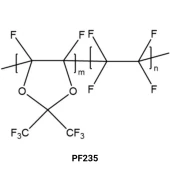
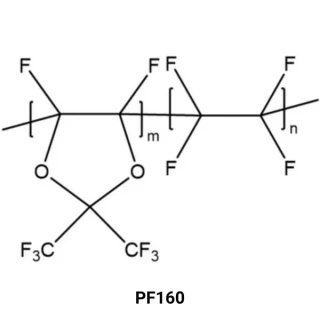
Poly[4,5-difluoro-2,2-bis(trifluoromethyl)-1,3-dioxole-co-tetrafluoroethylene] is a premium, fluorinated copolymer engineered for demanding optical, electronic, and chemical environments. Comparable to advanced perfluorinated polymer families used in high-end optics and microelectronics, this material combines an exceptionally high glass transition temperature of 240±2 °C with outstanding chemical stability and optical clarity. With an intrinsic viscosity of 100±5 mL/g and ≥99% purity (TGA), it offers a robust balance of processability and high molecular weight performance for cutting-edge R&D and specialized production applications.
This copolymer is supplied as powder, crystals, chunks, crystalline powder, or plastic pellets, providing flexibility for different fabrication and processing techniques such as melt processing, hot pressing, or solution-based coating (where compatible solvents and conditions are used). Its intrinsic viscosity in the 100±5 mL/g range indicates a high molecular weight grade, typically associated with superior mechanical integrity, film strength, and durability under thermal and mechanical stress. For projects that require specific rheological behavior, the high intrinsic viscosity is customizable, allowing researchers and engineers to optimize the polymer for particular processing windows or device architectures.
One of the most notable advantages of this polymer is its excellent optical performance. With transparency ≥95% and PDD of 87±1 %, it is particularly well suited for optical components and coatings where minimal light loss and low scattering are essential. Materials based on similar poly(dioxole-co-tetrafluoroethylene) structures are widely used in antireflective coatings, high-transparency windows, optical waveguides, and display components due to their high transmittance in the visible and near-UV ranges, low birefringence, and stable refractive index. These properties make the copolymer an attractive candidate for applications in precision optics, photonics, and optoelectronic interfaces where both clarity and stability over time are critical.
The fluorinated backbone of this material imparts exceptional resistance to chemicals, moisture, and environmental degradation. Similar perfluorinated copolymers are known for their low surface energy, inherent non-stick and anti-soiling behavior, and strong resistance to acids, bases, and solvents. Combined with a high glass transition temperature of 240±2 °C, this copolymer maintains dimensional stability and functional properties under elevated temperatures that would deform or degrade conventional engineering plastics. These characteristics are particularly valuable in microelectronics, semiconductor processing environments, membrane and filtration technologies, and high-reliability components that must withstand thermal cycling and aggressive cleaning or processing chemistries.
NMR analysis confirms conformity to the intended copolymer structure, and TGA-based purity ≥99% ensures low levels of residual volatiles and impurities. This level of quality control is important for advanced applications where trace contaminants can negatively affect optical transmission, electrical performance, or interfacial adhesion. The combination of high purity and high molecular weight makes this material suitable for thin-film deposition, precision molding, and surface-engineered components where defects and inclusions must be minimized. In comparison with more common fluoropolymers, the tailored dioxole-co-tetrafluoroethylene architecture typically offers higher transparency, better film-forming capability, and a tunable balance of stiffness and flexibility.
With its rare combination of transparency, thermal resistance, and chemical robustness, Poly[4,5-difluoro-2,2-bis(trifluoromethyl)-1,3-dioxole-co-tetrafluoroethylene] is an excellent choice for research laboratories and advanced manufacturing environments exploring next-generation optical coatings, high-performance dielectric layers, chemically resistant windows, and precision polymer optics. Its customizable intrinsic viscosity and versatile physical forms support a wide range of processing strategies, from prototyping to scale-up, making it a strategic material platform for innovative product development in optics, electronics, and specialty fluoropolymer engineering.
PF235 High-Tg Amorphous Fluoropolymer for Optical Applications
Specifications
| Optical Transparency: | 95 % |
|---|---|
| Glass Transition Temperature (Tg): | 240 degC |
| Material Form: | Powder, Pellets, Granules, Crystals, Other |
| Purity: | 99 % |
| Intrinsic Viscosity: | 100 mL/g |
| Purity: | ≥99% (TGA) |
| Intrinsic Viscosity: | 100±5 mL/g |
| Glass Transition Temperature: | 240±2 °C (DSC) |
| Transparency: | ≥95% |
| PDD: | 87±1 % |
| Catalog No.: | 932915 |
| CAS No.: | 37626-13-4 |
Got questions about specs? Use the inquiry form to ask.
 Download Data Sheet

Features
- High Glass Transition: TemperaturePF235 has a specified glass transition temperature of 240±2°C, making it suitable for applications that require greater thermal stability than lower-Tg amorphous fluoropolymer grades.
- High Optical Transparency: PF235 offers high optical transparency, supporting use in transparent coatings, optical layers and photonic-material research.
- Low Refractive Index: The amorphous fluoropolymer structure provides a low refractive index, making PF235 useful in optical systems where refractive-index contrast or reflection control is important.
- Low Dielectric Properties: PF235 can be evaluated for low-k dielectric and insulating applications in advanced electronics and high-frequency systems.
- Hydrophobic and Low-Surface-Energy Properties: The highly fluorinated polymer surface provides strong hydrophobicity and low surface energy, supporting anti-fouling, release and protective-coating research.
- Amorphous Structure: Unlike semi-crystalline fluoropolymers, PF235 remains amorphous, helping reduce optical scattering and anisotropic behavior.
Applications
- High-Temperature Optical Coatings: PF235 is well suited for research involving transparent fluoropolymer coatings where optical clarity and elevated-temperature stability are both required.
- Photonics and Waveguide Cladding: Its low refractive index and high thermal stability make PF235 a candidate material for optical waveguide cladding and photonic-layer research.
- High-Frequency Electronics: PF235 can be evaluated as a low-k insulating material in high-frequency electronic and communication applications.
- Microfluidics and Surface Engineering: Its hydrophobic, low-surface-energy surface supports research involving anti-fouling, release and chemically resistant coatings.
- Gas-Separation Membranes: The amorphous polymer structure and free-volume characteristics make PF235 relevant to gas-transport and separation-membrane research.
- High-Temperature Specialty Coatings: PF235 may be evaluated where transparent fluoropolymer films must retain performance under elevated thermal conditions.
Frequently Asked Questions
What is the glass transition temperature of PF235?
What is PF235 used for?
Is PF235 an alternative to Teflon™ AF 2400?
Can PF235 be supplied in bulk?
Can PF235 be supplied as a customized solution?
Can intrinsic viscosity be customized?
Got more questions? Use the inquiry form to ask the supplier directly.
Similar Products
Your inquiry has been received.
Create an account by adding a password
Why create an account?
- Auto-complete inquiry forms
- View and manage all your past messages
- Save products to your favorites
- Close your account anytime — no hassle