

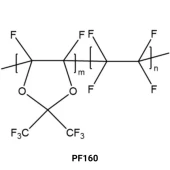
Description
Poly[4,5-difluoro-2,2-bis(trifluoromethyl)-1,3-dioxole-co-tetrafluoroethylene] (often classified within the Teflon AF–type amorphous fluoropolymers) is a premium-performance copolymer designed for demanding optical, electronic, and chemically aggressive environments. With a high intrinsic viscosity of 95 ± 5 mL/g and a purity of ≥99% (TGA), this material delivers an excellent combination of mechanical strength, film-forming capability, and process stability. Its glass transition temperature of 163 ± 2 °C enables use in applications requiring elevated thermal resistance while maintaining outstanding transparency and low color.
This copolymer is supplied as powder, crystals, chunks, crystalline powder, or plastic pellets, giving formulators and process engineers significant flexibility in how it is dissolved, cast, or melt-processed. Characterized by NMR to confirm structural integrity and by thermal analysis to verify purity and Tg, it offers the consistency and reproducibility required for advanced R&D and high-value manufacturing. The high intrinsic viscosity reflects a relatively high molecular weight regime, which is well suited for forming robust, defect-free thin films, membranes, and coatings with superior mechanical integrity compared to lower-viscosity analogues.
A key differentiator of this fluoropolymer is its exceptional optical performance. With transparency ≥95% and a PDD (perfluorodioxole content) of approximately 65–66%, the material exhibits a highly amorphous microstructure that minimizes light scattering and birefringence. Comparable materials in the same family are widely used as ultra-clear optical polymers for waveguides, lenses, windows, and encapsulants in photonics and optoelectronics, especially where low refractive index, low absorption in the UV–visible–NIR range, and excellent environmental stability are critical. The high dioxole content also contributes to low dielectric constant and low optical loss, making this copolymer a strong candidate for integrated optical circuits and high-frequency electronic substrates.
Chemically, the polymer backbone composed of fluorinated dioxole and tetrafluoroethylene units provides exceptional resistance to acids, bases, oxidizing agents, and organic solvents, on par with or surpassing many conventional fluoropolymers. This chemical inertness, combined with high transparency and a relatively high glass transition temperature, makes it attractive for microfluidic chips, analytical cuvette windows, and protective barrier coatings that must withstand harsh reagents while preserving optical clarity. In contrast to semi-crystalline fluoroplastics, this amorphous copolymer can form uniform, pinhole-free films and coatings that are easier to pattern, polish, or bond in precision assemblies.
The high intrinsic viscosity grade is particularly suitable when mechanical robustness, dimensional stability, and resistance to creep or deformation are design priorities. In many applications, higher molecular weight fluoropolymers show better tensile properties and reduced permeability, which is advantageous for gas barrier films, sensor encapsulation, and long-term protective layers in demanding outdoor or aerospace environments. Customization of intrinsic viscosity allows tuning of processing behavior and final properties, giving formulators the ability to balance solution viscosity, coating thickness, and mechanical performance for specific end uses.
Given its combination of ultra-high purity, high glass transition temperature, excellent light transmission, and controllable intrinsic viscosity, Poly[4,5-difluoro-2,2-bis(trifluoromethyl)-1,3-dioxole-co-tetrafluoroethylene] is an advanced fluoropolymer of choice for cutting-edge optical components, high-frequency electronics, precision membranes, and chemically resistant coatings. It bridges the gap between traditional fluoroplastics and specialty optical polymers, offering designers and researchers a versatile platform for next-generation devices requiring both stringent optical performance and extreme chemical and thermal stability.
PF160 Low-Refractive-Index Amorphous Fluoropolymer
Specifications
| Optical Transparency: | 95 % |
|---|---|
| Glass Transition Temperature (Tg): | 163 degC |
| Material Form: | Powder, Pellets, Granules, Crystals, Other |
| Purity: | 99 % |
| Intrinsic Viscosity: | 95 mL/g |
| Intrinsic Viscosity: | 95±5 mL/g |
| PDD: | 65±1 % |
| CAS No.: | 37626-13-4 |
| Catalog No.: | 412056 |
Got questions about specs? Use the inquiry form to ask.
 Download Data Sheet

Features
- High Optical Transparency: PF160 offers high optical transparency, making it suitable for research involving transparent coatings, optical layers and photonic materials.
- Low Refractive Index: Amorphous fluoropolymers are valued for their low refractive index, which can help reduce optical reflection and support refractive-index engineering in multilayer optical systems.
- High Thermal Stability: With a glass transition temperature of approximately 163°C, PF160 is suitable for applications requiring an amorphous fluoropolymer that maintains dimensional and optical stability at elevated temperatures.
- Low Dielectric Properties: The highly fluorinated polymer structure provides low dielectric characteristics that are useful in the development of insulating layers, high-frequency electronic materials and low-k coating systems.
- Hydrophobic Surface Properties: PF160 provides a highly fluorinated, low-surface-energy polymer surface, supporting research involving water repellency, release coatings and anti-fouling surfaces.
- Solution-Processable Film Formation: PF160 can be evaluated in coating and film-forming processes such as spin coating, dip coating and other solution-based deposition methods, depending on solvent system and formulation.
Applications
PF160 can be evaluated for advanced materials research in areas including:
- Optical Coatings and Photonics: Its low refractive index and high transparency make PF160 suitable for research involving anti-reflective coatings, optical protective layers, waveguide cladding and photonic structures.
- Semiconductor and Electronic Materials: PF160 can be evaluated as a low-k fluoropolymer for dielectric coatings, insulating layers and advanced electronic-material research.
- Microfluidics and Surface Engineering: The low-surface-energy fluorinated polymer surface supports research into hydrophobic, anti-fouling and release coatings for microfluidic and analytical devices.
- Gas-Separation Membranes: The amorphous polymer structure and free-volume characteristics make this polymer family relevant to research involving gas transport and membrane separation.
- Specialty Coatings: PF160 can also be evaluated for transparent protective coatings and chemically resistant fluoropolymer films where low surface energy and optical clarity are required.
Frequently Asked Questions
What is Poly[4,5-difluoro-2,2-bis(trifluoromethyl)-1,3-dioxole-co-tetrafluoroethylene] (CAS 37626-13-4) and what are its key properties?
What are typical applications of this PDD-TFE fluoropolymer in optics and electronics?
How does the high intrinsic viscosity (95 ± 5 mL/g) affect processing and performance?
What is the significance of the glass transition temperature (Tg = 163 ± 2 °C) for this fluoropolymer?
How does this material compare to other optical fluoropolymers used for high-transparency applications?
In what physical forms is this fluoropolymer supplied, and how does that impact processing?
What quality control tests are used to verify the identity and purity of this PDD-TFE copolymer?
Got more questions? Use the inquiry form to ask the supplier directly.
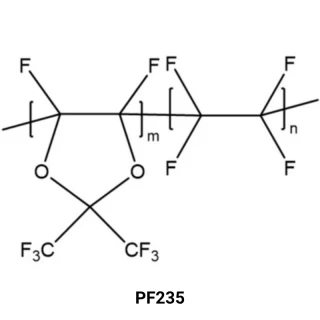
Similar Products
Your inquiry has been received.
Create an account by adding a password
Why create an account?
- Auto-complete inquiry forms
- View and manage all your past messages
- Save products to your favorites
- Close your account anytime — no hassle