
Description
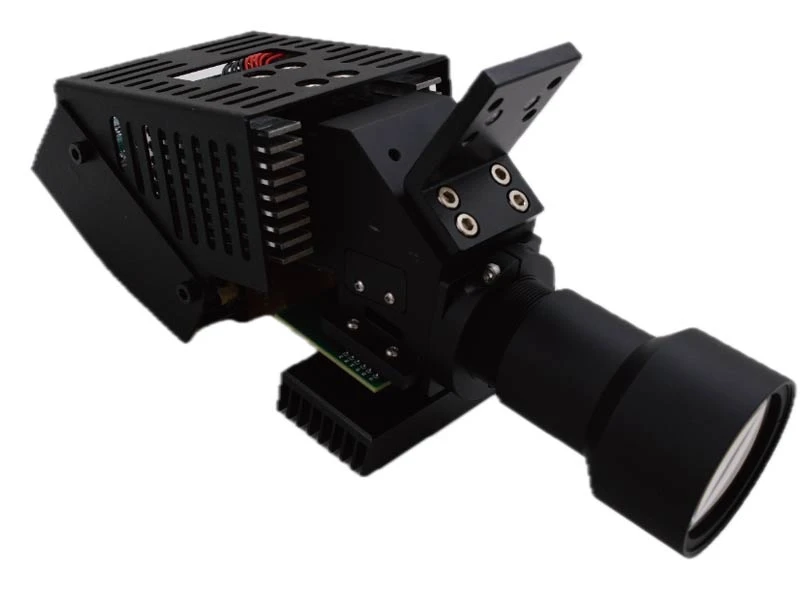
This structured-light projection engine is a dedicated light-pattern generator engineered as the core of high-performance 3D Automatic Optical Inspection (AOI) and Solder Paste Inspection (SPI) systems. Designed around Texas Instruments’ DLP4710 DMD chipset with a native resolution of 1920 × 1080, it delivers high-brightness, high-contrast pattern projection that directly defines the achievable measurement accuracy, inspection throughput, and reliability of modern 3D inspection platforms. By combining precision optics with robust industrial design, it provides a stable and repeatable optical foundation for inline electronics manufacturing environments.
The engine employs advanced DLP micromirror technology and a blue LED illuminant in the 450–460 nm range to generate finely encoded light patterns such as multi-frequency fringes, Gray codes, and random dot sequences. The short-wavelength blue illumination is intentionally selected to suppress specular glare from solder joints and metallic components, a critical advantage when inspecting high-density printed circuit boards (PCBs), connectors, and lead frames. With a fine pixel pitch and an F2.6 optical design, the projection system achieves high contrast ratios above 1500:1, low distortion (≤ 1.8%), and excellent illumination uniformity greater than 85%, enabling micron-level reconstruction precision in 3D scanning applications.
Optimized for machine vision integration, this structured-light projection engine is tailored for a working distance of 220 mm and projects a frame size of approximately 132.65 × 77.36 mm at that distance. A specially engineered shift design maintains projection-plane confocality with the measurement optics, improving phase stability and geometric consistency across the field of view. This is particularly important in 3D AOI and SPI systems where even minor deviations in projection geometry can translate into measurement errors on fine-pitch components, micro-BGAs, and complex solder joints. The result is a projection subsystem that supports repeatable, high-precision 3D reconstruction over the full active area.
For demanding industrial environments, the projection engine is built with an all-metal housing and passive cooling architecture that ensures long-term mechanical and thermal stability while minimizing vibration and fan-induced contamination. The design supports a wide operating temperature range from 0 to 60 °C, making it suitable for integration into enclosed AOI cabinets, SMT production lines, and precision metrology equipment. Weighing approximately 500 g and measuring 74.5 (W) × 110.7 (H) × 184.9 (L) mm, the compact form factor simplifies mounting, alignment, and replacement in both new system designs and upgrades to existing inspection platforms.
From a system integration perspective, the projection engine provides flexible electrical and control options to synchronize seamlessly with cameras, motion controllers, and external automation devices. It operates from a 12–19 V main power supply and supports a wide LED current control range (200 mA–16000 mA), allowing integrators to tune output power for different surface finishes, field-of-view sizes, or exposure strategies. Programmable exposure time combined with USB and RS485 communication interfaces gives developers direct access to pattern sequencing and illumination parameters, while opto-isolated trigger input and Schmitt-buffer trigger output signals enable precise timing coordination with image acquisition and motion stages in high-speed inline inspection systems.
In practical use, this structured-light projection engine serves as the optical backbone for 3D AOI, 3D SPI, and high-precision 3D scanning systems across electronics manufacturing, semiconductor packaging, and precision assembly verification. Its ability to project stable, high-contrast patterns on challenging reflective and mixed-material surfaces supports accurate height mapping, coplanarity checks, solder volume measurement, and fine-geometry inspection. For equipment manufacturers and system integrators looking to enhance the resolution, reliability, and throughput of their 3D inspection platforms, this engine offers a tightly optimized combination of DLP projection performance, blue-light glare control, and industrial-grade mechanical robustness.
DLP4710 Structured Light Projection Engine for 3D AOI SPI Inspection
Specifications
| Projection Technology: | DLP (DMD) |
|---|---|
| Pattern Type: | Programmable, Fixed dot / random |
| Native Resolution (horizontal): | 1920 pixels |
| Native Resolution (vertical): | 1080 pixels |
| Illumination Wavelength Range: | 450 – 560 nm |
| Working Distance: | 220 mm |
| Display Technology: | DMD Technology |
| DMD Chip: | TI DLP4710 |
| Illumination Color: | Blue LED (450–460 nm) |
| F#: | F2.6 |
| Relative Illumination: | >95% |
| Projection Angle: | 25° |
| Contrast: | >1500:1 |
| Distortion: | ≤ 1.8% |
| Frame Size: | 132.65 × 77.36 mm (@220 mm working distance) |
| Main Board Power Supply: | 12–19 V |
| LED Current: | 200 mA–16000 mA |
| Trigger Input: | Opto-isolated; drive current 6–14 mA, default 5 V |
| Trigger Output: | Schmitt-buffer; max drive 32 mA @5 V |
| Interfaces: | USB / RS485 / Trigger In / Trigger Out |
| Working Temperature: | 0–60° C |
| Weight: | Approx. 500 g |
| Dimensions: | 74.5 (W) × 110.7 (H) × 184.9 (L) mm |
| Cooling: | Passive |
| Construction: | All-metal |
| Manufacturer Part Number (MPN): | PRO4710-21f26-455 |
| FindLight SKU: | FL-24902 |
Got questions about specs? Use the inquiry form to ask.
 Download Data Sheet

Features
- High-Resolution DLP Projection Core – Built around the TI DLP4710 DMD chip with a native 1920 × 1080 resolution, delivering fine pixel pitch for micron-level 3D reconstruction detail in demanding AOI and metrology applications.
- Optimized Blue-LED Structured-Light Illumination – Uses a narrow-band blue LED (450–460 nm) source to effectively suppress specular reflections from solder joints and metallic components, improving pattern contrast on highly reflective PCB surfaces.
- Multi-Pattern Structured-Light Capability – Supports projection of multi-frequency fringes, Gray codes, and random dot patterns, enabling flexible implementation of phase-shifting, coded-light, and stereo-based 3D measurement algorithms.
- High-Brightness, High-Contrast Projection – DMD-based optical engine with contrast ratio of >1500:1 and illumination uniformity of >85% across the field, ensuring stable, high-SNR fringe images even on complex PCB topographies.
- Precision Optical Design for AOI – Special shift-design optics maintain projection-plane confocality, minimizing focus variation and distortion (≤ 1.8%) over the full field of view to improve 3D reconstruction accuracy at the board level.
- Optimized Field of View and Working Distance – Calibrated for a 220 mm working distance with a frame size of 132.65 × 77.36 mm and a 25° projection angle, ideal for standard PCB panel sizes and inline 3D AOI / 3D SPI systems.
- High Relative Illumination – Relative illumination of >95% from center to edge reduces vignetting and intensity roll-off, simplifying calibration and enhancing measurement consistency across the entire inspection area.
- Programmable Exposure and Flexible Triggering – Programmable exposure time combined with hardware Trigger In / Trigger Out allows precise synchronization with cameras, motion stages, and conveyors for high-speed inline inspection.
- Industrial-Grade Connectivity – Standard USB and RS485 interfaces support easy integration into a wide range of machine vision controllers and PLC-based systems, matching connectivity conventions used in modern 3D AOI equipment.
- Robust All-Metal Construction – Rigid all-metal housing with passive cooling enhances mechanical stability, eliminates fan-induced vibration and dust ingress, and improves reliability in 24/7 production environments.
- Wide Operating Temperature Range – Designed for industrial conditions with a working temperature range of 0–60 °C, ensuring stable performance in electronics manufacturing lines and factory-floor environments.
- High-Power, Precisely Controlled Illumination – LED current adjustable from 200 mA to 16000 mA, enabling fine tuning of brightness for different surface finishes, solder mask colors, and exposure strategies without compromising fringe quality.
- Compact, Lightweight Form Factor – Measuring only 74.5 (W) × 110.7 (H) × 184.9 (L) mm and weighing approximately 500 g, the projection engine fits easily into confined machine envelopes and multi-head AOI architectures.
- Stable Power and Signal Design – Operates from a broad 12–19 V main board power supply with opto-isolated trigger input and Schmitt-buffer trigger output (up to 32 mA @ 5 V), improving noise immunity and system-level reliability.
- Ideal for 3D AOI, 3D SPI, and Precision 3D Scanning – Engineered as the core projection module for high-performance 3D AOI, 3D SPI, and other high-precision 3D scanning applications requiring accurate geometry capture, high throughput, and strong interference resistance.
Applications
- 3D Automated Optical Inspection (3D AOI) for SMT and PCB Assembly
Ideal projection engine for high‑speed, high‑accuracy 3D AOI systems inspecting solder joints, components, and coplanarity on densely populated printed circuit boards. - 3D Solder Paste Inspection (3D SPI)
Enables micron‑level height and volume measurement of solder paste deposits, improving process control and yield in stencil printing and reflow processes. - Inline Electronics Manufacturing Inspection
Integrates into inline inspection stations for real‑time 3D defect detection (bridges, insufficient solder, tombstoning, skew, warpage) in high‑throughput SMT production lines. - High‑Precision 3D Metrology and Dimensional Measurement
Provides structured‑light patterns for non‑contact 3D measurement of mechanical parts, connectors, and micro‑features requiring micron‑level accuracy. - 3D Scanning and Reverse Engineering
Serves as the projection core of structured‑light 3D scanners for capturing detailed surface geometry of small to medium‑sized components for CAD, redesign, and quality verification. - Precision PCB and Substrate Topography Measurement
Measures board warpage, bow and twist, and substrate flatness in advanced packaging, HDI boards, and flexible circuits using high‑contrast blue structured light. - Semiconductor and Advanced Packaging Inspection
Supports 3D inspection of IC packages, wire bonds, bumps, micro‑BGAs, and advanced packaging structures where specular reflection control is critical. - Micro‑Assembly and MEMS Component Inspection
Delivers fine pixel‑pitch patterns for inspecting small opto‑electronic and MEMS assemblies, ensuring precise positioning and coplanarity in micro‑systems. - Connector, Terminal, and Pin Height Inspection
Enables fast 3D measurement of pin height, coplanarity, and deformation on connectors, sockets, and press‑fit components in automotive and industrial electronics. - Battery Module and Power Electronics 3D Inspection
Provides structured illumination for 3D inspection of busbars, weld seams, terminals, and automotive battery modules where metallic reflections need to be suppressed. - Industrial Robotics and Machine Vision Guidance
Acts as a structured‑light source for 3D vision‑guided robots, supporting accurate object localization, bin‑picking, placement, and assembly tasks. - Inline Surface Defect Detection and Flatness Analysis
Projects multi‑frequency fringe patterns for detecting dents, warpage, scratches, and other 3D surface anomalies on housings, enclosures, and machined parts. - Precision Optical Component and Lens Inspection
Used in metrology systems to characterize lens and optical surface geometry, sag, and shape deviations via phase‑measuring structured light. - 3D Profilometry of Solder Joints and Metal Surfaces
Blue‑light DLP projection enables robust 3D profilometry of highly reflective solder joints, plated surfaces, and metallic contacts with minimized glare. - Consumer Electronics Assembly Inspection
Supports 3D inspection of smartphones, tablets, wearables, and camera modules, including housing alignment, gap/flush measurement, and cosmetic surface checks. - Automotive Electronics and ECU Inspection
Provides structured‑light projection for 3D AOI of automotive control units, sensor modules, and power electronics, verifying solder quality and connector integrity. - Aerospace and Defense Electronics Quality Control
Delivers stable 3D inspection for mission‑critical electronics with stringent reliability requirements, including avionics boards and radar/communication modules. - Medical Device and Instrument PCBA Inspection
Enables high‑reliability 3D inspection of medical-grade PCBAs used in diagnostic equipment, patient monitors, and implantable device controllers. - Laboratory Research in 3D Imaging and Computer Vision
Serves as a programmable structured‑light source for academic and industrial R&D in 3D reconstruction, multi‑view stereo, and novel optical measurement methods. - 3D Shape Acquisition for AR/VR and Human–Machine Interfaces
Provides high‑resolution 3D data capture of objects, hands, and faces for gesture recognition, ergonomic evaluation, and AR/VR content creation systems. - Tool and Die, Mold, and Precision Machining Verification
Supports dimensional verification of molds, dies, and precision-machined components by projecting high‑contrast fringe patterns for fast 3D comparison to CAD.
Export & Trade Information
| ECCN: | EAR99 |
|---|---|
| HTS Code: | 9031.90.5900 |
| Estimated US Tariff: | 37.5% |
Frequently Asked Questions
What is the Structured‑Light Projection Engine and what are its main specifications?
How does this structured‑light projection engine improve 3D AOI and 3D SPI inspection accuracy?
Why does the engine use blue structured light (450–460 nm) and what advantages does it offer for electronics inspection?
What structured‑light patterns can this DLP engine project and how are they used for 3D reconstruction?
How do I integrate this structured‑light projection module into a 3D AOI camera or custom 3D scanner?
What are the trigger, synchronization, and interface options for high‑speed 3D inspection lines?
What environmental, mechanical, and reliability characteristics make this projection engine suitable for industrial use?
Got more questions? Use the inquiry form to ask the supplier directly.
Your inquiry has been received.
Create an account by adding a password
Why create an account?
- Auto-complete inquiry forms
- View and manage all your past messages
- Save products to your favorites
- Close your account anytime — no hassle