
Description
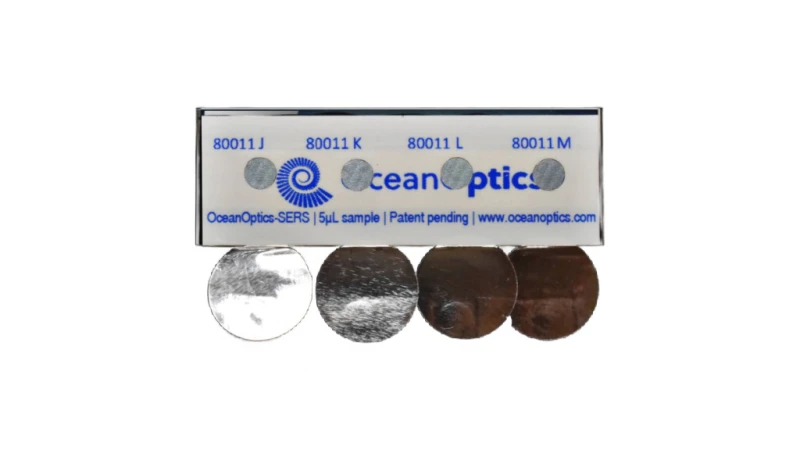
Ocean Optics SERS substrates and accessories enable highly sensitive molecular detection using Surface-Enhanced Raman Scattering (SERS) technology. Designed with a patented Signal-Enhancing Heat Sink, these high-performance substrates amplify weak Raman signals while maintaining stability, repeatability, and robustness across a wide range of laser powers.
Each substrate provides four large active SERS chips with clear serialization, ensuring reliable quantitative analysis and reproducible measurements. With minimal sample preparation requirements, these substrates support fast, field-deployable point-of-care (POC) sensing across biomedical, environmental, forensic, and security applications.
Ocean Optics SERS Raman Substrates – High-Sensitivity Signal-Enhancing Heat Sink Chips for 671–1064 nm
Specifications
| Consumable Type: | SERS substrate |
|---|---|
| Substrate Dimensions: | 75 × 24 × 0.2 mm |
| Active Area (chip Diameter): | Ø6 mm |
| Number Of Active Areas: | 4 |
| Analyte Volume: | 5–10 µL |
| Substrate Surface: | Polyethylene flexible adhesive film |
| Raman Excitation Wavelengths: | 671 / 785 / 830 / 1064 nm |
| Shelf Life (optimal Performance): | 8 months |
| Storage Temperature: | 5–60 (40–140) °C (°F) |
| Storage Humidity: | < 50, non-condensing % RH |
Got questions about specs? Use the inquiry form to ask.
 Download Data Sheet

Features
- Surface-Enhanced Raman Sensitivity: Amplifies weak Raman signals for trace-level molecular detection.
- Patented Signal-Enhancing Heat Sink: Maintains substrate integrity and signal stability across varying laser powers.
- Reproducible & Repeatable: Enables confident detection, quantification, and concentration regression.
- Long-Term Stability: Extended shelf life reduces scheduling pressure for testing.
- Robust Design: Flexible adhesive film and durable construction for field and lab use.
- Multiple Active Chips: Four large Ø6 mm SERS active areas per substrate with serialization.
- Minimal Sample Preparation: Supports rapid field-based and point-of-care diagnostics.
Applications
- Biomedicine: Biomarker detection, disease diagnostics, and therapeutic monitoring.
- Medical Diagnostics: Rapid point-of-care molecular identification.
- Forensics: Trace chemical and narcotics identification.
- Food Safety: Detection of contaminants, adulterants, and pathogens.
- Environmental Monitoring: Identification of pollutants and hazardous chemicals.
- Threat Detection: Rapid sensing of explosives or toxic agents in the field.
Frequently Asked Questions
What is SERS and why is it useful?
Which laser wavelengths are supported?
How much sample is required?
How long can the substrates be stored?
Are the measurements reproducible?
What are SERS Raman substrates used for?
How do SERS substrates improve Raman signal intensity?
Which excitation wavelengths are supported by these SERS substrates?
What types of samples can be analyzed using SERS substrates?
Are these SERS substrates compatible with portable Raman spectrometers?
What advantages do heat sink chips provide in SERS applications?
Can SERS substrates detect trace-level contaminants?
Are the substrates suitable for biomedical research?
What industries commonly use SERS Raman substrates?
How should SERS substrates be stored?
Why is 785 nm excitation commonly used in Raman spectroscopy?
What materials are commonly used in SERS substrates?
Got more questions? Use the inquiry form to ask the supplier directly.
Similar Products
Your inquiry has been received.
Create an account by adding a password
Why create an account?
- Auto-complete inquiry forms
- View and manage all your past messages
- Save products to your favorites
- Close your account anytime — no hassle