


Description
The wedge windows have two non-parallel planes, which can avoid the interference effect (Etalon effect) caused by the reflected light from the front and rear surfaces of the highly parallel window, and also avoid the optical interference feedback from the laser resonant cavity which leads to the poorstability of the laser output, mode jumping,etc. It is commonly used to deflect the incident beam to a specified direction by a certain deflection angle. When used in pairs, the outgoing beam can be positioned in any direction within an angular cone with the incident beam as the axis by the relative rotation of thetwo wedges.
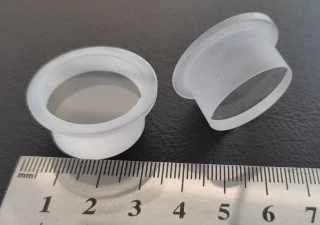
Factory Custom CaF2 BaF2 MgF2 LiF Wedge Window
Specifications
| Material: | BaF2, MgF2, IR Grade CaF2, CaF2 |
|---|---|
| Surface Flatness: | Lambda/4 |
| Surface Quality (Scratch-Dig): | 60-40 |
| Wedge Angle: | 60 arc minutes |
| Diameter: | 25 mm |
| Thickness: | 2 mm |
| Dimension Tolerance: | +0/-0.1mm |
| Angle Tolerance: | ±30'' |
Got questions about specs? Use the inquiry form to ask.
 Download Data Sheet

Features
- Multi-Material Compatibility: Available in CaF₂ (deep UV-mid IR), BaF₂ (Far IR), MgF₂ (UV-visible), Fused Silica (high-power lasers), and N-BK7 (visible-NIR) to match specific spectral needs
- Circular Profile Advantage: Optimized for circular beam paths (e.g., lasers, telescopes), minimizing beam clipping and pairing with standard cylindrical mounts for easy installation
- Customizable Performance: Adjustable wedge angles (0.5°–30°) for precise beam deviation; surface quality (S&D 40/20 optional) and coatings (AR tailored to target wavelengths) for low scatter/loss
- Broad Spectral Coverage: Operates efficiently from 0.13μm to 15μm , suitable for multi-band optical systems
- Environmental Durability: Chemically inert substrates (varies by material) and optional hydrophobic coatings resist moisture, dust, and corrosion in harsh environments
Applications
- Laser Systems: Protects high-power laser optics (e.g., cutting/welding machines) while adjusting beam paths; Fused Silica/MgF₂ options enhance laser damage resistance
- Astronomy & Space Optics: Shields telescope sensors from space debris; CaF₂/BaF₂ substrates enable UV-Far IR observation, while wedge angles correct optical path errors
- Industrial Inspection: Integrates into machine vision systems to deflect beams and protect lenses from factory dust; N-BK7 options suit visible-range inspection tasks
- UV/Far IR Research: Used in spectroscopy (UV-Vis-IR) and imaging setups; CaF₂/BaF₂ windows enable deep UV/Far IR measurements while adjusting beam alignment
- Medical Photonics: Shields laser therapy tools from biological contaminants; round profile simplifies integration into compact medical devices
Frequently Asked Questions
What is the difference between a round wedge window and a separate wedge prism + window?
How does the wedge angle of the window affect its protective performance?
What are the key differences in application suitability between rectangular and round wedge windows?
Got more questions? Use the RFQ form to ask the supplier directly.
Similar Products
Need pricing for this product? Send a quick inquiry
Your inquiry has been received.
Create an account by adding a password
Why create an account?
- Auto-complete inquiry forms
- View and manage all your past messages
- Save products to your favorites
- Close your account anytime — no hassle