
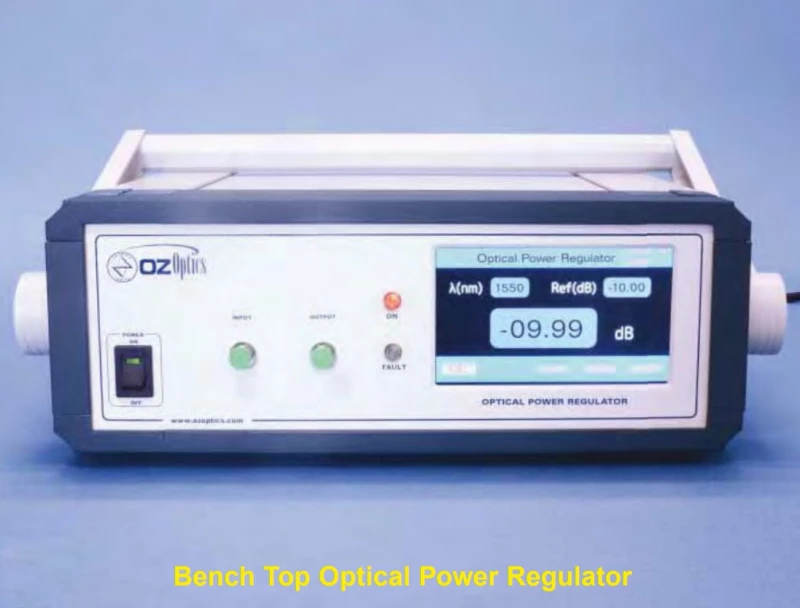
Description
Optical power regulators are essential components in modern fiber optic systems, ensuring stable and consistent optical output power even in the presence of fluctuating input signals or environmental changes. These devices are particularly valuable in applications where signal integrity is critical, such as Dense Wavelength Division Multiplexing (DWDM) networks and precision test equipment. By maintaining a constant output power, optical power regulators help prevent transmission errors and enhance the overall reliability of optical communication systems.
The advanced design of these regulators combines variable optical attenuator technology with real-time optical power monitoring. This integration enables the system to automatically adjust attenuation levels based on feedback from the power monitor, effectively compensating for variations caused by polarization dependent loss (PDL), amplifier gain fluctuations, or other disturbances. The result is a highly stable output, with regulation accuracy better than ±0.1 dB and rapid millisecond-level response times, making them suitable for both dynamic and static environments.
Optical power regulators are available in a variety of configurations to suit different operational needs. Options include single and multi-channel versions, as well as compatibility with both singlemode and polarization maintaining (PM) fibers. These units can be supplied as compact OEM modules for integration into larger systems, stand-alone bench-top devices for laboratory use, or rack-mountable units for deployment in network infrastructures. Their versatility and robust performance make them a preferred choice for engineers and system integrators seeking precise power stabilization solutions in optical networks and instrumentation.
With a wide dynamic attenuation range of up to 50 dB and low insertion loss, these regulators are engineered to handle a broad spectrum of input power levels and wavelengths. They are designed to deliver consistent performance across standard telecom wavelengths, ensuring minimal polarization dependence and wavelength-dependent variation. This makes them ideal for demanding applications where maintaining signal quality and consistency is paramount.
Optical Power Regulator
Specifications
| Minimum Insertion Loss: | 1 dB |
|---|---|
| Attenuation Range: | 50 dB |
| Input Power Range: | -20 to +25 dBm |
| Wavelength Dependent Response: | ±0.25 dB (over the wavelength range of 1510–1610 nm) |
| Polarization Dependence: | ±0.1 dB |
Got questions about specs? Use the inquiry form to ask.
 Download Data Sheet

Features
- Precise Output Power Control: Maintains optical output power to within ±0.1 dB for exceptional signal stability.
- Wide Dynamic Range: Offers up to 50 dB attenuation range, accommodating a broad spectrum of input power levels (-20 dBm to +25 dBm).
- Ultra-Fast Response: Millisecond-level response speed ensures rapid compensation for power fluctuations.
- Multiple Configurations: Available in single and multi-channel versions to suit diverse application needs.
- Fiber Compatibility: Supports both singlemode and polarization maintaining (PM) fiber types, with customizable core/cladding sizes.
- Flexible Form Factors: Choose from OEM miniature modules, stand-alone bench-top units, or rack-mountable systems for seamless integration.
- Low Insertion Loss: Typical minimum insertion loss of just 1 dB, preserving signal integrity.
- Wavelength Versatility: Operates across a wide wavelength range (1510–1610 nm), with wavelength-dependent response of ±0.25 dB.
- Minimal Polarization Dependence: Polarization-dependent loss (PDL) is kept to ±0.1 dB, ensuring consistent performance in PM applications.
- Comprehensive Connector Options: Compatible with a wide range of industry-standard connectors (FC/PC, SC, LC, MU, and more).
- High Backreflection Level: Achieves up to 60 dB backreflection for singlemode and PM fibers at 1310 and 1550 nm.
- User-Friendly Controls: Simple interface for enabling/disabling feedback, monitoring signal intensity, and adjusting output power.
- Ideal for Power Stabilization: Perfect for DWDM networks, optical test equipment, and any application requiring stable fiber optic output.
- OEM Customization: Customizable to meet specific wavelength, fiber, and connector requirements for integration into larger systems.
- Reliable Performance: Designed for long-term stability and robust operation in demanding environments.
Applications
- Power Stabilization in DWDM Networks
Ensures consistent optical power levels in Dense Wavelength Division Multiplexing (DWDM) systems, minimizing transmission errors caused by power fluctuations. - Signal Conditioning in Test Equipment
Maintains stable optical output for precise and repeatable measurements in laboratory and production test setups. - Optical Communication Systems
Regulates signal power in fiber optic communication links to compensate for variable losses and maintain optimal system performance. - Optical Amplifier Gain Control
Compensates for changes in optical amplifier gain, ensuring stable output power in Erbium-Doped Fiber Amplifiers (EDFAs) and other optical amplifiers. - Laser Source Power Regulation
Maintains constant output from laser sources used in research, manufacturing, and communication applications. - Fiber Optic Sensor Systems
Stabilizes optical power in distributed and point fiber optic sensor networks, improving measurement accuracy and reliability. - Optical Component and Module Testing
Provides stable input power for testing optical components such as attenuators, switches, multiplexers, and demultiplexers. - Automated Production Testing
Enables automated test setups requiring precise and repeatable optical power levels for quality control and device characterization. - Research and Development
Used in R&D environments for experiments requiring tightly controlled optical power, such as nonlinear optics and quantum communication studies. - Optical Network Equipment Manufacturing
Integrated into network equipment to ensure stable optical output in routers, switches, and transceivers. - Medical and Biomedical Instrumentation
Maintains stable optical power in medical imaging, diagnostic, and therapeutic devices utilizing fiber optics. - Metrology and Calibration Systems
Used in optical metrology setups to provide a stable reference power for calibration of photodetectors and other optical instruments. - Polarization Maintaining (PM) Fiber Applications
Ensures stable power in systems using PM fibers, critical for polarization-sensitive applications such as coherent communication and sensing. - OEM Integration
Embedded in OEM devices and modules requiring automatic optical power regulation for enhanced performance and reliability.
Frequently Asked Questions
What is an optical power regulator and what does it do?
How does the OZ Optics optical power regulator work?
What are the main features and benefits of the OZ Optics optical power regulator?
What fiber types and connectors are supported by the OZ Optics optical power regulator?
What is the typical insertion loss and attenuation range of the optical power regulator?
In which applications is the OZ Optics optical power regulator most commonly used?
What options are available for integrating the optical power regulator into my system?
Got more questions? Use the inquiry form to ask the supplier directly.
Your inquiry has been received.
Create an account by adding a password
Why create an account?
- Auto-complete inquiry forms
- View and manage all your past messages
- Save products to your favorites
- Close your account anytime — no hassle