


Description
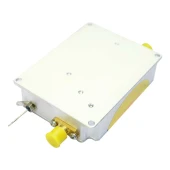
The MY-RF-TTL-90M-2.5W-R2 is a compact, high‑stability acousto‑optic driver and RF power supply specifically designed for 90 MHz acousto‑optic modulators and deflectors. Comparable to industry‑standard AO drivers used in laser modulation, scanning, Q‑switching, and beam shaping systems, this unit delivers up to 2.5 W of RF output power with a tightly controlled carrier frequency of 90 MHz. Its design is optimized for integration into OEM laser systems, laboratory setups, and scientific instruments where fast, clean modulation and repeatable performance are critical.
Operating from a single DC +24 V ±0.5 V supply, the MY-RF-TTL-90M-2.5W-R2 provides a stable RF source with a fixed operating frequency of 90 MHz and a maximum driver output power of at least 2.5 W. The driver supports TTL modulation, allowing straightforward interfacing with digital control electronics such as pulse generators, FPGA boards, and laboratory timing systems. With a driver turn‑off time of less than 70 ns, this unit enables rapid on/off control of the acoustic wave in the AO crystal, supporting applications that demand fast switching, high‑speed pulse picking, and precise timing alignment with laser pulses.
In comparison with similar RF drivers used across photonics and laser processing markets, this model emphasizes spectral purity and signal integrity. A harmonic suppression ratio of at least 25 dBc helps minimize unwanted frequency components, reducing spurious modulation of the optical beam and improving overall system contrast. Such performance is beneficial in high‑resolution laser imaging, fiber‑optic communication experiments, and precision metrology, where extraneous sidebands and RF noise can degrade measurement accuracy or beam quality. The clean RF spectrum also aids in maintaining stable diffraction efficiency in acousto‑optic modulators over extended operating periods.
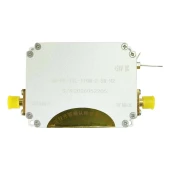
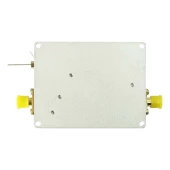
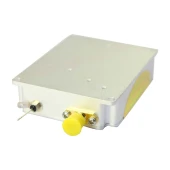
The MY-RF-TTL-90M-2.5W-R2 is equipped with standard RF and control interfaces to simplify system integration. The RF signal output is provided via an SMA‑K (female) connector, which is commonly used in acousto‑optic and RF subsystems for reliable, low‑loss connections to AO cells and coaxial transmission lines. A separate SMA‑K connector is dedicated to the TTL control signal input, ensuring clear segregation between RF power and low‑level control lines. Power is supplied through a feed‑through capacitor interface, supporting low‑noise DC input and enhancing overall electromagnetic compatibility inside compact laser or optical instruments.
For fine optimization of system performance, the driver includes an internal output power adjustment interface using a Ø3 mm multi‑turn slotted potentiometer. This allows technicians or OEM integrators to trim the RF drive level to match the specific acousto‑optic device in use, balancing diffraction efficiency, thermal load, and long‑term reliability. Such adjustability is commonly found in professional‑grade AO drivers deployed in research laboratories, spectroscopy setups, and industrial laser tools, where each AO crystal and optical configuration may require slightly different RF power levels for optimal performance.
Overall, the MY-RF-TTL-90M-2.5W-R2 offers a robust blend of fast TTL modulation, stable 90 MHz operation, and convenient SMA‑based interfacing in a driver power supply tailored for acousto‑optic applications. Its combination of quick turn‑off time, adequate RF power, and harmonic suppression makes it suitable for demanding optical modulation tasks such as high‑speed intensity control, beam switching, pulse shaping, and dynamic beam routing in both free‑space and fiber‑based laser systems.
90MHz 2.5W TTL Acousto-Optic RF Driver Power Supply
Specifications
| Accessory Type: | Driver |
|---|---|
| Model: | MY-RF-TTL-90M-2.5W-R2 |
| Output Signal Frequency: | 90 MHz |
| Operating Frequency: | 90 MHz |
| Operating Voltage: | DC +24 V ±0.5 V |
| Maximum Driver Output Power: | ≥2.5 W |
| Modulation Mode: | TTL |
| Harmonic Suppression Ratio: | ≥25 dBc |
| Driver Turn-off Time: | <70 ns |
| Signal Output Interface: | SMA-K |
| Control Signal Input Interface: | SMA-K |
| Power Supply Interface: | Feed-through capacitor |
| Output Power Adjustment Interface: | Ø3 mm multi-turn slotted potentiometer (internal adjustment) |
Got questions about specs? Use the inquiry form to ask.
 Download Data Sheet

Features
- High-Frequency RF Output – 90 MHz Center Frequency
Optimized 90 MHz output enables precise control of acousto‑optic modulators, deflectors, and frequency shifters commonly used in laser modulation, Q‑switching, and beam steering applications. - High Output Power – ≥ 2.5 W RF Drive
Delivers ≥ 2.5 W RF power, providing strong acoustic excitation for a wide range of acousto‑optic devices, including higher‑power AOMs used in industrial and scientific laser systems. - Fast TTL Modulation Capability
Supports TTL modulation for digital on/off control of RF power, allowing easy integration with pulse generators, digital I/O boards, and timing electronics in laser labs and OEM systems. - Ultra‑Fast Turn‑Off Time < 70 ns
Driver turn‑off time of less than 70 ns enables rapid modulation of laser intensity via the AOM, well‑suited for high‑speed switching, pulse picking, and time‑resolved experiments. - Low Harmonics – ≥ 25 dBc Harmonic Suppression
Harmonic suppression ratio of ≥ 25 dBc reduces unwanted spectral components, helping to minimize spurious diffraction orders and improving beam quality and system stability. - Stable 24 V DC Operation
Designed for a DC +24 V ± 0.5 V supply, providing stable and reliable operation from common industrial and laboratory power sources. - Compact, Integrated RF Driver & Power Supply
Combines RF driver and power supply electronics in a single compact module, simplifying system design and reducing the need for separate RF amplifiers and power conditioning. - SMA RF Output Interface
Uses a standard SMA‑K signal output interface, ensuring easy connection to coaxial cables and acousto‑optic devices, and compatibility with common RF lab infrastructure. - SMA TTL Control Input
Features an SMA‑K control signal input interface for robust, shielded TTL modulation signals, reducing noise pickup and ensuring reliable high‑speed switching. - Feed‑Through Capacitor Power Interface
Power is supplied via a feed‑through capacitor interface, improving filtering and EMI suppression for cleaner operation in electrically noisy environments. - Internal Multi‑Turn Power Adjustment
Equipped with a Ø3 mm multi‑turn slotted potentiometer for internal output power adjustment, allowing fine‑tuning of RF drive level to match the specific acousto‑optic device and application. - Optimized for Acousto‑Optic Modulators and Q‑Switches
Frequency, power level, and modulation performance are tailored for common AOM and AO Q‑switch models around 90 MHz, making this driver a drop‑in solution for many commercial AO devices. - Ideal for OEM Integration and Laboratory Use
Suitable for laser manufacturers, research labs, and system integrators requiring a reliable, ready‑to‑use 90 MHz RF driver with TTL control for precision optical modulation. - Enhanced System Reliability
Solid‑state RF design with controlled operating voltage and harmonic suppression helps maintain long‑term stability, reducing downtime and maintenance in continuous‑use environments.
Applications
- Acousto-Optic Modulators (AOMs) – Driving 90 MHz AOMs in fiber and free-space setups for efficient beam intensity modulation, frequency shifting, and pulse picking in laser systems.
- Q-Switching in Solid-State Lasers – Providing fast TTL-controlled RF drive for acousto-optic Q-switches in Nd:YAG, Nd:YVO4, and similar DPSS lasers to generate high-peak-power pulses.
- Laser Pulse Picking and Gating – Enabling nanosecond-scale turn‑off times for precise selection or suppression of individual pulses from mode-locked or high-repetition-rate laser sources.
- Laser Power Stabilization and Attenuation – Driving AO-based variable attenuators to regulate and stabilize laser output power in research, industrial, and medical laser platforms.
- Frequency Shifting for Interferometry – Generating stable 90 MHz RF drive for AOM-based frequency shifters used in heterodyne interferometers, Doppler velocimetry, and phase-sensitive metrology.
- Optical Communication and Fiber Systems – Providing modulation and switching in fiber-optic links, test beds, and coherent communication experiments using acousto-optic devices at RF frequencies around 90 MHz.
- Laser Scanning and Beam Steering – Driving acousto-optic deflectors (AODs) for rapid, inertia-free beam steering in imaging, microscopy, printing, and material processing systems.
- Time-Resolved Spectroscopy – Enabling gated excitation and detection through AO modulators to achieve precise timing control in fluorescence lifetime, pump–probe, and transient absorption measurements.
- Optical Trapping and Tweezers – Controlling laser beam position and intensity via AODs for dynamic manipulation of particles and cells in optical tweezers and microfluidic experiments.
- Laser Marking and Micromachining – Providing reliable RF drive for AO modulators in high-speed laser marking, cutting, drilling, and microfabrication tools where rapid on/off control is required.
- LIDAR and Time-of-Flight Systems – Modulating laser beams in range-finding, 3D scanning, and atmospheric sensing systems to implement pulse shaping, gating, and frequency shifting.
- Holography and Diffractive Optics – Driving AOMs in dynamic holography setups for real-time control of reference or object beams, and for generating tunable diffraction patterns.
- Optical Coherence Tomography (OCT) – Providing frequency-shifted reference beams via AOMs in swept-source and heterodyne OCT configurations to enhance sensitivity and depth resolution.
- Atomic, Molecular, and Optical Physics Experiments – Controlling laser frequency, intensity, and timing for laser cooling, trapping, and spectroscopy of atoms and ions using AO modulators.
- Quantum Optics and Quantum Information – Implementing fast switching and routing of single-photon or entangled beams through AO devices in quantum communication and quantum sensing setups.
- Fiber Laser Seed Modulation – Driving AO modulators in fiber laser cavities for pulse shaping, repetition-rate control, and amplitude modulation in MOPA (Master Oscillator Power Amplifier) systems.
- Biomedical and Surgical Lasers – Enabling precise temporal and power control of treatment beams in ophthalmic, dermatological, and surgical laser platforms using AO-based modulation.
- Laser Safety Shutters and Interlocks – Implementing high-speed electronic shutters with AO modulators to protect sensitive components and ensure operator safety in laboratory and industrial environments.
- RF Test and Measurement for AO Devices – Serving as a dedicated, matched RF driver in AO device characterization lines for measuring diffraction efficiency, response time, and thermal behavior.
- Education and R&D Laboratories – Providing a compact, 24 V DC powered RF driver solution for university and research labs working on photonics, acousto-optics, and laser system development.
Frequently Asked Questions
What is the MY-RF-TTL-90M-2.5W-R2 acousto‑optic driver power supply used for?
What are the key electrical and RF specifications of the MY-RF-TTL-90M-2.5W-R2 driver?
How is the MY-RF-TTL-90M-2.5W-R2 connected to an acousto‑optic modulator and to the control electronics?
Can the MY-RF-TTL-90M-2.5W-R2 safely drive my acousto‑optic modulator?
How fast can I modulate the acousto‑optic device with this TTL RF driver?
What are the power supply and grounding requirements for the MY-RF-TTL-90M-2.5W-R2?
How do I adjust and optimize the RF output power for my acousto‑optic system?
Got more questions? Use the inquiry form to ask the supplier directly.
Similar Products


Your inquiry has been received.
Create an account by adding a password
Why create an account?
- Auto-complete inquiry forms
- View and manage all your past messages
- Save products to your favorites
- Close your account anytime — no hassle