
Description
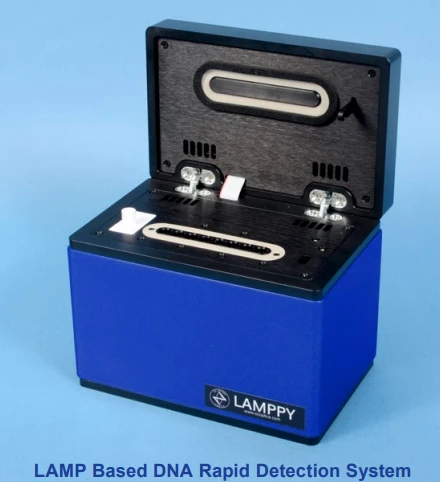
The LAMPPY™ Universal Optical DNA Rapid Detection System is an advanced, isothermal molecular diagnostics platform designed for rapid, real-time detection of viral, bacterial, and fungal DNA/RNA. Built around Loop-mediated Isothermal Amplification (LAMP), this compact system offers a powerful alternative to conventional qPCR instruments by eliminating the need for complex thermal cycling. Laboratories, clinics, field-testing teams, and research facilities can obtain highly sensitive and specific results in as little as 20 minutes, enabling faster decision-making in critical diagnostic and screening scenarios.
Unlike traditional PCR-based analyzers that require precise and repeated temperature changes, LAMPPY™ operates at a constant temperature, significantly streamlining both the hardware and workflow. This isothermal approach allows the instrument to be smaller, more robust, and a fraction of the cost of conventional qPCR systems, while still delivering comparable analytical performance. It is particularly suited for the rapid detection of pathogens such as Covid-19, SARS, Ebola, Cholera, and Salmonella, as well as a wide spectrum of other microbial targets in clinical, environmental, and food safety applications.
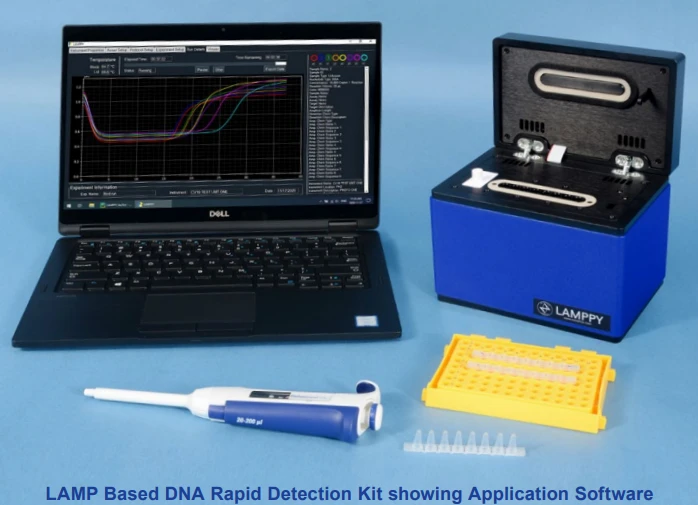
At the core of the LAMPPY™ system is an integrated optical engine featuring an array of high-powered LEDs, sensitive photodiodes, and optimized optical filters that enable real-time quantitative monitoring of nucleic acid amplification. Fluorescence or intercalating dye signal is continuously measured throughout the reaction, allowing the user to track amplification curves and threshold times rather than relying solely on end-point measurements. The accompanying intuitive software displays this data in real time, providing clear visualization of amplification kinetics and offering built-in melt analysis capabilities for enhanced specificity and assay verification.
The instrument’s design emphasizes practicality and portability. A compact footprint and modular architecture facilitate easy cleaning, routine maintenance, and integration into existing laboratory workflows or portable diagnostic kits. LAMPPY™ can be operated with an external battery, transforming it into a field-deployable solution for point-of-care testing, outbreak investigation, and on-site screening where mains power or large benchtop analyzers are not available. Wireless communication via dual-band Wi-Fi and Bluetooth enables seamless connection to laptops, tablets, or compatible mobile devices, enhancing flexibility in both fixed and mobile testing environments.
Sample handling is designed for efficiency and throughput. The standard configuration allows users to process up to 8 samples simultaneously, with higher-capacity variants available upon request to accommodate up to 96 samples. This scalability makes the LAMPPY™ series suitable for low- to medium-throughput laboratories, as well as for institutions that anticipate growth in testing volume. Typical workflows involve mixing the sample with primers, enzymes, intercalating dye, and reaction buffer, after which the mixture is placed into the instrument’s temperature-controlled block. An integrated lid heater minimizes condensation and evaporation, improving reaction consistency and reproducibility across wells.
In comparative performance evaluations, LAMPPY™ has demonstrated sensitivity, specificity, and overall accuracy on par with leading qPCR platforms when using properly validated LAMP-based assay kits. For example, in a clinical study performed at Acibadem University using saliva samples from hospital patients, LAMPPY™ was directly compared to a recognized qPCR system with both instruments running the same LAMP assay for SARS-CoV-2. The results showed closely matched diagnostic performance metrics, confirming that a well-designed isothermal optical platform can achieve high-quality molecular diagnostic outcomes while dramatically reducing instrument complexity, footprint, and cost.
Because of its rapid turnaround time, ease of use, and strong analytical performance, the LAMPPY™ Universal Optical DNA Rapid Detection System is well suited for a wide array of applications. These range from frontline screening and diagnosis of infectious diseases to routine monitoring of food and water for microbial contamination, molecular biology and genetics research, and use as a precise dry block incubator for temperature- controlled amplification protocols. Its combination of speed, affordability, and portability positions LAMPPY™ as a compelling choice for laboratories and organizations seeking to expand their molecular testing capabilities without the high investment and stringent infrastructure requirements associated with conventional qPCR technologies.
LAMPPY Universal Optical DNA Rapid Detection System for Pathogens
Specifications
| Electrical Dynamic Range: | 120 dB |
|---|---|
| Optical Dynamic Range: | 60 dB |
| Excitation Wavelength: | 478 nm |
| Excitation Wavelength Bandwidth (FWHM): | 20 nm |
| Detection Wavelength Range: | 500 – 595 nm |
| Operational Temperature Range: | 18 – 94 degC |
| Detection Method: | Isothermal DNA/RNA amplification (LAMP – Loop-mediated Isothermal Amplification) |
| Target Types: | Viral, fungal, and bacterial DNA/RNA |
| Example Pathogens: | Covid-19, SARS, Ebola, Cholera, Salmonella |
| Detection Time: | As little as 20 minutes |
| Typical Result Time: | Usually within 30 minutes |
| High Viral Load Result Time: | Less than 20 minutes |
| Sample Capacity: | Up to 8 samples simultaneously |
| Higher Throughput Option: | Up to 96 samples (available upon request) |
| Optical Components: | Array of high powered LEDs, photodiodes, and filters |
| Connectivity: | Dual-band Wi‑Fi and Bluetooth |
| Power Option: | Can be paired with an external battery for portable use |
| Lid Feature: | Lid heater to prevent evaporation and condensation |
| Analysis Capability: | Real-time quantitative detection with melt analysis |
| System Type: | Universal optical DNA rapid detection system |
| Model / Series: | LAMPPY™ Series |
| Application Areas: | Infectious disease screening and diagnosis; food and water microbe testing; molecular biology research; dry block incubator |
| Comparative Cost: | A fraction of the cost of qPCR-based systems |
Got questions about specs? Use the inquiry form to ask.
 Download Data Sheet

Features
- Universal DNA/RNA Detection for Multiple Pathogens – Detects viral, bacterial, and fungal DNA/RNA including COVID‑19, SARS, Ebola, Cholera, Salmonella and a wide range of other infectious agents for clinical, environmental, and food safety testing.
- Ultra‑Fast Results in as Little as 20 Minutes – Isothermal amplification (LAMP) delivers rapid qualitative and quantitative results, typically within 20–30 minutes, significantly reducing turnaround time compared to conventional PCR and qPCR systems.
- High Sensitivity and Specificity at Low Viral Loads – LAMP‑based detection offers PCR‑level sensitivity and specificity, enabling reliable detection of low copy numbers of target nucleic acids for early-stage infection monitoring and screening.
- Cost‑Effective Alternative to qPCR – Eliminates the need for complex thermal cycling, making it significantly more affordable than standard qPCR platforms in terms of both instrument cost and operational expenses.
- Real‑Time Fluorescence Monitoring – Integrated high‑power LEDs, photodiodes, and optical filters provide real‑time quantitative fluorescence data, allowing users to monitor amplification curves as the reaction progresses.
- Integrated Melt Curve Analysis – Built‑in software supports melt analysis for verification of amplification products and improved assay specificity, comparable to higher‑end real‑time PCR systems.
- Intuitive, User‑Friendly Software Interface – Easy‑to‑use software displays live amplification curves, threshold settings, and melt profiles, streamlining workflow for laboratory technicians and non‑specialist users.
- Dry Block Incubator Functionality – Stable isothermal control enables use as a dry block incubator for nucleic acid amplification and other temperature‑sensitive molecular biology protocols.
- Compact, Modular Benchtop Design – Small footprint and modular construction facilitate easy cleaning, servicing, and integration into crowded laboratory benches or mobile diagnostic stations.
- Portable and Field‑Deployable – Can be paired with an external battery to create a fully portable solution for on‑site testing in remote locations, field clinics, border control, agriculture, and environmental surveillance.
- Multi‑Sample Throughput – Standard configuration supports up to 8 samples simultaneously, with higher throughput options (up to 96 samples) available on request to meet clinical and high‑volume testing needs.
- Wireless Connectivity and Data Transfer – Equipped with dual‑band Wi‑Fi and Bluetooth for seamless data export, remote monitoring, integration with LIMS, and simplified result sharing.
- Lid Heater to Prevent Evaporation and Condensation – Heated lid minimizes condensation on tube caps, ensuring consistent reaction volumes and more reproducible amplification results.
- Validated Performance vs. Leading qPCR Systems – Clinical comparison studies (e.g., at Acibadem University using saliva samples) demonstrate comparable sensitivity, specificity, and accuracy to established qPCR platforms while offering faster and more economical operation.
- Broad Application Range – Ideal for infectious disease screening and diagnosis, food and water microbiological testing, environmental monitoring, and molecular biology research, supporting both routine diagnostics and R&D.
- Reduced Infrastructure Requirements – Isothermal technology eliminates the need for advanced thermal cyclers and extensive lab infrastructure, enabling deployment in low‑resource or decentralized testing environments.
- OEM and Private Label Options – Available for private labelling and OEM integration, enabling diagnostic companies and system integrators to incorporate the LAMPPY™ platform into customized product offerings.
- Optimized for LAMP and Isothermal Assays – Specifically designed for Loop‑mediated Isothermal Amplification (LAMP) and related isothermal chemistries, supporting rapid assay development for emerging pathogens and custom targets.
Applications
- Point-of-care infectious disease diagnostics – Rapid screening and confirmation of viral, bacterial, and fungal pathogens (including COVID‑19, SARS, Ebola, Cholera, Salmonella, influenza, RSV, and emerging infectious diseases) in decentralized clinics, urgent care centers, and physician offices.
- Hospital and clinical laboratory testing – High‑sensitivity nucleic acid detection for respiratory panels, sepsis panels, gastrointestinal pathogens, and nosocomial infections, as a cost‑effective alternative to qPCR in routine diagnostic labs.
- Public health surveillance and outbreak monitoring – Field‑deployable screening of populations for pandemic preparedness, contact tracing campaigns, and early detection of community spread in urban, rural, and resource‑limited settings.
- Mobile and field‑deployable molecular testing – Battery‑powered operation for on‑site DNA/RNA analysis at border control, refugee camps, airports, seaports, and mass‑gathering events where rapid decisions are critical.
- Veterinary diagnostics – Detection of viral and bacterial diseases in livestock, poultry, aquaculture, and companion animals (e.g., avian influenza, foot‑and‑mouth disease, swine pathogens, fish pathogens) to support herd health and biosecurity.
- Food safety and quality control – Rapid screening of food products and raw materials for contamination by Salmonella, Listeria, E. coli, Campylobacter, and other foodborne pathogens in meat, dairy, produce, and ready‑to‑eat foods.
- Water and environmental microbiology testing – Monitoring of drinking water, wastewater, recreational water, ballast water, and process water for microbes such as Vibrio cholerae (Cholera), Salmonella, Legionella, coliforms, and fecal indicators.
- Agricultural and plant pathogen detection – On‑site identification of plant diseases caused by bacteria, fungi, and viruses in crops, greenhouses, and seed lots to protect yields and enable precision agriculture practices.
- Biothreat and biodefense monitoring – Rapid DNA/RNA detection for biosurveillance programs, early warning of biological threats, and verification of suspect samples in security, military, and emergency response environments.
- Molecular biology and genomic research – Real‑time amplification monitoring, melt curve analysis, and assay development for gene expression studies, genotyping, SNP analysis, and target validation in academic and industrial laboratories.
- Assay and kit development (OEM/private label) – Integration as a core detection engine for custom LAMP‑based test kits, multiplex panels, and branded molecular diagnostic platforms through OEM and private‑label partnerships.
- Educational and training laboratories – Hands‑on molecular diagnostics training in universities, teaching hospitals, and technical programs, using a compact, affordable alternative to conventional qPCR systems.
- Dry block incubation and isothermal amplification workflows – Use as a dry block incubator for LAMP, RPA, and other isothermal amplification protocols where constant temperature and lid heating minimize evaporation and condensation.
- Pharmaceutical and biotech QC testing – In‑process and final product testing for microbial contamination, cell line authentication, and rapid sterility checks during bioprocessing, vaccine production, and biologics manufacturing.
- Wastewater‑based epidemiology – Community‑level surveillance of viral load (e.g., SARS‑CoV‑2, enteric viruses) in sewage samples to provide early indicators of infection trends and to complement clinical testing data.
- Remote and low‑infrastructure settings – Reliable DNA/RNA detection in field labs, mobile clinics, and rural health posts where access to conventional thermal cyclers and complex qPCR instruments is limited.
- Clinical evaluation and method comparison studies – Use alongside standard qPCR platforms in validation studies, sensitivity/specificity benchmarking, and clinical trials comparing LAMP performance to established molecular methods.
Frequently Asked Questions
What is the LAMPPY™ LAMP-based DNA rapid detection system and what pathogens can it detect?
How does the LAMPPY™ LAMP system work compared to traditional PCR or qPCR machines?
How fast and accurate is the LAMPPY™ system for COVID‑19 and other infectious disease testing?
What are the main applications of the LAMPPY™ LAMP based DNA rapid detection system?
How many samples can LAMPPY™ process at once, and are higher throughput models available?
What makes LAMPPY™ suitable for portable and field‑deployable pathogen detection?
What software features and OEM options are available for the LAMPPY™ DNA detection system?
Got more questions? Use the inquiry form to ask the supplier directly.
Your inquiry has been received.
Create an account by adding a password
Why create an account?
- Auto-complete inquiry forms
- View and manage all your past messages
- Save products to your favorites
- Close your account anytime — no hassle