
Description
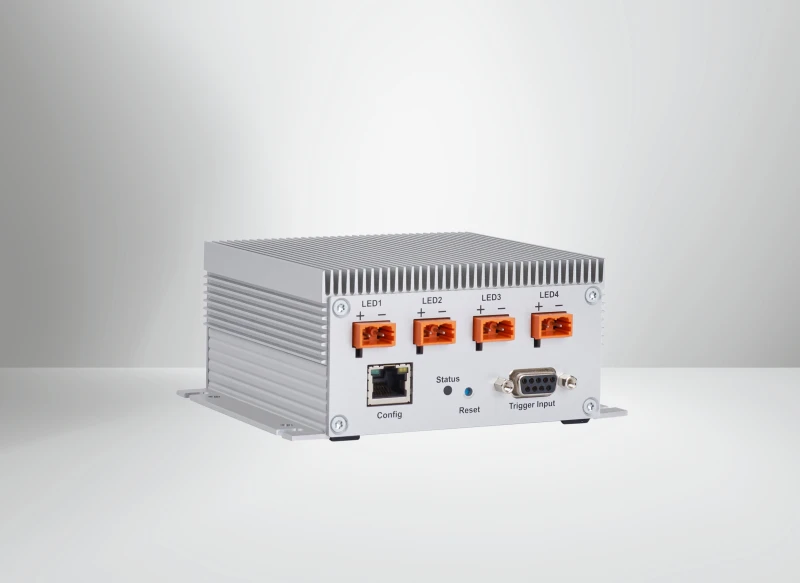
The 4-channel digital LED pulse controller is engineered for demanding machine vision, scientific imaging, and OEM illumination systems that require precise control of high-power LEDs and LED arrays. Unlike simple LED drivers or basic strobe controllers, this unit offers finely tunable current, pulse length, and timing for each channel independently, enabling highly repeatable and application-specific lighting profiles. With constant current outputs and sophisticated monitoring, it supports both continuous and pulsed operation of powerful LEDs in industrial and laboratory environments.
Designed for use with camera-based inspection systems, industrial image processing setups, high-speed LED lighting, and stroboscopic or hyperspectral illumination, this controller can be pulsed up to 100 kHz while maintaining excellent pulse stability and minimal overshoot. This makes it particularly suitable for short-exposure, high-frame-rate imaging where precise synchronization between light and camera is essential. The controller’s ability to deliver up to 30 A of LED current (depending on version and operating mode) ensures that even high-intensity LED modules and multi-die LED clusters can be driven at optimal brightness levels.
Each of the four output channels operates as an independent constant-current source with its own configurable parameters. Users can adjust current setpoints in fine increments, define pulse lengths and delays across a wide range from microseconds to seconds, and choose channel-specific operating modes such as OFF, Steady, Follow, or externally triggered pulse operation (single or repeat). This flexibility enables advanced lighting strategies, such as sequential illumination for multi-angle inspection, multiplexed wavelength switching in multispectral or hyperspectral systems, and tailored strobe sequences for motion-freeze applications in production lines.
The controller is available in a Standard and a High-Resolution variant to match different application requirements. The Standard version supports currents up to 30 A with step sizes in the milliamp range, making it an excellent choice for driving powerful LED arrays and high-intensity flash illumination in pulsed mode, while still supporting continuous outputs up to several amperes. The High-Resolution version focuses on ultra-fine current control up to 3 A with higher setting precision, ideal for applications where exact intensity balancing, linearity, and repeatability are critical, such as calibrated imaging setups or sensitive optical measurements.
High electrical efficiency of up to approximately 97% and carefully optimized power electronics help to minimize heat generation and ensure stable operation over long duty cycles. Fast rise and fall times in the microsecond range allow the creation of nearly square pulses with low overshoot, which is especially important when driving LEDs near their performance limits or when precise temporal profiles are required. Coupled with low jitter in both pulse length and delay, this ensures that every exposure is illuminated identically, improving measurement accuracy and repeatability in automated inspection and metrology systems.
Built-in monitoring and protective functions add an important safety and reliability layer: the device continuously supervises LED current, housing and internal temperatures, and key operating parameters such as pulse length and current. This helps protect connected LEDs from overcurrent or excessive thermal load, and supports stable long-term operation even under intensive pulsed regimes. The wide supply voltage range allows flexible integration into existing power infrastructures, while the output voltage range adapts to different LED forward voltages and string configurations.
Integration into control architectures is streamlined through digital interfaces such as Ethernet or USB, enabling straightforward connection to PCs, industrial controllers, or custom OEM control software. Supplied configuration and control software facilitates setup of all four channels, making it easy to define and store complex timing patterns, current profiles, and trigger configurations without deep hardware programming expertise. For automated systems, these interfaces support remote configuration, monitoring, and synchronization with external triggers or camera signals, which is a key requirement in modern machine vision installations.
The compact design and relatively low weight allow flexible mounting in control cabinets or directly on machinery. Mounting holes and DIN rail clips enable quick mechanical integration into standard industrial environments.
4 Channel Digital LED Pulse Controller for High Speed Industrial Lighting
Specifications
| Driver Type: | CW, Pulsed, CW + Pulsed |
|---|---|
| Number Of Channels: | 4 |
| Max Output Current: | 30 Max Output Current (A) |
| Max Pulse Frequency: | 100 kHz |
| Supply Voltage: | 9 – 48 VDC |
| Standard Variant Pulsed Current: | up to 30 A pulsed |
| Weight: | 0.5 kg |
| Mounting: | Mounting holes, clip for DIN rails |
| Ambient Temperature: | 0 to 40 °C |
| Interfaces: | Ethernet or USB |
| Monitoring: | LED current, housing temperature, internal temperatures, pulse length/current parameters |
| Pulse Delay Jitter: | < 0.1 μs |
| Pulse Delay Range: | 5 μs to 60 s |
| Pulse Length Jitter: | < 0.1 μs |
| Pulse Length Adjustment Range: | 5 μs to 60 s |
| High-Resolution Variant Pulsed Current: | up to 3 A pulsed |
| High-Resolution Variant DC Current: | up to 1.5 A DC |
| High-Resolution Variant Output Current Range: | 0 to 3 A in 1 mA steps |
| Number Of Channels: | 4 independent constant current outputs |
| Standard Variant Continuous Current: | up to 5 A CW |
| Standard Variant Output Current Range: | 0 to 30 A in 8 mA steps |
| Total Power Dissipation: | 10 W |
| Output Voltage: | 0 to Vin - 1 V |
| Efficiency: | up to 97 % |
| Fall Time (t90-10): | 1 μs |
| Rise Time (t10-90): | 3 μs |
| Trigger Input High Level: | 2.4 to 5 V |
| Trigger Input Low Level: | 0 to 0.8 V |
Got questions about specs? Use the inquiry form to ask.
 Download Data Sheet

Features
- 4 Independent High-Power LED Channels – Control up to four separate high-power LEDs or LED groups, each with fully independent parameter settings for maximum flexibility in multi-channel lighting setups.
- Ultra-Fast Pulsed Operation up to 100 kHz – Designed as a high‑speed digital LED pulse controller for demanding machine vision, stroboscopic and high‑speed imaging applications with pulse frequencies up to 100 kHz.
- High Current Drive up to 30 A per Channel – Standard variant supports LED currents from 0 to 30 A (up to 5 A continuous, up to 30 A pulsed), enabling intense, short‑duration light pulses for high‑intensity illumination.
- High-Resolution Current Control in mA Steps – Fine, software-defined current adjustment:
- Standard version: 0–30 A in 8 mA steps
- High‑Resolution version: 0–3 A in 1 mA steps
- Extremely Stable, Square Pulse Shapes – Low overshoot and optimized driver electronics ensure near‑ideal square pulses with excellent reproducibility of the pulse shape, crucial for quantitative imaging and time‑critical measurements.
- Fast Rise and Fall Times – Rise time (10–90%) of approx. 3 µs and fall time (90–10%) of approx. 1 µs enable sharp, well‑defined pulses for high‑speed camera synchronization and stroboscopic illumination.
- Wide Pulse Length and Delay Range – Software‑configurable pulse length and delay from 5 µs to 60 s per channel with jitter < 0.1 µs, offering precise temporal control from very short flashes to long exposures.
- Multiple Operating Modes per Channel – Each channel can be configured independently in OFF, Steady, Follow or PULSE mode (external trigger, single shot or repeat), enabling flexible sequencing and complex illumination patterns without extra hardware.
- High Efficiency Power Conversion – Efficiency up to 97% (Pout / Pin) minimizes heat generation and energy loss, supporting reliable operation in compact systems and control cabinets.
- Wide Input Voltage Range – Accepts a supply voltage from 9 to 48 V DC, simplifying integration into a broad variety of industrial and OEM power infrastructures.
- Integrated Monitoring and Protection – Continuous monitoring of LED current, housing and internal temperatures, as well as pulse length and current parameters, helps protect LEDs and electronics from overload, overheating or misconfiguration.
- Constant Current Outputs for LED Safety – Four independent constant current outputs with parameter monitoring ensure stable LED operation, improved lifetime and consistent optical output even under varying supply conditions.
- Precision Timing for Machine Vision – Low jitter (< 0.1 µs) and accurate timing control make this LED pulse controller ideal for camera-based inspection, industrial image processing and synchronized multi‑channel illumination.
- Ideal for High-Speed and Hyperspectral Imaging – Optimized for high‑speed LED lighting, stroboscopic illumination and hyperspectral imaging systems where repeatable, short pulses and programmable spectral sequences are critical.
- Ethernet or USB Connectivity – Modern digital interfaces (Ethernet or USB) allow simple integration into PC‑based control systems, machine vision software and automated test setups.
- Intuitive PC Software Included – Comes with operating software for convenient configuration of current, pulse width, delay and operating modes, as well as real‑time monitoring and diagnostics of all four channels.
- Compact, OEM-Friendly Design – Lightweight (approx. 0.5 kg) with a small footprint, suitable for integration into control cabinets, OEM equipment, laboratory setups and production lines.
- Flexible Mounting Options – Equipped with mounting holes and clips for DIN rails, allowing rapid installation in industrial environments and standardized 19" or cabinet systems.
- Broad Ambient Temperature Range – Designed for reliable operation from 0 to 40 °C, covering typical conditions in labs, cleanrooms, inspection stations and factory environments.
- Adjustable Output Voltage Range – Output voltage from 0 up to (Vin – 1 V) supports a wide variety of LED stacks and forward voltages while maintaining constant current control.
- Low Total Power Dissipation – Total power dissipation of 10 W supports cooler operation, less thermal stress and easier thermal management in compact system designs.
Applications
- Machine Vision & Industrial Image Processing
- Precise stroboscopic illumination for high-speed production line inspection
- Trigger-synchronized LED lighting for line-scan and area-scan cameras
- Defect detection in electronics, PCB assembly and semiconductor packaging
- Dimensional and surface inspection of metals, plastics, glass and textiles
- Code reading and OCR under controlled pulsed illumination
- Multi-angle and multi-channel lighting control for 3D machine vision systems
- High-Speed Imaging & Motion Analysis
- High-speed camera illumination in R&D and quality control labs
- Freeze-frame imaging of fast-moving parts, drops, sprays and rotating tools
- Ballistics and impact testing with microsecond LED pulses
- Vibration and modal analysis with synchronized strobe lighting
- Sports motion analysis and biomechanics studies with flicker-free pulses
- Stroboscopic & Pulsed Illumination
- Strobe lighting for rotating machinery inspection (shafts, gears, turbines)
- Inspection of printing presses, webs and packaging films at line speed
- Pulsed backlight and bright-field / dark-field illumination
- Phase-locked stroboscopy for process monitoring and synchronization
- Replacement of xenon flash lamps with high-power pulsed LEDs
- Hyperspectral, Multispectral & Fluorescence Imaging
- Time-controlled illumination for line-scan hyperspectral cameras
- Sequential control of different wavelength LED channels (VIS, NIR, UV)
- Food sorting and agricultural product inspection using multispectral lighting
- Fluorescence excitation with short, high-current LED pulses
- Raman and photoluminescence set-ups using modulated LED sources
- Scientific & Laboratory Applications
- Optical experiments requiring defined pulse length, delay and amplitude
- Time-resolved spectroscopy with microsecond-level timing control
- Photobiology and photochemistry with programmable light dose profiles
- Pulsed excitation in microscopy, microfluidics and flow cytometry
- Synchronization of LED light sources with laboratory instrumentation via trigger inputs
- Medical & Life Science Imaging
- Illumination control for diagnostic imaging systems and endoscopy
- High-speed LED pulsing for ophthalmic imaging and fundus cameras
- Fluorescence and luminescence imaging in life science instruments
- Optogenetics and neural stimulation with precisely timed LED pulses
- Photoactivation, photobleaching and phototherapy research
- Automation, Robotics & Smart Factory
- LED lighting for robotic vision and pick-and-place systems
- Dynamic illumination in smart cameras and embedded vision systems
- Position and presence detection with synchronized LED strobes
- Barcode, DMC and label verification on moving objects
- Condition monitoring of automated assembly and packaging lines
- Electronics, Semiconductor & PCB Inspection
- Solder joint, BGA and lead inspection with angle-selective lighting
- Wafer and die inspection using short, high-current LED pulses
- Micro-crack and contamination detection on reflective surfaces
- Conformal coating and bonding inspection under UV and visible LEDs
- Failure analysis and reliability testing with reproducible light profiles
- Printing, Packaging & Web Inspection
- Print registration and color inspection at high web speeds
- Detection of misprints, streaks and label defects
- Inspection of foils, films, nonwovens and paper
- Verification of security printing and special inks using UV / VIS LEDs
- Edge, splice and tear detection under pulsed illumination
- Traffic, Security & Surveillance
- ANPR / LPR camera illumination with synchronized LED pulses
- Red-light and speed enforcement systems using high-power LEDs
- IR and NIR pulsed lighting for covert surveillance and monitoring
- Gate, tunnel and toll system imaging with multi-channel LED control
- Event-triggered illumination to reduce power consumption and glare
- Test, Measurement & Production Test Benches
- LED lifetime, stress and reliability testing with programmable pulse patterns
- Characterization of LED modules, COBs and light engines
- Electronic device testing that requires synchronized optical stimuli
Frequently Asked Questions
What is the LEJ 4‑channel LED Pulse Controller and what is it used for?
What are the key performance specifications of this LED pulse controller?
What is the difference between the Standard and High‑Resolution variants?
Which operating modes and triggering options does the LED Pulse Controller support?
How do I connect and control the 4‑channel LED Pulse Controller (interfaces and software)?
What safety and monitoring features does the LED Pulse Controller provide?
How does this LED Pulse Controller compare to other machine vision LED drivers?
Got more questions? Use the inquiry form to ask the supplier directly.
Your inquiry has been received.
Create an account by adding a password
Why create an account?
- Auto-complete inquiry forms
- View and manage all your past messages
- Save products to your favorites
- Close your account anytime — no hassle