
Description
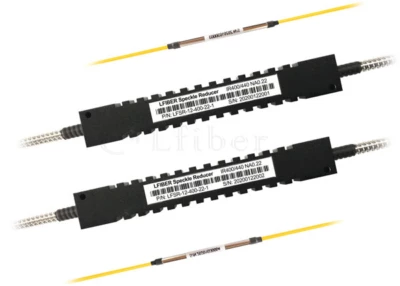
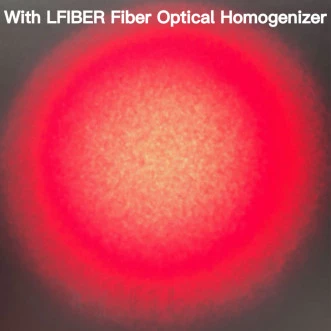
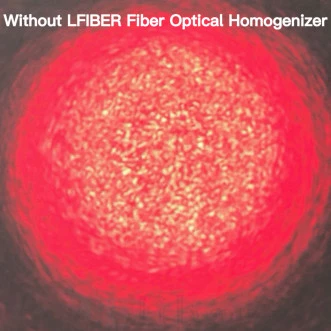
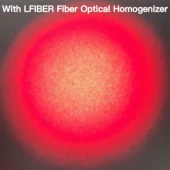
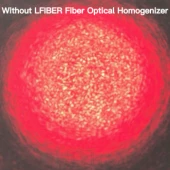
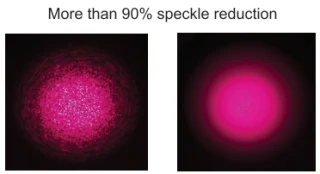
The in-line fiber speckle reducer (also known as a fiber beam homogenizer) is a passive, all-fiber component designed to significantly improve the quality of multimode laser beams. By efficiently scrambling the modal distribution inside the fiber, this device reduces speckle noise, hot spots, striations, and other forms of beam non-uniformity that commonly degrade performance in high-precision laser applications. The result is a smoother, more uniform intensity profile at the fiber output, enabling more consistent and repeatable interaction with targets, substrates, or downstream optics.
Unlike free-space speckle reduction techniques that rely on moving parts, diffusers, or complex optical assemblies, this in-line solution is fully contained within the fiber path. It leverages a carefully engineered multimode fiber structure to redistribute optical power over the entire core, homogenizing the beam with high transmission efficiency (typically ≥ 90%). Because the design is all-fiber and fully passive, it delivers high stability, low maintenance, and excellent robustness against environmental changes such as vibration or temperature fluctuations. This makes it particularly suitable for industrial and OEM integrations where long-term reliability is critical.
The in-line fiber speckle reducer is optimized for broad spectral coverage, supporting operating wavelengths from 400 nm to 1800 nm. This wide range allows it to be used with a variety of laser sources, including visible, near-infrared, and short-wave infrared systems commonly found in laser illumination, imaging, and materials processing. Available fiber core/cladding sizes include 105/125 μm, 200/220 μm, 300/330 μm, 400/440 μm, 600/660 μm, and 800/830 μm with a numerical aperture of 0.22, ensuring compatibility with many standard multimode fiber-coupled diode and solid-state laser platforms. By matching the device parameters to the laser and system geometry, integrators can maintain good coupling efficiency while effectively mitigating speckle-related artifacts.
The more uniform beam profile delivered by this homogenizer is especially valuable in laser material processing tasks such as cutting, welding, marking, scribing, drilling, and surface treatment. In these applications, non-uniform intensity can cause uneven energy deposition, leading to inconsistent feature dimensions, variable surface finishes, or localized overheating. By smoothing out hot spots and filling in low-intensity regions, the in-line fiber speckle reducer helps improve process repeatability, edge quality, and overall throughput. It can also enhance the effective depth of field and process window in systems where the beam is scanned or imaged over larger fields.
Beyond industrial processing, the component is also well suited for machine vision illumination, microscopy, projection, and scientific imaging where speckle noise degrades contrast and measurement accuracy. Many high-brightness LED and laser-based lighting systems use multimode fibers to route light to the point of use; however, the resulting speckle patterns and striations can be problematic for cameras and sensors. By deploying this in-line speckle reducer near the output, integrators obtain a smoother, more uniform illumination field that improves image quality, detection sensitivity, and quantitative analysis. The device is equally relevant in biomedical optics, spectroscopy setups, and metrology systems that rely on stable, uniform fiber-delivered light.
For easy integration into different platforms, the speckle reducer is offered with a range of mechanical and fiber interface options. It can be packaged in a compact steel tube or box-style housing, supporting a variety of deployment scenarios from benchtop prototypes to tightly packed OEM modules. Input and output fiber pigtails are available in standard lengths such as 0.5 m, 1.0 m, 1.5 m, and 2.0 m or customized upon request. Jacket and tubing options include bare fiber (without jacket), 900 μm loose tube, and 2.0 mm or 3.0 mm cable constructions, enabling integrators to choose the right balance between flexibility, ruggedness, and footprint. The device can be terminated with common connector types including no connector, SC/PC, FC/PC, ST, SMA905, and others to match existing system hardware.
Because performance requirements vary across applications, the in-line fiber speckle reducer is available in a customizable configuration. Users can specify parameters such as fiber core diameter, numerical aperture, operating wavelength band, connector style, pigtail length, and packaging format to align precisely with their laser source and system layout. This tailored approach ensures that the speckle reduction performance, transmission efficiency, and mechanical integration all meet the demands of the target application. As system requirements evolve, the
In Line Fiber Speckle Reducer Beam Homogenizer for Multimode Lasers
Specifications
| Wavelength: | 400 – 1800 nm |
|---|---|
| Typical Power Loss: | 5 % |
| Fiber Core/Cladding (μm): | 105/125, 200/220, 400/440 |
| Numerical Aperture: | 0.22 |
| Transmission Efficiency: | ≥90% |
| Input/output Connectors: | No connectors, SC/PC, FC/PC, ST, SMA 905, etc. |
Got questions about specs? Use the inquiry form to ask.
 Download Data Sheet

Features
- High-Efficiency Speckle Reduction – Effectively suppresses laser speckle noise, hot spots, and modal interference to deliver a smoother, more uniform output beam profile.
- True In-Line All-Fiber Design – All-fiber, fully passive structure integrates directly into multimode fiber lines without free-space optics, simplifying alignment and system integration.
- Beam Homogenization for Multimode Lasers – Converts non-uniform, speckled multimode laser outputs into homogenized beams with improved intensity uniformity across the spot.
- High Transmission Efficiency (≥ 90%) – Optimized design minimizes insertion loss, maintaining high optical throughput for power-sensitive applications.
- Broad Wavelength Range (400–1800 nm) – Supports a wide spectral range, making it suitable for visible, NIR, and IR laser sources including diode, fiber, and solid-state lasers.
- Supports Multiple Fiber Core Sizes – Available in common multimode core/cladding sizes: 105/125, 200/220, 300/330, 400/440, 600/660, and 800/830 μm for easy compatibility with existing systems.
- Standard 0.22 NA Multimode Interface – Designed for 0.22 numerical aperture multimode fibers, enabling straightforward integration with typical high-power delivery fibers.
- Compact and Rugged Package Options – Offered in robust steel tube or protective box housings suitable for both benchtop setups and OEM integration.
- Flexible Fiber Jacket and Cable Options – Choice of bare fiber, 900 μm loose tube, or 2.0/3.0 mm cable to match laboratory, industrial, or field deployment requirements.
- Customizable Fiber Pigtail Lengths – Standard input/output pigtails from 0.5 m to 2.0 m (and longer on request) for easy routing inside instruments or systems.
- Wide Connector Compatibility – Available with no connector, SC/PC, FC/PC, ST, SMA905, and other common terminations to fit existing laser and delivery assemblies.
- Passive, Maintenance-Free Operation – No moving parts, electronics, or active control; provides stable performance without recalibration or periodic maintenance.
- High Reliability and Long-Term Stability – Engineered for stable speckle suppression and beam quality over time, suitable for continuous operation in demanding environments.
- Improved Process and Imaging Quality – Reduces speckle artifacts that degrade laser material processing, microscopy, imaging, and illumination uniformity.
- Ideal for Laser Material Processing – Homogenized beam profile enhances cutting, welding, marking, and surface treatment consistency on metals, polymers, and other materials.
- Enhanced Illumination for Machine Vision – Produces uniform fiber-delivered illumination for machine vision, inspection, and quality control systems, minimizing image non-uniformities.
- Better Performance in Bio-Imaging & Microscopy – Reduces speckle-induced contrast and noise in confocal, widefield, and fluorescence microscopy when using multimode laser illumination.
- Compatible with High-Power Multimode Sources – Designed to handle typical high-power multimode laser outputs (within specified limits), suitable for industrial and scientific use.
- Seamless OEM and System Integration – Compact footprint, standard fiber interfaces, and customizable specifications make it ideal for integration into commercial instruments and laser systems.
- Custom-Engineered Solutions Available – Parameters such as core size, NA, wavelength band, connectors, cable type, and package can be tailored for specific applications and performance requirements.
Applications
- Laser Material Processing and Micromachining
Essential for applications such as laser cutting, welding, drilling, scribing, and surface texturing where a highly uniform energy distribution improves process consistency, cut quality, and edge smoothness. The in-line fiber speckle reducer minimizes hot spots and striations, reducing thermal damage, burn marks, and micro-cracks in metals, ceramics, glass, and polymers. - Laser Marking, Engraving, and Additive Manufacturing
Provides a homogenized beam for precision laser marking and engraving on metals, plastics, and semiconductors, resulting in more consistent marking depth and contrast. In metal 3D printing and additive manufacturing, uniform illumination improves melt pool stability, dimensional accuracy, and surface finish of printed parts. - Flat-Field Illumination for Machine Vision and Inspection
Used in machine vision lighting systems to generate uniform, speckle-free illumination over cameras’ fields of view. Ideal for defect inspection, pattern recognition, and dimensional measurement in electronics manufacturing, wafer inspection, PCB inspection, glass and film inspection, and high-speed industrial vision systems. - Microscopy, Confocal and Multiphoton Imaging
Improves uniformity in excitation beams delivered via multimode fibers to microscopes, reducing speckle artifacts and intensity non-uniformity in the field of view. Suitable for fluorescence microscopy, confocal microscopy, multiphoton imaging, and other advanced imaging techniques where stable, even illumination is critical for quantitative analysis. - Endoscopy and Fiber-Based Imaging Systems
Homogenizes the output of multimode delivery fibers in medical and industrial endoscopes, borescopes, and inspection probes. This improves image quality, reduces bright spots, and enhances contrast when illuminating tissue, cavities, pipes, turbines, engines, or other hard-to-reach structures. - Laser Projection, Display, and Cinema Systems
Mitigates laser speckle in projection systems that use multimode fiber delivery, enabling smoother, more uniform illumination on screens and surfaces. Suitable for laser cinema projectors, digital signage, head-up displays (HUDs), and high-brightness projection where speckle reduction is required for comfortable viewing. - Scientific Illumination and Optical Experiments
Provides stable, homogeneous beams for laboratory setups requiring controlled illumination, including interferometry, holography, scattering experiments, and photonic research. Reducing speckle and modal noise improves measurement repeatability and accuracy in precision optical experiments. - Fiber-Delivered Pump Lasers and Amplifiers
Improves the spatial uniformity of pump light delivered to solid-state gain media, fiber lasers, and optical amplifiers. Homogenized pump beams can help reduce localized heating, mitigate hot spots in the gain medium, and enhance output beam quality and system stability. - Laser-Based Medical and Biomedical Systems
Applicable in dermatology, phototherapy, photodynamic therapy, optical diagnostics, and therapeutic laser systems that route light through multimode fibers. A uniform intensity profile can improve treatment uniformity, reduce risk of tissue damage from hot spots, and enhance patient safety and comfort. - Spectroscopy, Fluorescence Excitation, and Raman Systems
Used to stabilize and homogenize excitation beams delivered through multimode fibers in Raman, fluorescence, absorption, and reflection spectroscopy. Reduced speckle and modal noise improve signal uniformity on samples, leading to better signal-to-noise ratio and more reliable spectral data. - Homogeneous Illumination for Lithography and UV Curing
Provides flat, speckle-reduced illumination for UV and visible lithography processes, mask exposure, and photoresist curing. Also useful in fiber-delivered UV curing systems for adhesives, coatings, and inks, where even exposure across the curing area is critical for consistent mechanical and optical properties. - Laser Line Generation and Structured Light
Enhances the quality of laser lines and structured light patterns produced through multimode fibers by eliminating intensity ripples and speckle-induced artifacts. Beneficial in 3D scanning, triangulation sensors, displacement measurement, and profile measurement systems. - Uniform Backlighting and Panel Illumination
Used to deliver homogenized light to integrating rods, light guides, or diffusers in backlight modules for displays, panels, and inspection windows. The speckle reducer ensures smooth luminance distribution without visible granular noise, especially wh
Frequently Asked Questions
What is an in-line fiber speckle reducer (beam homogenizer) and what does it do?
How does LFIBER’s in-line fiber speckle reducer work inside a multimode fiber system?
What are the key specifications and fiber options for this fiber speckle reducer?
In which applications should I use an in-line fiber speckle reducer instead of other beam homogenization methods?
How do I choose the right fiber core size, NA, and wavelength range for my speckle reducer?
Can this in-line fiber speckle reducer handle high-power lasers, and what about reliability and stability?
How do I order a customized in-line fiber speckle reducer and what parameters must I specify?
Got more questions? Use the inquiry form to ask the supplier directly.
Similar Products
Your inquiry has been received.
Create an account by adding a password
Why create an account?
- Auto-complete inquiry forms
- View and manage all your past messages
- Save products to your favorites
- Close your account anytime — no hassle