
Optical isolators and circulators is the topic of this blog article.
This article is brought to you by j-fiber, a leading manufacturer of optical fibers.
Lasers hate feedback. A stray reflection bouncing back into a laser cavity from a fiber connector, a lens surface, or a downstream component can destabilize the output, introduce noise, or in high-power systems, damage the source outright. This is the problem optical isolators exist to solve, and it’s why they sit quietly in nearly every serious laser system, from telecom transmitters to industrial fiber lasers.
Optical circulators solve a related but distinct problem: how to route light in a single direction through a shared port, enabling technologies like Raman amplification, OCT imaging, and fiber sensing. Both components rely on the same underlying physics – nonreciprocal light propagation – but they serve different roles in a system.
This guide breaks down how these components work, the key specifications that determine performance, and how to choose the right one for a given application.
What Are Optical Isolators and Circulators?
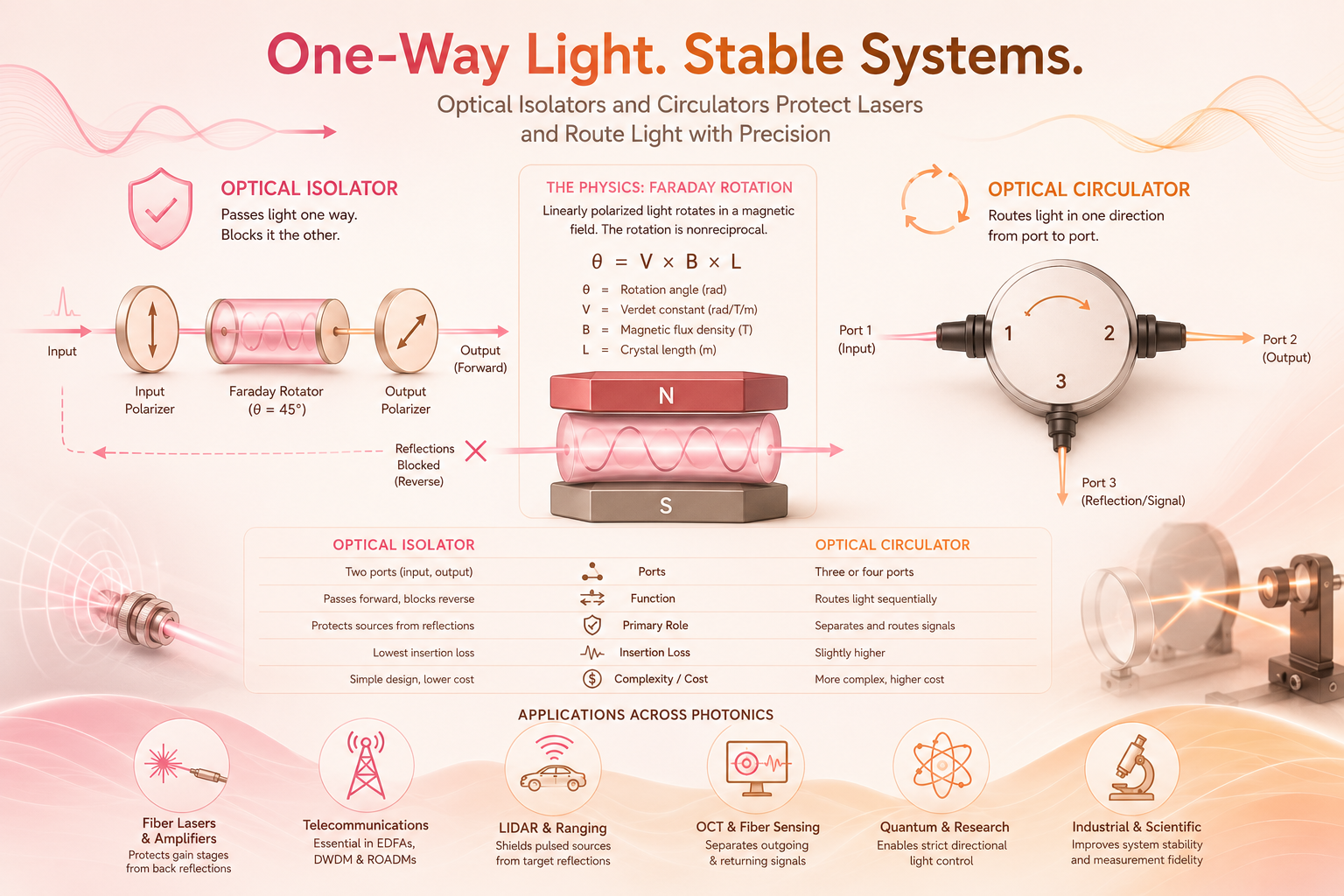
An optical isolator is a passive, nonreciprocal device that allows light to pass through in one direction while blocking (or heavily attenuating) light traveling in the reverse direction. Think of it as a one-way valve for photons — or, for an electronics analogy, the optical equivalent of a diode, which passes current in one direction and blocks it in the other. Once installed inline, it requires no power, no active control, and no maintenance; it simply enforces a direction on the light passing through it.
An optical circulator is a multi-port nonreciprocal device, typically three or four ports, that routes light sequentially from port to port in one direction only. Light entering port 1 exits port 2; light entering port 2 exits port 3; light entering port 3 does not leak back into port 1. This directional routing lets a single fiber carry both outgoing and returning signals without a conventional (reciprocal) splitter, which would waste at least half the optical power in each direction and let outgoing and returning signals interfere with each other.
Both components solve problems that ordinary optics, lenses, mirrors, beamsplitters, plain glass, simply can’t. In a conventional optical element, light traveling forward and light traveling backward experience identical physics; if you can send light one way through a component, you can always send it back the same way. That symmetry, called reciprocity, is a basic property of most materials and is exactly what isolators and circulators are built to break. They do this using magneto-optic materials whose optical properties depend on the direction of an applied magnetic field rather than just the geometry of the light path, which is what gives them their one-way behavior. This distinction – nonreciprocal versus reciprocal components – is the dividing line between components that merely redirect light and components that can enforce a direction on it.
The Physics: Faraday Rotation and Nonreciprocal Control
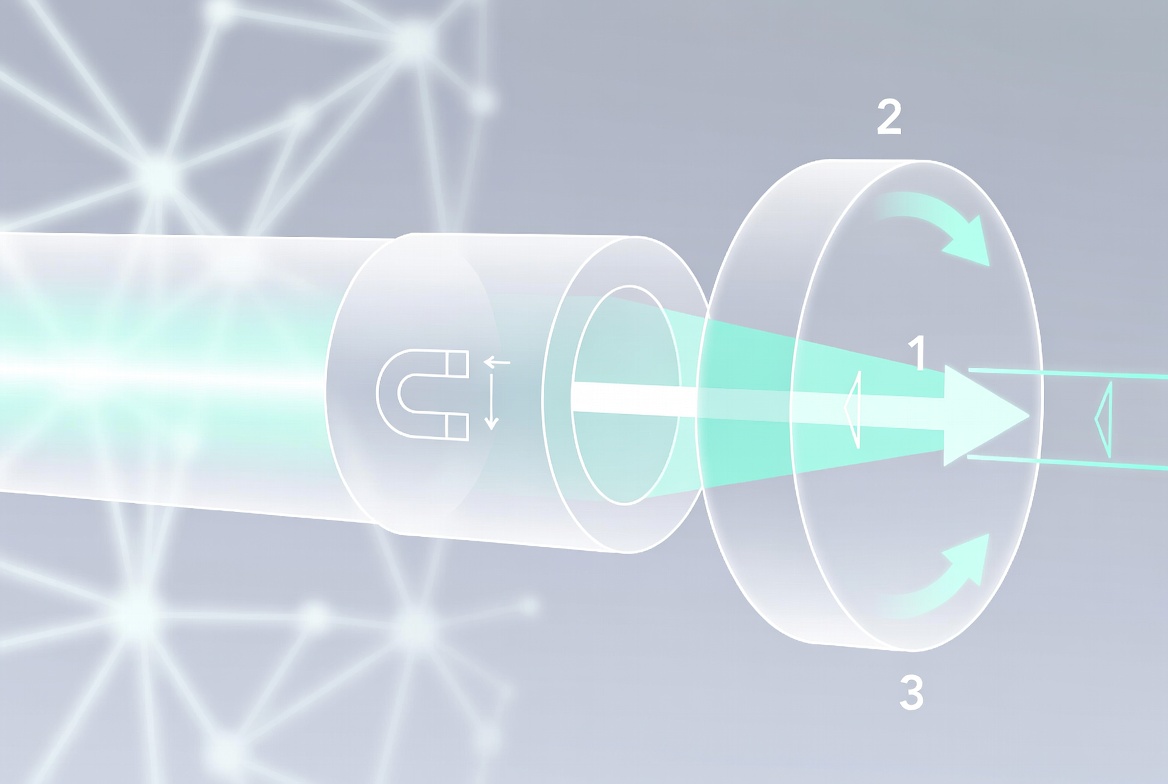
The core mechanism is the Faraday effect, discovered in 1845: when linearly polarized light passes through certain materials (commonly terbium-doped garnets) in the presence of a magnetic field aligned with the light’s propagation direction, its plane of polarization rotates. Critically, this rotation is nonreciprocal — if the light is reflected and sent back through the same material, the polarization continues rotating in the same absolute direction rather than unwinding.
The amount of rotation is described by a simple relationship:
θ = V × B × L
where θ is the rotation angle, V is the material’s Verdet constant (a measure of how strongly it responds to a magnetic field, typically given in radians per tesla per meter), B is the magnetic flux density, and L is the length of the crystal the light travels through. In plain terms: a stronger magnet, a longer crystal, or a material with a higher Verdet constant all produce more rotation. This is why isolator manufacturers can hit an exact target angle by adjusting crystal length and magnet strength rather than needing an exotic new material for every design.
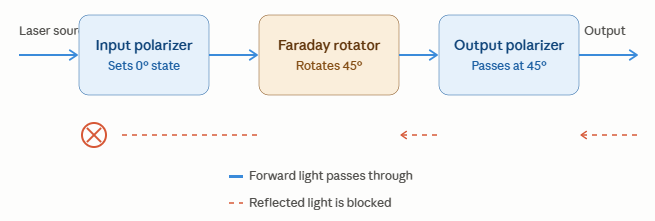
A typical isolator exploits this with a simple three-stage construction:
- An input polarizer sets the light to a known linear polarization.
- A Faraday rotator, sized so θ = 45° at the design wavelength.
- An output polarizer aligned to pass light at that 45° angle.
Forward-traveling light passes through cleanly. Light reflected back from downstream optics passes through the Faraday rotator a second time, picking up another 45° of rotation in the same direction — landing at 90° relative to the input polarizer, which blocks it almost entirely. The blocked power follows Malus’s law, roughly scaling with cos²(90°) ≈ 0, which is why a well-built isolator can suppress reflections by several orders of magnitude rather than just partially attenuating them.
One practical consequence of the θ = V × B × L relationship: since V depends on wavelength, the 45° rotation is only exact at the design wavelength — this is the physical reason isolators are narrowband parts rather than universal components, and why the datasheet’s wavelength range matters as much as its isolation number.
Circulators use the same Faraday rotation building block, combined with polarization beam displacers and walk-off crystals, to steer light between three or more physical ports instead of simply blocking a return path.
Key Performance Parameters
Datasheets for isolators and circulators can look intimidating at first glance, but the useful information boils down to a handful of numbers that predict how the part will actually behave in a system. Some describe how well the component does its main job, blocking reflections or minimizing loss, while others catch failure modes that only show up once the part is under real optical power or handling a specific polarization state. Knowing what each spec actually measures makes it much easier to compare parts across vendors rather than defaulting to whichever number looks biggest.
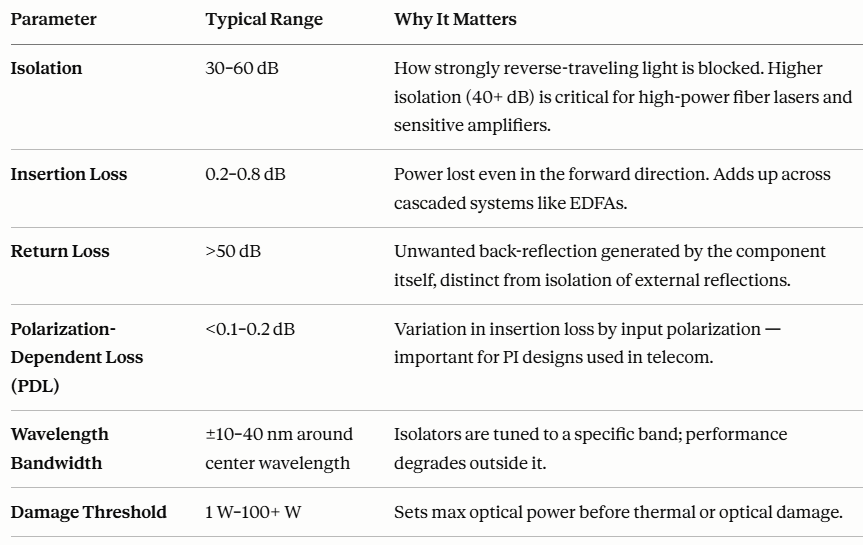
Rule of thumb: every 3 dB of isolation halves the returned power, so going from 30 dB to 40 dB isolation is roughly an order-of-magnitude improvement in feedback suppression — often the difference between a stable laser and one exhibiting mode-hopping or intensity noise.
Optical Isolators vs. Optical Circulators: Key Differences
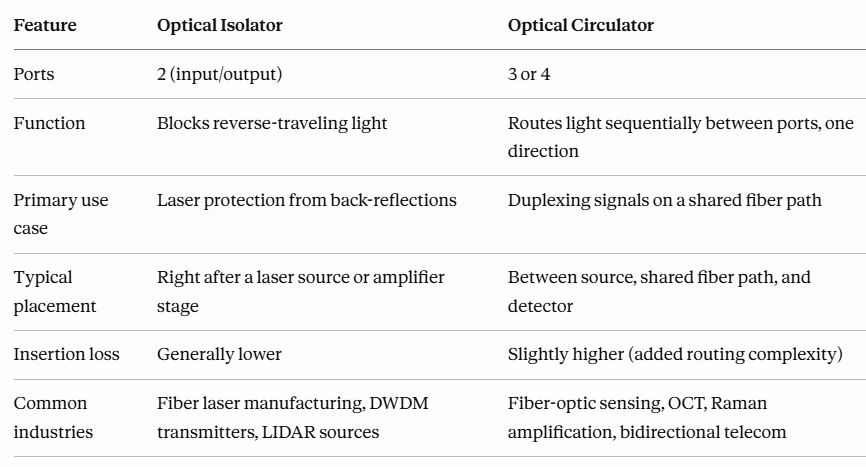
Though both rely on the same nonreciprocal Faraday rotation, isolators and circulators are built for different jobs and aren’t interchangeable. An isolator is a simple pass/block gate with one input and one output, while a circulator is a routing device with multiple ports that shuttles light around a loop. Choosing between them usually comes down to whether you need to protect a source from reflections (isolator) or need to separate outgoing and incoming signals on a shared path (circulator). The table below summarizes the practical distinctions.
Common Types and Configurations
Polarization-dependent (PD) isolators assume a fixed input polarization and offer the highest isolation at the lowest cost — the default for sources with well-defined polarization, like many fiber laser pump diodes.
Polarization-independent (PI) isolators split the input into two orthogonal polarization components, process each separately, and recombine them, allowing them to isolate unpolarized or drifting light — standard in telecom.
Free-space isolators are used where light travels through air or bulk optics, common in laser system integration and scientific instrumentation.
Fiber-coupled isolators are pigtailed for direct inline splicing into fiber laser and amplifier chains — the dominant form factor in commercial fiber laser manufacturing.
Circulators are described by port count: 3-port is the workhorse for sensing and telecom duplexing; 4-port adds flexibility for add-drop configurations in wavelength-division multiplexing.
Applications Across Photonics
From telecom backbones to biomedical imaging, isolators and circulators show up wherever a system can’t tolerate stray reflections or needs to squeeze bidirectional traffic onto a single optical path. The specific role each component plays shifts with the application – sometimes it’s pure laser protection, other times it’s efficient signal routing – but the underlying value is the same: cleaner, more stable light where it’s needed most. A few of the most common use cases illustrate the range:
- Fiber lasers and amplifiers — isolators after gain stages prevent back-reflected light from destabilizing the amplifier chain, essential in high-power cutting and welding lasers.
- Telecommunications (DWDM/EDFA) — both components are standard in erbium-doped fiber amplifiers and ROADMs.
- LIDAR and ranging — isolators protect pulsed sources from reflections off the target scene.
- OCT and fiber sensing — circulators separate outgoing illumination from the returning signal on a shared fiber, without the loss penalty of a splitter.
- Quantum and research photonics — used anywhere strict directional light control matters, such as cavity experiments and squeezed-light generation.
optical isolation
How to Choose the Right Optical Isolators and Circulators
With the physics and specs covered, choosing a specific part comes down to matching a handful of system parameters against the datasheet, most selection mistakes come from skipping one of these rather than misreading any single number. The checklist below moves roughly in order of how likely each item is to rule out a candidate part entirely, so working through it top to bottom is a reasonable way to narrow a shortlist quickly.
- Confirm the operating wavelength band — verify the isolation curve covers your source’s full tuning range.
- Match the polarization state of your source to a PD or PI design.
- Size the damage threshold with margin — thermal lensing in the Faraday crystal is a common failure mode.
- Check insertion loss budget across the whole optical chain.
- Decide between free-space and fiber-coupled based on your existing optical path.
- For circulators, confirm port count and directionality match your intended routing.
Conclusion
Optical isolators and circulators are unglamorous components, but they’re foundational to keeping laser systems stable and enabling directional light routing that would otherwise require lossy workarounds. Understanding the Faraday effect and the specs that actually drive performance. isolation, insertion loss, PDL, damage threshold, makes it far easier to spec the right part.


