
Optical phased arrays for solid-state LiDAR – principles, advantages and applications, is the topic of this blog article.

This article is brought to you by Connet Laser Technology, a leading manufacturer of lasers for LiDAR and other applications.
Optical Phased Arrays for Solid-State LiDAR: Introduction
LiDAR (Light Detection and Ranging) has become one of the most important sensing technologies in modern engineering. By emitting laser pulses and measuring the time it takes for reflected light to return, LiDAR systems can determine distances with extremely high precision. This capability allows them to generate detailed three-dimensional representations of the surrounding environment. From autonomous vehicles and robotics to environmental mapping, smart cities, and infrastructure monitoring, LiDAR is rapidly becoming a cornerstone technology for spatial awareness and real-time sensing.
The growing demand for high-resolution 3D sensing has pushed LiDAR systems into a wide range of industries. Autonomous driving platforms rely on LiDAR to detect obstacles, pedestrians, and road features. Industrial robots use it for navigation and collision avoidance. In geospatial mapping, airborne LiDAR systems help generate highly accurate topographical maps, while environmental researchers use it to study forests, coastlines, and atmospheric conditions. As these applications expand, engineers are seeking LiDAR solutions that are smaller, faster, and more reliable.
Traditional LiDAR systems rely on mechanical scanning components, such as rotating mirrors, spinning sensor assemblies, or oscillating MEMS mirrors, to steer laser beams across a scene. While effective, these mechanical systems often suffer from several limitations. They tend to be bulky and complex, increasing system size and manufacturing cost. Mechanical motion also introduces reliability concerns over long operational lifetimes, particularly in automotive and industrial environments where sensors must withstand vibration, temperature variations, and continuous operation.
To overcome these challenges, the industry is increasingly turning toward solid-state LiDAR technologies. Solid-state LiDAR eliminates moving mechanical parts and instead uses electronic or photonic methods to steer the laser beam. This approach can significantly improve reliability while enabling smaller and more scalable sensor designs. Several solid-state approaches exist, including MEMS-based systems, flash LiDAR, and optical phased arrays.
Among these technologies, optical phased arrays (OPAs) have emerged as one of the most promising solutions for next-generation LiDAR systems. OPAs enable beam steering entirely through optical interference, allowing the direction of a laser beam to be controlled electronically by adjusting the phase of light emitted from multiple optical elements.
Optical phased arrays allow engineers to control the direction of a laser beam by manipulating the phase of light across an array of emitters integrated on a photonic chip. By precisely adjusting the relative phase between emitters, the emitted beams interfere constructively in a specific direction, effectively steering the combined beam without requiring any mechanical motion. This technique enables extremely fast, precise, and reliable beam steering.
As photonic integration technologies continue to advance, particularly through silicon photonics platforms, optical phased arrays are becoming increasingly practical for compact, chip-scale LiDAR systems. These integrated devices can combine lasers, waveguides, phase shifters, and emitters on a single photonic chip, enabling highly scalable sensing architectures. Such developments are attracting significant interest from companies developing sensors for autonomous vehicles, robotics, drones, and augmented reality systems.
This article explores the principles of optical phased arrays, how they operate in solid-state LiDAR systems, and why they are becoming a key enabling technology for next-generation optical sensing platforms. We will examine the underlying physics of beam steering, the architecture of integrated OPA devices, and the advantages and challenges associated with their deployment in modern LiDAR applications.
What Are Optical Phased Arrays?
An optical phased array is a device that steers a beam of light by controlling the relative phase of multiple coherent optical emitters arranged in an array.
The concept is analogous to phased array antennas used in radar systems. In radar, multiple antennas emit electromagnetic waves with controlled phase differences. These phase differences cause constructive and destructive interference that shapes and directs the beam.
Optical phased arrays apply the same concept at optical wavelengths.
A typical optical phased array consists of:
-
A coherent laser source
-
Waveguides that distribute light across the array
-
Phase shifters that control the phase of each element
-
An array of optical emitters
By adjusting the phase of each emitter, the combined interference pattern steers the output beam in a specific direction. The steering angle is determined by the phase gradient across the array. When the phase difference between adjacent emitters changes, the beam shifts accordingly.
Young’s double-slit experiment is a classic illustration of double-beam interference. Optical phased arrays extend this principle to many emitters, where controlled multi-beam interference in the far field enables precise beam steering.

Principle of a uniform 1D-OPA (Courtesy of Springer)
How Optical Phased Arrays Enable LiDAR
LiDAR systems measure distance by emitting laser pulses and detecting the reflected light from objects. By scanning the laser beam across a scene and measuring the time of flight of reflected signals, the system constructs a detailed 3D map.
In traditional systems, scanning is performed using:
-
Rotating mirrors
-
MEMS mirrors
-
Mechanical spinning assemblies
Optical phased arrays perform this scanning without moving parts. Instead of rotating a mirror, the beam direction changes electronically through phase control. The scanning process typically works as follows:
-
A coherent laser feeds light into a photonic integrated circuit.
-
The circuit distributes the light across many waveguides.
-
Each waveguide contains a controllable phase shifter.
-
Light exits through emitters arranged in an array.
-
By changing the phases, the beam steers across the field of view.
Because the beam direction is controlled electronically, scanning speeds can be extremely high, often far exceeding mechanical alternatives.
Key Components of Optical Phased Arrays for LiDAR
Laser Source
OPAs require a coherent laser source, typically operating in the near-infrared region (around 905 nm or 1550 nm for LiDAR applications). Coherence is essential because the emitted beams must interfere constructively to form a directed beam.
Waveguide Network
Light from the laser is distributed across the array through integrated optical waveguides. These waveguides are often fabricated using silicon photonics platforms, which allow large-scale integration of optical components on semiconductor chips.
Phase Shifters
Phase shifters control the optical phase of each element in the array. Several technologies are used:
-
Thermo-optic phase shifters
-
Electro-optic phase shifters
-
Carrier-injection modulators
Thermo-optic shifters are common due to their simplicity, though electro-optic approaches offer faster response times.
Optical Emitters
The emitters radiate light into free space. Common emitter designs include:
-
Grating couplers
-
Nano-antennas
-
End-fire waveguide emitters
These emitters convert guided optical modes into free-space radiation that forms the steered beam.
Beam Steering with Optical Phased Arrays
Beam steering occurs through interference between emitters. If all emitters produce light with identical phase, the beam travels perpendicular to the array. However, introducing a linear phase shift across the array tilts the beam. The steering angle θ approximately follows:
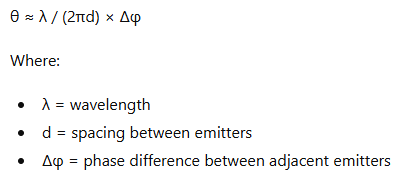
This relationship shows that the beam direction depends on both the wavelength and the phase gradient. By dynamically adjusting phase values, OPAs can sweep the beam across the desired scanning range.
Advantages of Optical Phased Arrays in LiDAR
No Moving Parts
One of the most important benefits is the elimination of mechanical scanning components. This results in:
-
Higher reliability
-
Longer operational lifetime
-
Reduced mechanical failure
These advantages are particularly important for automotive applications where durability is critical.
Faster Beam Steering
Electronic phase control allows beam steering at extremely high speeds. Scanning rates can reach microseconds or faster, far exceeding mechanical systems. This enables rapid scene acquisition and improved object detection in dynamic environments.
Compact Integration
Optical phased arrays can be fabricated using photonic integrated circuit technology. This allows many optical components to be integrated on a single chip, significantly reducing system size and weight. Compact sensors are especially valuable for:
-
autonomous vehicles
-
drones
-
mobile robotics
Scalability
Integrated photonics enables large arrays of emitters. Increasing the number of emitters improves:
-
beam quality
-
angular resolution
-
signal strength
This scalability is essential for high-performance LiDAR systems.
Challenges of Optical Phased Arrays for LiDAR
Despite their advantages, optical phased arrays also face several technical challenges.
Limited Field of View (FOV)
One of the main challenges of optical phased arrays is the limited field of view (FOV) that can be achieved through beam steering. The maximum steering angle is primarily constrained by the spacing between emitters in the array and the formation of grating lobes. When emitters are spaced too far apart relative to the wavelength of the emitted light, unwanted secondary beams, known as grating lobes, can appear in addition to the main steered beam. These parasitic beams can reduce measurement accuracy and introduce ambiguity in LiDAR sensing.
To suppress grating lobes and maintain a single well-defined output beam, the spacing between adjacent emitters must typically be comparable to or smaller than half the optical wavelength. Achieving such tight spacing, however, can be challenging from a fabrication standpoint, particularly for large arrays integrated on photonic chips. As a result, designing OPAs that combine a wide steering range, high beam quality, and manufacturable device geometries remains an active area of research in integrated photonics.

Optical Power Efficiency
Losses in waveguides, beamsplitters, and emitters can reduce optical power. Efficient power distribution across large arrays remains a key engineering challenge.
Thermal Effects
Many optical phased arrays rely on thermo-optic phase shifters to control the phase of light in each waveguide. In these devices, small heaters locally change the refractive index of the waveguide material through temperature variation, thereby adjusting the optical phase. While this approach is relatively simple to implement and compatible with many photonic integration platforms, it also introduces several limitations.
Thermal tuning typically requires continuous power to maintain the desired phase shift, which can increase overall power consumption—especially in large arrays with many phase shifters. In addition, temperature fluctuations in the environment or within the device itself can lead to phase drift, potentially affecting beam stability and steering accuracy.
To address these challenges, researchers are exploring alternative phase control mechanisms, including electro-optic phase shifters, carrier-injection devices, and MEMS-based approaches. These techniques can offer faster response times and lower power consumption, making them attractive options for next-generation optical phased array systems.
Fabrication Complexity
Large arrays require precise control of waveguide geometry and phase alignment. Manufacturing variations can degrade beam quality if not carefully managed. However, advances in semiconductor fabrication are rapidly improving production capabilities.
Silicon Photonics and Integrated OPAs
One of the most important developments in optical phased arrays is the use of silicon photonics platforms. Silicon photonics allows photonic components to be fabricated using processes similar to those used in semiconductor electronics. Advantages include:
-
high-volume manufacturing
-
compact integration
-
compatibility with CMOS processes
Using silicon photonics, engineers can integrate:
-
lasers
-
modulators
-
phase shifters
-
detectors
-
waveguides
onto a single chip.
This integration significantly reduces cost and system complexity. Many startups and major technology companies are now developing chip-scale LiDAR systems based on OPAs.
Applications of Optical Phased Array LiDAR
Optical phased array LiDAR is being explored across many industries.
Autonomous Vehicles
Autonomous driving systems require accurate real-time perception of the surrounding environment. OPA LiDAR offers:
-
high reliability
-
compact sensors
-
fast scanning speeds
These advantages make it an attractive candidate for next-generation automotive sensors.
Robotics and Automation
Industrial robots and autonomous mobile robots increasingly rely on LiDAR sensors for navigation, localization, and obstacle detection in dynamic environments. By generating accurate three-dimensional maps of their surroundings, LiDAR systems enable robots to move safely and efficiently through warehouses, factories, and other complex industrial spaces.
Solid-state LiDAR sensors, such as those based on optical phased arrays, are particularly attractive for these applications because they contain no moving parts. This improves reliability and durability, which are critical in harsh industrial environments where sensors may be exposed to vibration, dust, temperature fluctuations, and continuous operation. Their compact size and potential for large-scale integration also make them well suited for modern robotic platforms where space and power efficiency are important design considerations.
Drones and UAVs
Weight and size are critical for aerial platforms. Integrated OPA LiDAR systems can provide high-resolution sensing while minimizing payload mass.
Augmented and Virtual Reality
Optical phased arrays are also being explored for beam steering in AR/VR displays and depth sensing systems. Compact photonic beam steering could enable advanced gesture recognition and spatial mapping.
Environmental Mapping
LiDAR is widely used for mapping terrain, forests, and infrastructure. OPA-based sensors could reduce the size and cost of airborne and portable mapping systems.
Future Outlook
Optical phased arrays are still an emerging technology, but rapid progress in photonic integration is accelerating their development. Several trends are shaping the future of OPA LiDAR:
-
Larger emitter arrays for improved resolution
-
Hybrid electronic-photonic integration
-
Low-power electro-optic phase control
-
Mass manufacturing using CMOS photonics
As these technologies mature, optical phased arrays could become the foundation for a new generation of compact, high-performance LiDAR sensors. Their ability to steer light electronically without moving parts represents a major shift in how optical scanning systems are designed. For applications ranging from autonomous vehicles to robotics and smart infrastructure, optical phased arrays may soon play a central role in enabling reliable and scalable 3D sensing.


