
Laser cleaning technology, its applications and benefits is the topic of this blog article.
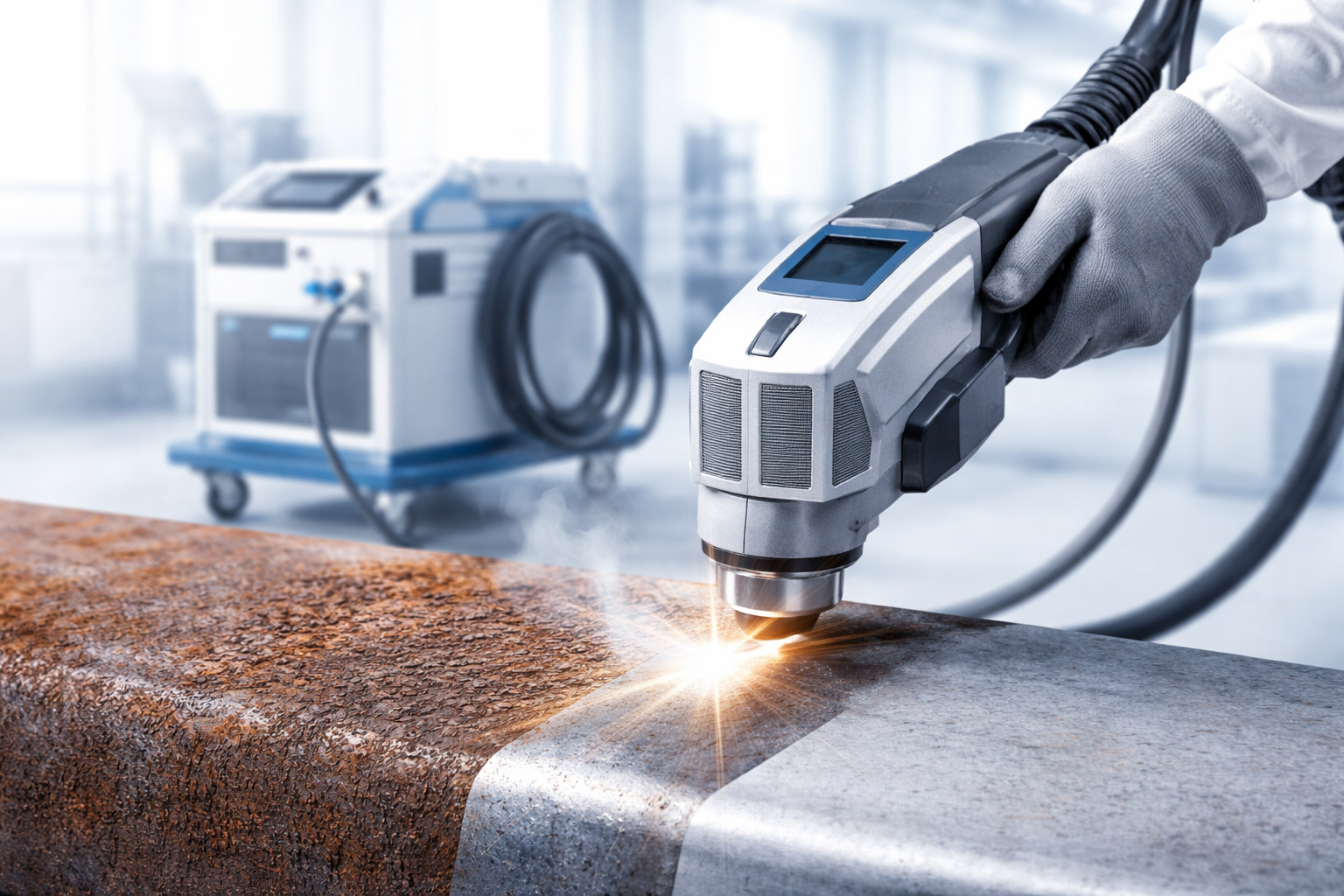
Laser technology has transformed many areas of industrial manufacturing, from precision cutting and welding to additive manufacturing and micromachining. In recent years, another application has been rapidly gaining traction across multiple industries: laser cleaning. By using high-energy laser pulses to remove unwanted material from surfaces, laser cleaning systems offer a precise, environmentally friendly alternative to conventional cleaning methods such as chemical solvents, sandblasting, and abrasive scrubbing.
As manufacturers seek more sustainable, cost-effective, and controllable processes, laser cleaning technology is emerging as a powerful solution for surface preparation, rust removal, coating stripping, and contamination control.
This article is brought to you by RPMC Lasers - a US based distributor of lasers and laser solutions.
How Laser Cleaning Works
Laser cleaning operates by directing high-energy laser pulses onto a contaminated surface. When the laser beam interacts with unwanted material, such as rust, paint, oil residues, oxide layers, or coatings, it deposits energy within a very thin surface layer. This rapid energy absorption causes localized heating, expansion, and ablation, which breaks the bond between the contaminant and the substrate. As a result, the unwanted layer is vaporized, fractured, or ejected as fine particles, while the underlying material remains largely unaffected.
The effectiveness of this process relies on differences in optical and thermal properties between the contaminant and the base material. In many practical cases, corrosion products, paints, and organic residues absorb laser energy much more efficiently than the metal or substrate beneath them. This contrast allows the laser to remove only the unwanted layer with high selectivity and minimal substrate damage. By carefully controlling parameters such as pulse energy, repetition rate, scanning speed, and spot size, operators can tune the process for delicate cleaning or more aggressive material removal.
Several physical mechanisms may contribute to laser cleaning depending on the material and laser parameters. These include photothermal ablation, where heat causes the contaminant to vaporize; photomechanical effects, where rapid thermal expansion creates micro-shocks that lift particles from the surface; and plasma generation, which can further assist in breaking apart stubborn contamination layers. The combination of these effects enables efficient removal of contaminants that are otherwise difficult to eliminate with mechanical or chemical methods.
Most industrial laser cleaning systems rely on pulsed fiber lasers, which offer excellent beam quality, high efficiency, and reliable operation. Systems may use nanosecond pulses for general surface preparation, while picosecond or femtosecond lasers are sometimes employed for precision cleaning applications where extremely fine control and minimal heat-affected zones are required. In some heavy-duty applications, continuous-wave lasers combined with high-speed scanning can also be used to thermally remove coatings.
The laser beam is typically delivered through a fiber-optic cable to a galvanometer scanning head, which rapidly steers the beam across the surface in programmed patterns. This scanning approach allows for uniform coverage, adjustable cleaning intensity, and compatibility with automated production systems. In robotic or inline manufacturing environments, laser cleaning heads can be mounted on robot arms or motion stages, enabling consistent surface preparation prior to welding, bonding, coating, or inspection.
Because the process is non-contact, highly controllable, and free of chemical consumables, laser cleaning offers a precise and environmentally friendly alternative to conventional surface treatment methods.
Limitations of Traditional Cleaning Methods
Before laser cleaning systems became widely available, industries relied on several conventional surface treatment techniques. While effective, these methods often present environmental, safety, and operational challenges.
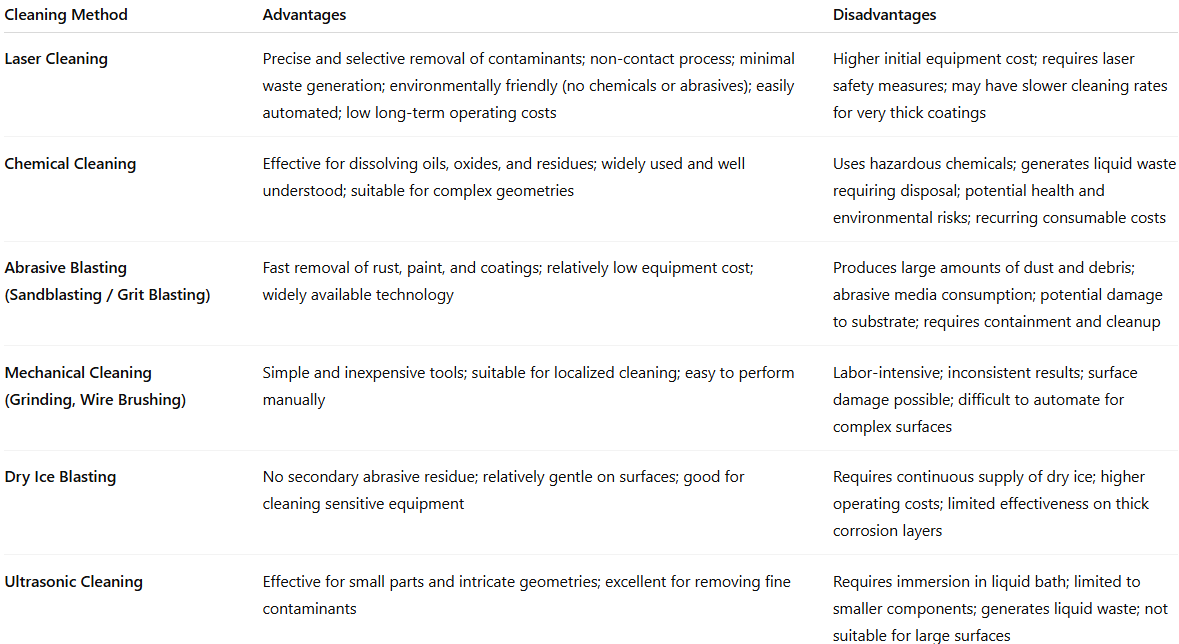
Chemical cleaning involves solvents or acids that dissolve contaminants. Although widely used, these chemicals can produce hazardous waste, require careful handling, and create regulatory compliance challenges.
Abrasive blasting methods, such as sandblasting or grit blasting, physically remove surface layers through mechanical impact. While efficient, abrasive blasting generates dust and debris, can damage delicate surfaces, and requires containment systems to manage waste material.
Mechanical cleaning techniques, including wire brushing or grinding, can be labor-intensive and difficult to automate for complex geometries.
Laser cleaning addresses many of these limitations by offering a contactless, highly controllable cleaning method with minimal waste generation.
Key Advantages of Laser Cleaning
Laser cleaning technology provides several significant advantages compared to traditional surface treatment processes.
One of the most important benefits is its environmentally friendly operation. Because the process does not rely on chemical solvents or abrasive media, it generates little secondary waste. The removed contaminants are typically converted into small particles or vapor that can be easily captured by filtration systems.
Another advantage is precision. Laser cleaning can selectively remove thin surface layers without damaging the underlying material. This makes it suitable for delicate components and high-value parts where surface integrity must be preserved.
Laser cleaning also improves process control. By adjusting laser parameters such as pulse energy, repetition rate, and scanning speed, operators can precisely tailor the cleaning process to different materials and contamination levels.
Additionally, laser cleaning systems are highly compatible with automation. Robotic integration allows consistent cleaning performance in industrial production environments.
Table: Comparison of laser cleaning technology with traditional industrial cleaning methods.
Applications Across Multiple Industries
The versatility of laser cleaning technology has led to its adoption across a wide range of industries.
In the automotive sector, laser cleaning is used for rust removal, paint stripping, and surface preparation before welding or bonding. Removing oxide layers before welding improves weld quality and reliability.
In aerospace manufacturing and maintenance, laser cleaning helps remove coatings, corrosion, and contaminants from high-value components without damaging sensitive materials such as aluminum alloys or composite structures.
Industrial maintenance teams use laser cleaning systems to restore molds, dies, and production tools. Because the process is non-contact, it can remove residues without causing wear to precision tooling.
Laser cleaning has also found important applications in cultural heritage restoration. Conservators use controlled laser pulses to remove dirt, soot, or biological growth from sculptures, monuments, and historical artifacts without harming the original surface.
In electronics manufacturing, laser cleaning can remove oxides and contaminants from delicate components before soldering or bonding operations.
Laser Cleaning for Surface Preparation Before Welding
One of the most widely adopted industrial applications of laser cleaning is surface preparation prior to welding. In many manufacturing environments, including automotive production, shipbuilding, heavy machinery fabrication, and pipeline construction, metal surfaces must be thoroughly cleaned before welding to ensure strong, reliable joints. Contaminants such as rust, oxide layers, oils, paint residues, and mill scale can significantly reduce weld quality by introducing porosity, weakening the bond, or causing inconsistent penetration.
Laser cleaning provides a highly effective method for preparing weld seams without the drawbacks associated with traditional techniques such as grinding, chemical cleaning, or abrasive blasting. By directing controlled laser pulses along the weld line, the system selectively removes oxidation and surface contamination while leaving the base metal intact. The process exposes clean metallic surfaces that are ideal for welding, improving both mechanical strength and repeatability of the weld seam.
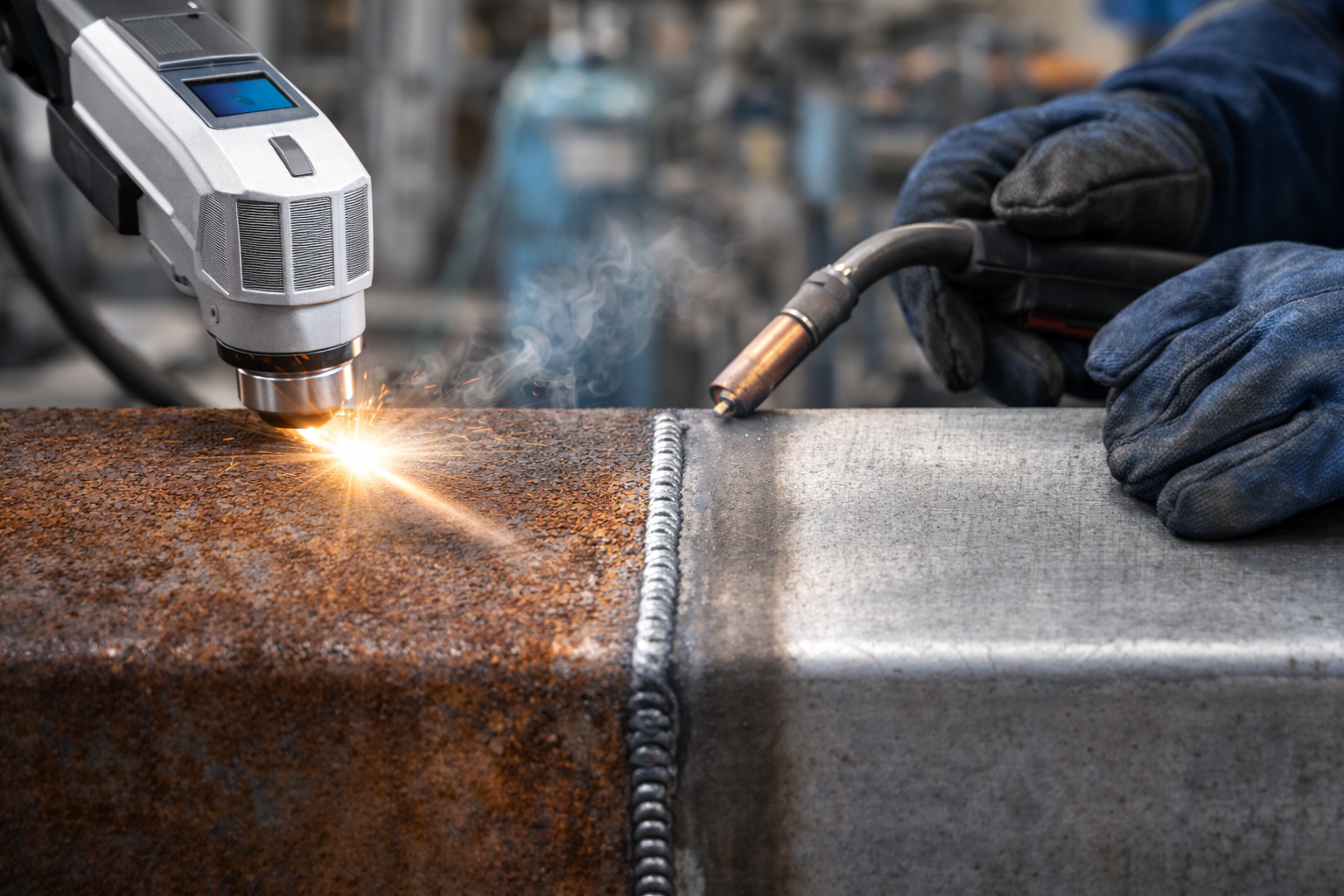
In automated production lines, laser cleaning systems are often integrated directly into the welding workflow. A galvanometer scanning head or robotic arm moves the laser beam precisely along the planned weld path, cleaning the joint immediately before the welding torch arrives. This inline cleaning approach minimizes the time between cleaning and welding, preventing new oxidation from forming and improving overall process efficiency.
Another key advantage of laser cleaning in welding preparation is the absence of consumables. Unlike abrasive blasting or chemical treatments, the process does not require media, solvents, or water, which reduces operating costs and eliminates secondary waste streams. Additionally, because the laser is a non-contact tool, it avoids mechanical wear on the surface and allows precise treatment of complex geometries, narrow seams, or delicate components.
As manufacturers continue to automate production and demand higher weld quality, laser cleaning is increasingly becoming a preferred solution for precision surface preparation in modern welding processes.
Environmental and Safety Benefits
One of the primary drivers behind the growth of laser cleaning is the increasing emphasis on environmentally sustainable manufacturing.
Traditional cleaning methods often produce chemical waste, abrasive debris, or contaminated water that must be carefully managed and disposed of according to environmental regulations. These processes can increase operational costs and introduce potential health hazards for workers.
Laser cleaning significantly reduces these risks. Since the process uses only light energy, it eliminates the need for harmful chemicals and minimizes waste generation. The small amount of particulate matter produced during cleaning can typically be captured with standard industrial extraction systems.
In addition to environmental benefits, laser cleaning also improves workplace safety by reducing worker exposure to hazardous substances and airborne particles.
Advances in Laser Cleaning Systems
Recent advances in laser technology have made laser cleaning systems more powerful, efficient, and affordable than ever before.
High-power pulsed fiber lasers have become the preferred source for many cleaning applications due to their reliability, compact size, and excellent beam quality. Modern systems can deliver hundreds of watts of average power while maintaining precise control over pulse parameters.
Scanning optics and galvanometer systems allow the laser beam to rapidly cover large surface areas with consistent energy distribution. This enables faster cleaning speeds and greater productivity.
Portable laser cleaning units have also become increasingly popular. These compact systems can be used in field maintenance operations such as shipyard repair, infrastructure restoration, and industrial equipment servicing.
Economic Benefits and Return on Investment
While the initial cost of a laser cleaning system may be higher than that of traditional cleaning equipment, many companies find that the long-term economic benefits outweigh the upfront investment.
Laser cleaning eliminates recurring costs associated with chemical solvents, abrasive media, and waste disposal. Maintenance costs are also relatively low because fiber lasers typically require minimal servicing.
Automation capabilities further improve productivity by reducing manual labor and ensuring consistent cleaning results. As a result, many manufacturers achieve a favorable return on investment within a relatively short period.
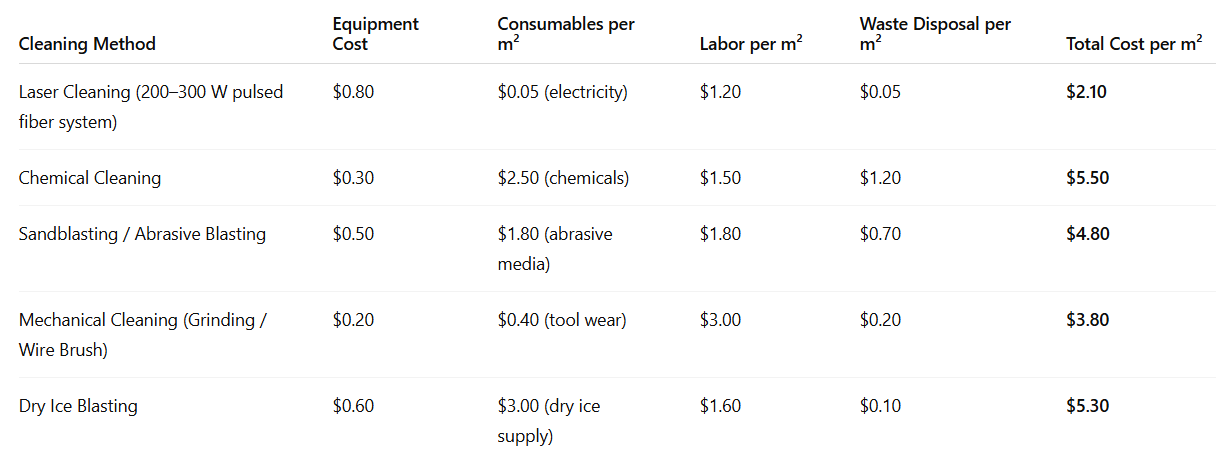
Here is a simple example cost comparison for cleaning 1 m² of rusted steel surface, assuming typical industrial conditions. Values are illustrative but realistic for comparison.
Assumptions used in this example
Equipment cost assumes amortization over ~5 years of industrial use
Labor cost assumes ~$30/hour operator wage
Cleaning rate assumptions:
Laser cleaning: ~2 m²/hour
Sandblasting: ~4 m²/hour
Mechanical cleaning: ~1 m²/hour
Electricity cost assumed ~$0.12/kWh
Waste disposal reflects typical industrial disposal fees
Key takeaway: Although laser cleaning systems have higher upfront capital cost, their low consumable use and minimal waste disposal costs often result in lower operating cost per square meter, especially in high-volume or automated production environments.
Future Outlook for Laser Cleaning Technology
The demand for cleaner, safer, and more sustainable manufacturing processes continues to grow across global industries. As environmental regulations become stricter and companies seek more efficient production methods, laser cleaning is expected to play an increasingly important role in industrial surface treatment.
Ongoing research is exploring new laser sources, advanced scanning systems, and intelligent process control methods that will further enhance the performance of laser cleaning systems.
With its combination of precision, efficiency, and environmental advantages, laser cleaning technology is poised to become a mainstream solution for surface preparation and maintenance in the years ahead.


