
Event-based vision sensors, also known as neuromorphic cameras, is the subject of this blog article.

This article is brought to you by Ocean Optics - a leading manufacturer of compact handheld UV-VIS and NIR spectrometers
Event-Based Vision Sensors: A Paradigm Shift in Imaging
For decades, imaging technology has relied on a familiar principle: capture a full frame, process it, and repeat. Whether in machine vision, consumer electronics, or scientific instrumentation, frame-based cameras have dominated due to their simplicity and maturity. However, as applications demand higher speed, lower latency, and improved efficiency, the limitations of conventional imaging architectures have become increasingly apparent.
Event-based vision sensors, often referred to as neuromorphic cameras, represent a fundamentally different approach. Instead of capturing entire frames at fixed intervals, these sensors respond asynchronously to changes in light intensity at the pixel level. This seemingly simple shift has profound implications for how visual information is captured, processed, and utilized across a wide range of industries.
By focusing only on changes in the scene rather than static information, event-based cameras dramatically reduce data redundancy, enabling faster and more efficient processing. This makes them particularly well-suited for high-speed robotics, autonomous vehicles, industrial inspection, and augmented reality applications, where conventional cameras struggle with motion blur, latency, or overwhelming data volumes. The unique architecture of these sensors not only enhances temporal resolution but also opens new avenues for advanced computer vision algorithms, offering a glimpse into a future where imaging is both smarter and more adaptive.
What Are Event-Based (Neuromorphic) Cameras?
Event-based cameras, also known as neuromorphic vision sensors, represent a radical shift from conventional imaging technologies by mimicking the processing principles of the human retina. Unlike traditional cameras, which capture full frames at fixed intervals regardless of scene activity, event-based sensors operate on a fundamentally different principle: they respond only to changes in brightness. This selective responsiveness allows the sensor to capture meaningful visual information with unprecedented efficiency.
In an event-based sensor, each pixel functions as an independent light detector and autonomously generates an “event” whenever it perceives a change in intensity that surpasses a predefined threshold. Rather than producing uniform frames at regular intervals, the camera outputs a stream of asynchronous events that represent only the dynamic aspects of a scene.
Each event typically encodes three critical pieces of information:
- Pixel coordinates – indicating the precise spatial location of the change.
- Timestamp – recording the exact moment the change occurred, often with microsecond precision.
- Polarity – specifying whether the brightness increased or decreased.
Because the data is sparse and event-driven, event-based cameras eliminate the redundant information inherent in conventional frame-based imaging. This allows for much lower data throughput in static or slow-moving scenes, while simultaneously providing extremely high temporal resolution in fast-moving or highly dynamic environments. The result is a camera that excels at capturing motion with minimal latency, even under challenging lighting conditions, making it ideal for robotics, autonomous vehicles, industrial inspection, and advanced computer vision applications.
How Event-Based Vision Sensors Differ from CMOS and CCD Cameras
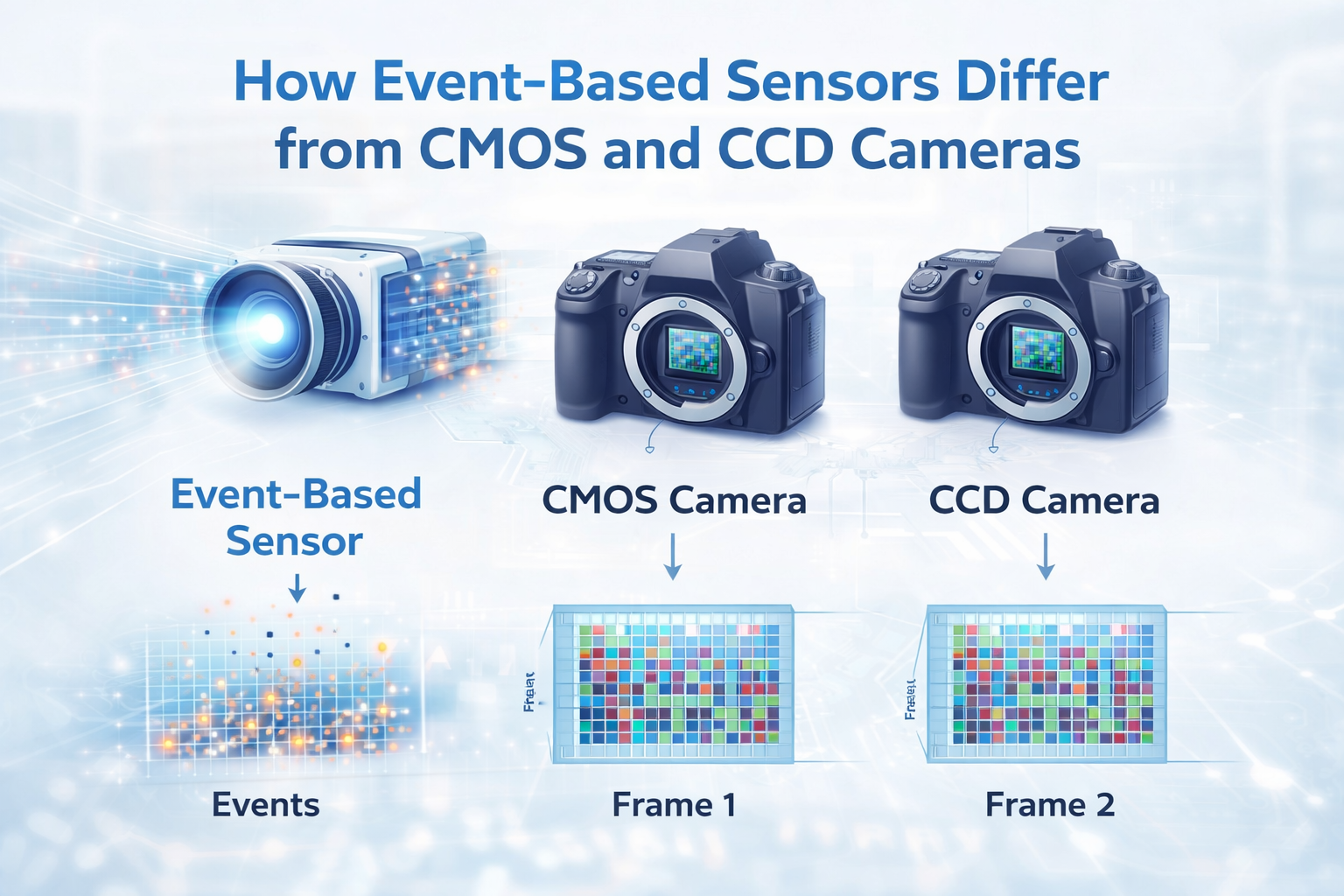
To fully appreciate the advantages of event-based vision, it is useful to compare it directly with conventional imaging technologies such as CMOS and CCD sensors. While all three technologies detect light and convert it into electrical signals, their operational principles diverge significantly.
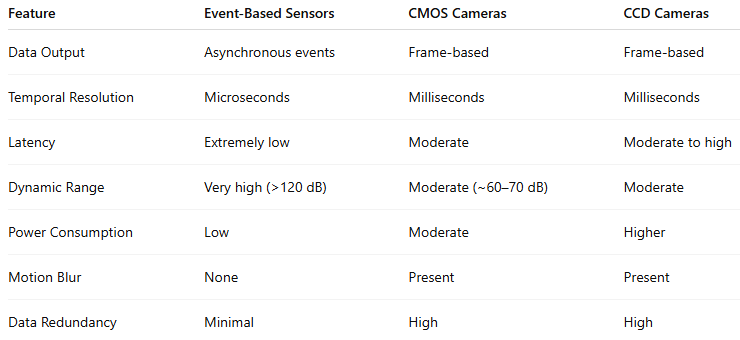
The absence of motion blur is particularly noteworthy. Since event-based sensors react only to changes, fast-moving objects are captured with exceptional clarity. Additionally, the high dynamic range allows these sensors to operate effectively in challenging lighting conditions, such as scenes with both very bright and very dark regions.
The Core Advantages of Event-Based Vision
The benefits of event-based imaging extend beyond incremental improvements; they redefine performance limits in several key areas.
First, temporal resolution is no longer constrained by frame rates. Traditional cameras operating at 30 or even 1000 frames per second cannot match the microsecond-level responsiveness of event-based sensors. This makes them ideal for applications where precise timing is critical, such as high-speed industrial inspection or scientific measurements.
Second, the reduction in data redundancy leads to significant gains in efficiency. Frame-based systems capture vast amounts of unnecessary information, especially in static scenes. Event-based sensors, by contrast, transmit only meaningful changes, reducing bandwidth requirements and enabling real-time processing with lower computational overhead.
Third, power consumption is inherently lower. Because fewer data are generated and processed, these sensors are particularly attractive for edge devices, mobile platforms, and embedded systems where energy efficiency is a priority.
Finally, the combination of high dynamic range and absence of motion blur allows for reliable operation in environments that challenge conventional cameras, including low-light conditions, high-contrast scenes, and fast-moving systems.
Applications Driving Adoption
The unique characteristics of event-based vision sensors have opened new possibilities across multiple domains, particularly where speed, efficiency, and robustness are essential.
In industrial inspection, these sensors enable the detection of defects on rapidly moving production lines, where traditional cameras may struggle with motion blur or insufficient frame rates. Their ability to capture transient events with high temporal fidelity improves both accuracy and throughput.
In robotics and autonomous systems, event-based cameras provide real-time feedback with minimal latency, enhancing navigation, obstacle avoidance, and interaction with dynamic environments. This is especially valuable for drones and mobile robots operating under strict power constraints.
Automotive applications, particularly in advanced driver-assistance systems (ADAS), benefit from the high dynamic range and fast response times of event-based sensors. These capabilities improve performance in challenging lighting conditions such as tunnels, nighttime driving, or direct sunlight.
Scientific research is another area where these sensors are gaining traction. High-speed phenomena, such as fluid dynamics, laser-material interactions, and neural activity, can be captured with unprecedented temporal resolution, enabling new insights and experimental techniques.
Challenges and Limitations of Event-Based Vision Sensors
Despite their advantages, event-based vision sensors are not without challenges. One of the primary barriers to adoption lies in the need for new data processing paradigms. Traditional computer vision algorithms are designed for frame-based inputs and cannot be directly applied to event streams.
Developing efficient algorithms for event-based data requires a shift toward spatiotemporal processing and often involves specialized hardware or neuromorphic computing architectures. While progress in this area has been rapid, the ecosystem is still evolving.
Another limitation is the relative novelty of the technology. Compared to CMOS and CCD sensors, which benefit from decades of optimization and standardization, event-based sensors are still maturing. This can affect availability, cost, and integration complexity.
Finally, event-based sensors are less effective in completely static scenes, where no changes occur. In such cases, hybrid systems that combine event-based and frame-based imaging are often employed to provide a more comprehensive solution.
Choosing the Right Event-Based Camera
Selecting an event-based vision sensor requires careful consideration of several factors, particularly as the technology continues to evolve and diversify.
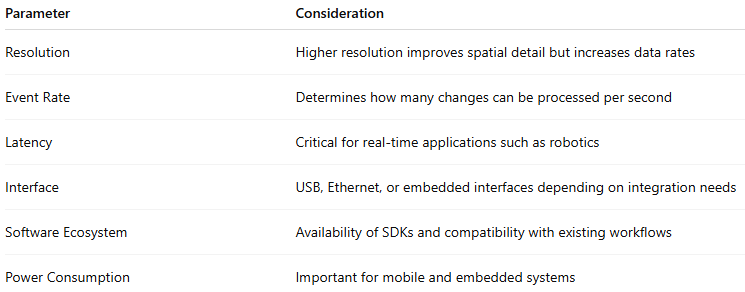
In many cases, the choice will depend on the specific application requirements, including speed, environmental conditions, and system constraints. As the market grows, more standardized solutions are likely to emerge, simplifying the selection process.
The Future of Imaging: Toward Event-Driven Systems
Event-based vision sensors are part of a broader trend toward event-driven computing, where systems respond dynamically to changes rather than processing static data streams. This paradigm aligns closely with developments in artificial intelligence, edge computing, and neuromorphic hardware.
As algorithms and hardware continue to mature, the integration of event-based sensors with conventional imaging systems is expected to become more common. Hybrid approaches can leverage the strengths of both technologies, providing comprehensive visual information across a wide range of conditions.
In the long term, event-based vision may not simply complement traditional imaging but redefine it. By prioritizing efficiency, speed, and relevance of data, these sensors offer a glimpse into a future where machines perceive the world in a manner more akin to biological systems.
Conclusion
Event-based vision sensors represent a significant departure from conventional imaging technologies, offering unparalleled temporal resolution, efficiency, and adaptability. While challenges remain in terms of ecosystem development and algorithm design, the potential benefits are substantial.
As industries continue to demand faster, smarter, and more efficient sensing solutions, neuromorphic cameras are poised to play a central role in the evolution of machine vision and photonics. For engineers, researchers, and system designers, understanding this technology is no longer optional – it is a step toward staying ahead in an increasingly dynamic and data-driven world.
References
- Event-based Vision: A Survey: https://arxiv.org/abs/1904.08405
- Hardware, Algorithms, and Applications of the Neuromorphic Vision Sensor: A Review: https://www.mdpi.com/1424-8220/25/19/6208


