
Laser sintering 3D printing is the subject of this blog article.
This article is brought to you by Zolix Instruments, a leading manufacturer of motion control and spectroscopy solutions.
Laser Sintering 3D Printing: A Deep Dive into SLS and Beyond
Additive manufacturing has evolved far beyond basic prototyping tools. Among the most powerful and industrially relevant approaches is laser sintering, a class of technologies that leverages high-energy laser beams to fuse powdered materials into functional parts. While our introductory guide covered the fundamentals of 3D printing, this article explores the physics, process dynamics, advantages, limitations, and real-world applications of laser sintering, while positioning it against competing additive technologies.
Building on this foundation, it is important to recognize that laser sintering is not a single, uniform process but rather a family of closely related technologies, each optimized for specific materials, performance requirements, and industrial use cases. From polymer-based selective laser sintering (SLS) systems widely used in product development to metal-focused processes such as direct metal laser sintering (DMLS) and selective laser melting (SLM), these technologies are reshaping how engineers approach design, prototyping, and production.
At the same time, laser sintering exists within a broader and increasingly competitive additive manufacturing landscape. Technologies such as stereolithography (SLA), fused deposition modeling (FDM), and newer powder-based approaches like Multi Jet Fusion (MJF) continue to evolve rapidly, each offering distinct advantages in cost, speed, material compatibility, and surface quality. Understanding where laser sintering excels, and where alternative methods may be more suitable, is essential for making informed engineering and business decisions.
In the sections that follow, we will take a closer look at the underlying physics of laser sintering, compare it systematically with other laser and non-laser 3D printing technologies, and highlight practical considerations for selecting the right process. Whether you are developing functional prototypes, producing end-use parts, or exploring scalable digital manufacturing strategies, laser sintering offers a compelling combination of design freedom and industrial performance.
What Is Laser Sintering?
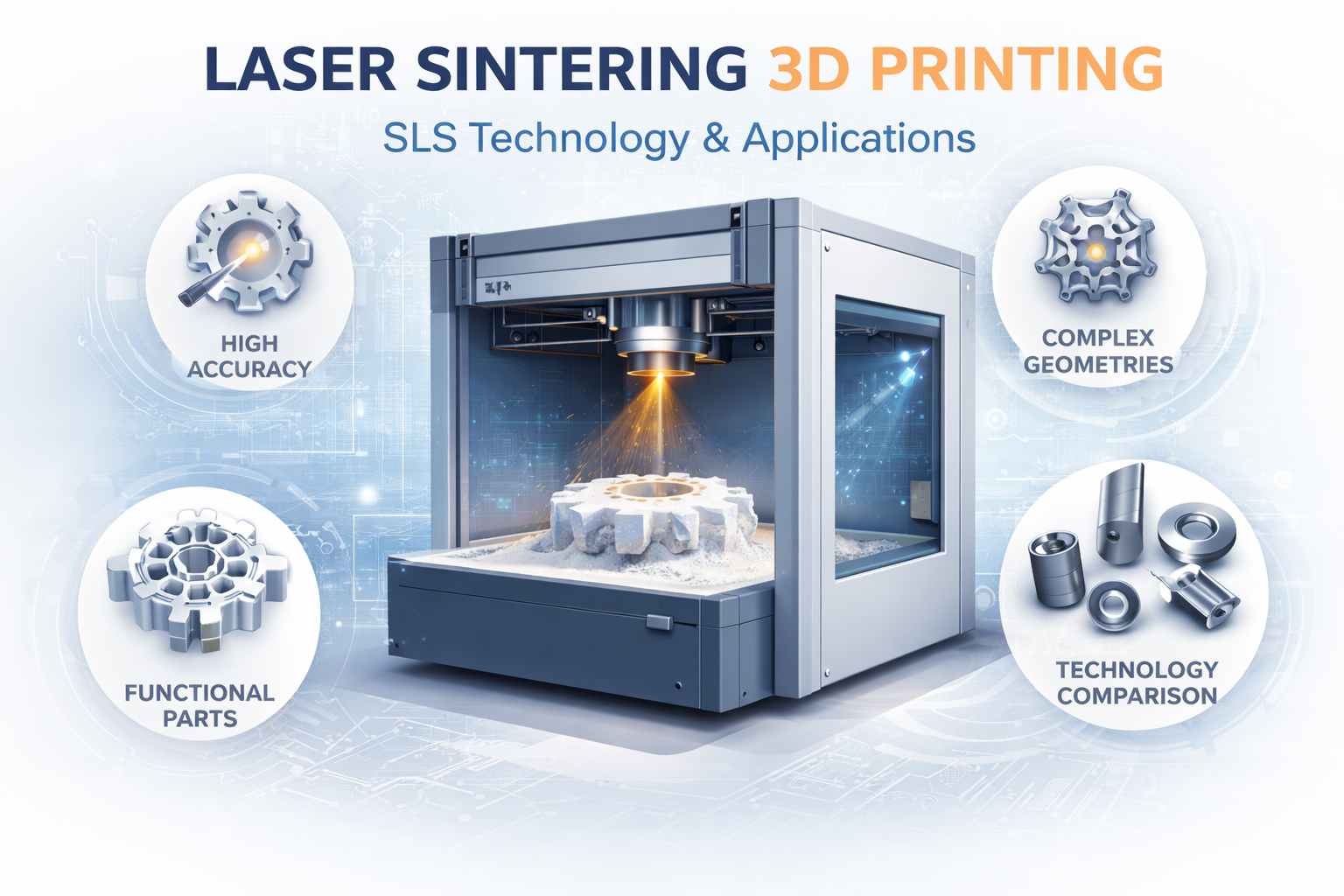
Laser sintering refers to a group of powder bed fusion (PBF) technologies where a laser selectively fuses powdered material layer by layer to create a solid object. The most common variant is Selective Laser Sintering (SLS), primarily used for polymers such as nylon (PA11, PA12). In SLS:
- A thin layer of powder is spread across a build platform
- A laser scans and sinters selected regions
- The platform lowers and the process repeats layer by layer
The unsintered powder acts as a natural support structure, enabling the fabrication of highly complex geometries without additional supports .
Closely related technologies include:
- DMLS / SLM (Direct Metal Laser Sintering / Selective Laser Melting) – for metals
- Multi Jet Fusion (MJF) – a non-laser but competing powder-based process
- Binder Jetting – powder-based but uses binders instead of lasers
The Physics Behind Laser Sintering
Unlike melting-based techniques, SLS typically operates just below the melting point, where particles fuse through diffusion and partial melting.
Key physical phenomena include:
- Thermal diffusion and neck formation between particles
- Laser-material interaction (absorption, scattering)
- Powder packing density and particle size distribution
- Cooling rates influencing microstructure and porosity
These factors directly affect:
- Mechanical strength
- Surface roughness
- Dimensional accuracy
Advanced modeling shows that laser power, scan speed, and temperature uniformity strongly influence part density and defect formation.
Key Advantages of Laser Sintering
Design Freedom Without Supports
Because the surrounding powder supports the part, SLS can produce:
- Internal channels
- Lattice structures
- Moving assemblies in a single print
Functional, End-Use Parts
SLS parts are known for:
- High strength and durability
- Good thermal resistance
- Isotropic mechanical properties
These characteristics allow SLS to compete with traditional manufacturing for low- to mid-volume production.
High Material Utilization
Unused powder can often be recycled, reducing waste compared to subtractive methods.
Batch Production Efficiency
Multiple parts can be nested in a single build volume, maximizing throughput.
Limitations and Challenges of Laser Sintering in 3D Printing
Despite its strengths, laser sintering is not universally optimal.
Surface Finish
SLS parts tend to have:
- Grainy or rough surfaces
- Limited optical clarity
This often requires post-processing (e.g., bead blasting, polishing).
Equipment Cost
Industrial SLS systems are significantly more expensive than:
- FDM printers
- Desktop SLA systems
Material Constraints
While growing, the material palette is still more limited than:
- Injection molding
- Some filament-based systems
Thermal Management Complexity
Maintaining uniform temperature across the powder bed is critical and technically challenging.
Comparison: Laser vs Non-Laser 3D Printing Technologies
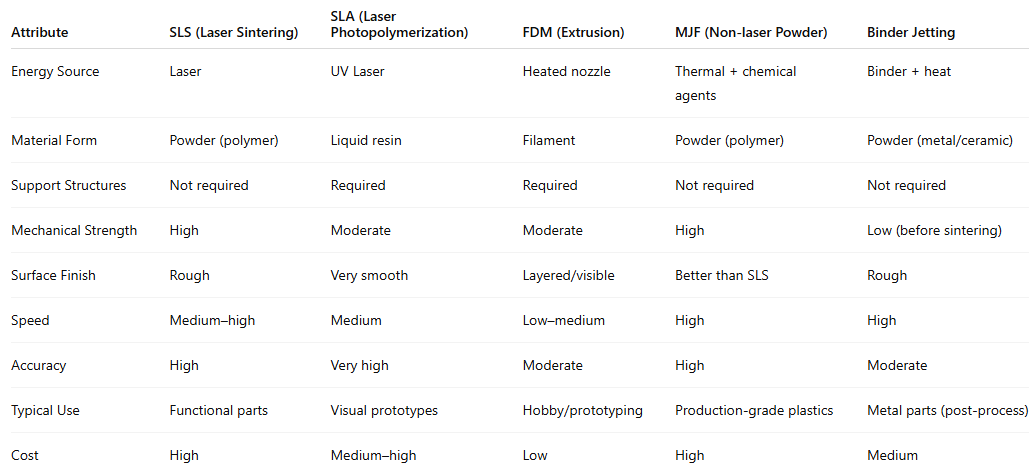
Below is a comprehensive comparison table positioning SLS against major additive manufacturing methods.
Table 1: SLS vs Other 3D Printing Technologies
Key insight:
SLS sits in a unique position where it balances mechanical performance, geometric freedom, and production capability, making it one of the most versatile additive technologies.
Comparison Within Laser-Based Technologies
Laser-based additive manufacturing includes multiple subtypes. Below is a focused comparison.
Table 2: SLS vs SLA vs DMLS/SLM
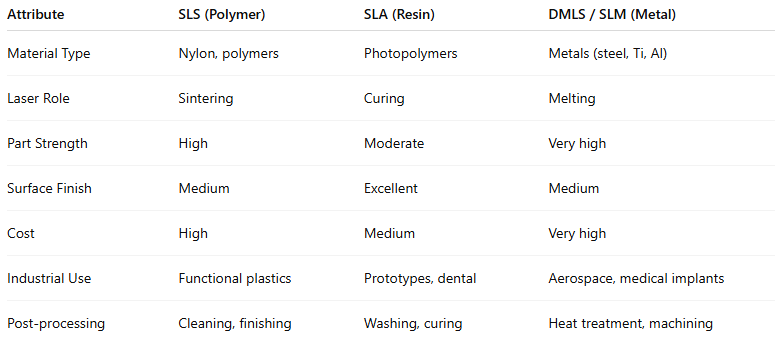
Takeaway:
- Use SLS for durable plastic components
- Use SLA for high-detail aesthetics
- Use DMLS/SLM for high-performance metal parts
Real-World Applications of Laser Sintering
1. Aerospace
- Lightweight ducting
- Brackets and housings
- Wind tunnel models
2. Automotive
- Functional prototypes
- Custom tooling
- Low-volume production parts
3. Medical
- Orthotics and prosthetics
- Patient-specific devices
4. Consumer Products
- Eyewear frames
- Footwear midsoles
- Wearable devices
5. Industrial Tooling
- Jigs and fixtures
- Casting patterns
SLS is particularly valuable in mass customization, where each part may differ slightly but must be produced efficiently.
SLS vs Injection Molding: When Does It Win?
While injection molding dominates high-volume production, SLS excels in:
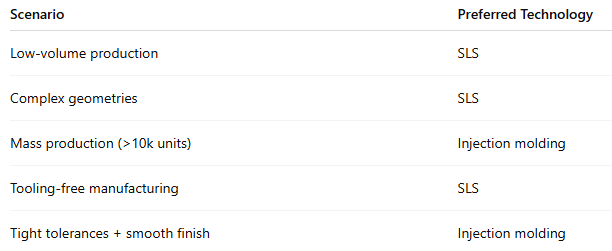
SLS eliminates tooling costs, making it ideal for:
- Rapid iteration
- Custom products
- Spare parts manufacturing
Emerging Trends in Laser Sintering
1. Material Innovation
New materials include:
- Carbon fiber-reinforced nylons
- Flame-retardant polymers
- Flexible elastomers
2. Process Automation
Modern systems feature:
- Automated powder handling
- Closed-loop thermal control
- AI-driven process optimization
3. Hybrid Manufacturing
Combining:
- SLS + CNC machining
- SLS + injection molding inserts
4. Sustainability
- Powder reuse strategies
- Reduced material waste
- Digital inventory replacing physical stock
Strengths and Weaknesses Summary
Strengths
- Complex geometries without supports
- Strong, functional parts
- Efficient batch production
- No tooling required
Weaknesses
- High capital cost
- Rough surface finish
- Limited transparency and aesthetics
- Thermal process complexity
When Should You Choose Laser Sintering 3D Printing?
SLS is the right choice when:
- You need functional, load-bearing plastic parts
- Your design includes internal channels or complex geometry
- You want to avoid tooling costs
- You are producing low-to-medium volumes
It is less suitable when:
- Ultra-smooth surfaces are critical
- Optical clarity is required
- Budget constraints favor low-cost methods like FDM
Final Thoughts
Laser sintering has transitioned from a prototyping tool into a production-ready manufacturing technology. Among additive processes, it uniquely combines:
- Mechanical performance
- Design freedom
- Manufacturing scalability
As materials improve and costs gradually decrease, SLS and related laser-based processes are expected to play an increasingly central role in digital manufacturing ecosystems.
For companies working in photonics, optics, and precision engineering, laser sintering represents not just a manufacturing method, but a strategic capability for rapid innovation and customization.


