Single-photon detectors in quantum technologies is the subject of this blog article.
Single-photon detectors and sources are essential building blocks for quantum technologies. They allow precise detection and controlled generation of individual photons, enabling breakthroughs in sensing, computing, and secure communications. In 2026, quantitative performance improvements continue to expand their practical use. This article provides a data-driven overview, including typical values, comparison tables, and simple formulae where relevant.
This article is brought to you by RPMC Lasers.
What Are Single-Photon Detectors and Sources?
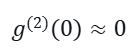
Single-photon detectors register the arrival of individual photons by converting them into electrical signals. Their sensitivity reaches the fundamental quantum limit. Single-photon sources emit photons one at a time. Ideal sources exhibit strong photon antibunching, quantified by the second-order correlation function:
Values of <0.5 confirm single-photon character. Lower values indicate higher purity.
Types of Single-Photon Detectors
Superconducting Nanowire Single-Photon Detectors (SNSPDs)
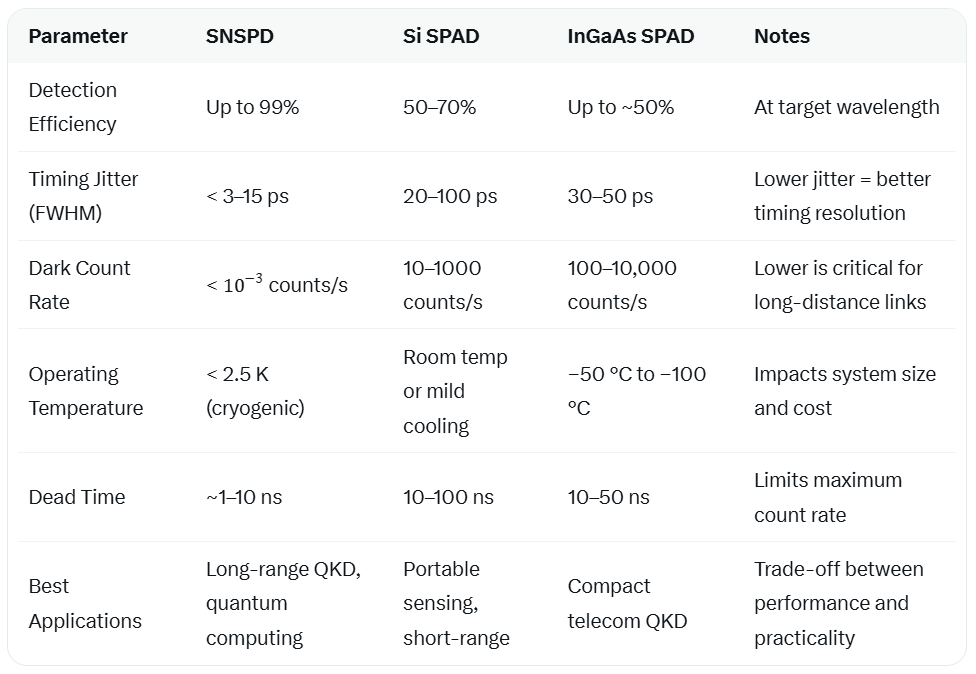
An SNSPD consists of a narrow superconducting nanowire biased near its critical current. Absorption of a single photon creates a resistive hotspot, generating a measurable voltage pulse. Typical quantitative performance (telecom wavelengths 1310–1550 nm):
- Detection efficiency: up to 99%
- Timing jitter: < 3 ps (FWHM); optimized systems achieve 4.3 ps
- Dark count rate: < 10^−3 counts/s
- Operating temperature: < 2.5 K (cryogenic)
SNSPDs deliver the best combination of efficiency, speed, and low noise for high-performance systems.
Single-Photon Avalanche Diodes (SPADs)
SPADs operate in Geiger mode. A single photon triggers a self-sustaining avalanche. Typical performance:
- Silicon SPADs (visible/NIR): Detection efficiency ~50–70%, jitter 20–100 ps, room temperature or moderate cooling
- InGaAs/InP SPADs (telecom): Detection efficiency up to ~50% (gated mode), jitter 30–50 ps, requires cooling to ~ −50 °C to −100 °C
SPADs offer compactness and lower cost but suffer from higher dark counts and afterpulsing.
Other Technologies
Transition-Edge Sensors (TES)
Transition-edge sensors offer true photon-number resolution, allowing them to distinguish between one, two, three, or more photons in a single pulse. They typically achieve high detection efficiencies (often above 90%) and excellent energy resolution. However, this comes at the expense of relatively slow response times — usually in the range of 1–10 microseconds. TES devices require millikelvin operating temperatures and are primarily used in specialized applications where photon-number resolution is critical, such as quantum state characterization, quantum computing readout, and astronomical observations.
Emerging Integrated Detectors
Significant research is focused on developing single-photon detectors that are directly integrated onto photonic chips. Waveguide-coupled SNSPDs and on-chip SPADs are among the leading approaches. These integrated detectors aim to combine high performance with improved scalability, lower optical losses, and compatibility with semiconductor manufacturing processes. While still maturing, they are considered essential for building large-scale quantum photonic circuits and practical quantum networks.
Comparison of Detector Technologies
The table below summarizes key quantitative differences.
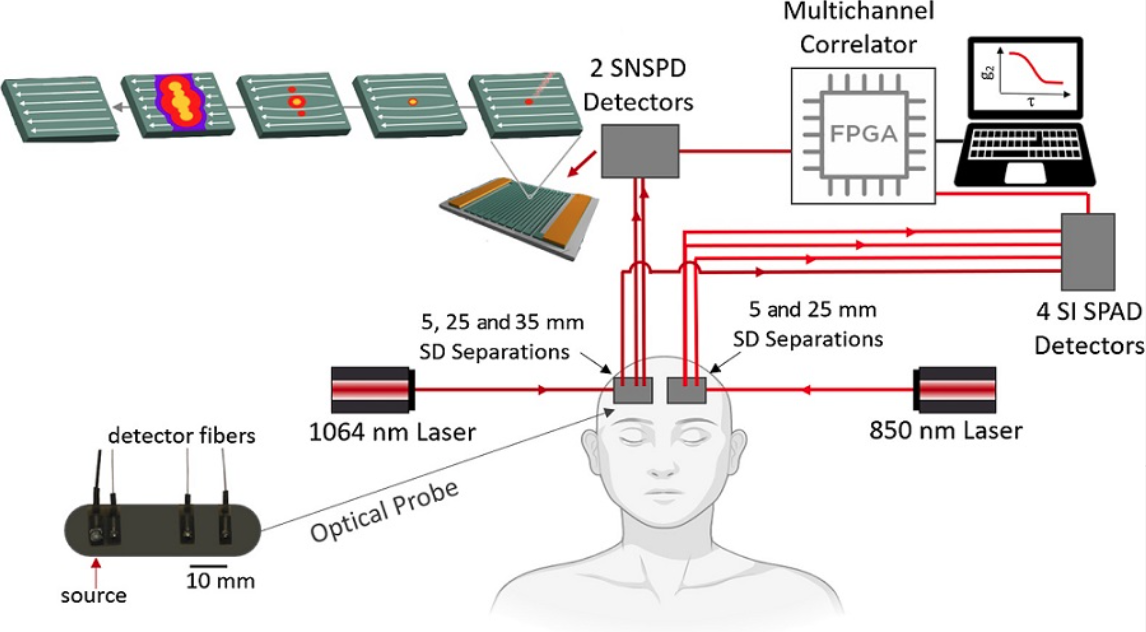
Example schematic showing SNSPDs in a multi-channel detection setup (illustrative of typical fiber-coupled configurations).
Single-Photon Sources
Quantum dot (QD) sources are among the most advanced deterministic emitters, especially at telecom wavelengths. Other common sources include spontaneous parametric down-conversion (SPDC) for entangled pairs. Key quantitative figures include:
- Brightness (photons per pulse or per second)
- Collection efficiency (often 10–50% with photonic structures)
- Indistinguishability (Hong-Ou-Mandel visibility > 90% in top devices)
Key Performance Metrics and Simple Formulae
Engineers evaluate detectors using these primary metrics.
Detection Efficiency
Detection efficiency (η) is defined as: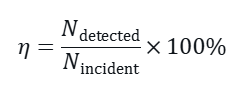
It represents the probability that an incoming photon will be successfully registered by the detector. This is one of the most critical performance parameters because it directly affects the overall system performance in almost every quantum application.
Higher detection efficiency improves the signal-to-noise ratio and increases the rate at which useful data can be collected. In quantum key distribution (QKD), for instance, the achievable secure key rate scales roughly linearly with detection efficiency. SNSPDs can reach efficiencies as high as 99% at telecom wavelengths (1310–1550 nm), while well-optimized InGaAs SPADs typically achieve around 40–50% in gated operation. Even a 10–20% improvement in efficiency can meaningfully extend the maximum transmission distance or increase the final key rate in fiber-based quantum communication systems.
In quantum sensing and imaging applications, higher detection efficiency allows weaker signals to be detected more reliably, improving measurement precision and reducing the required integration time.
Timing Jitter and Range Resolution
Timing jitter refers to the uncertainty in the exact moment a photon is detected. It is typically reported as the full width at half maximum (FWHM) of the timing distribution and is a key factor in applications that require precise timing information.
In time-of-flight measurements, such as quantum LiDAR or ranging systems, timing jitter directly limits spatial resolution according to the following relation: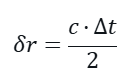
where c is the speed of light and Δt is the timing jitter (FWHM).
For example, an SNSPD with a timing jitter of 5 ps can achieve a range resolution of approximately 0.75 mm. In contrast, typical InGaAs SPADs with jitter in the 30–50 ps range are limited to resolutions of several millimeters under similar conditions.
Beyond ranging applications, low timing jitter is critical for quantum key distribution, where it enables higher clock rates and reduces errors caused by timing mismatches. In quantum computing, particularly for photonic and superconducting qubit readout, sub-10 ps jitter supports faster measurement cycles and improves overall system fidelity. SNSPDs currently lead in this metric, with demonstrated jitter values below 5 ps in optimized systems, while SPADs generally operate in the 30–100 ps range depending on the device and operating conditions.
Dark Count Rate Impact
Dark count rate (DCR) refers to the rate at which a detector registers false counts in the absence of any incident photons. These false events arise mainly from thermal noise, tunneling, or background radiation.
The signal-to-noise ratio in low-light or photon-starved conditions scales inversely with the dark count rate. A lower DCR is therefore essential for detecting very weak signals. SNSPDs typically achieve extremely low dark count rates, often below 10^−3 counts per second (and sometimes in the micro-counts per second range). In contrast, InGaAs SPADs commonly exhibit dark count rates between 100 and 10,000 counts per second, depending on temperature and gating conditions.
This difference has major practical consequences. In quantum key distribution, a high dark count rate increases the quantum bit error rate and limits the maximum secure transmission distance. In quantum sensing and long-integration-time experiments (such as astronomical observations or weak-signal detection), the ultra-low DCR of SNSPDs allows meaningful measurements over much longer periods without being overwhelmed by noise.
Dead Time and Maximum Count Rate
Dead time (also called recovery time) is the period after a detection event during which the detector cannot register another photon. This parameter directly limits the maximum count rate a detector can handle.
The theoretical maximum sustainable count rate is approximately:
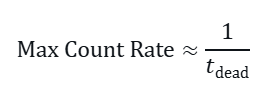
SNSPDs generally have shorter dead times (typically in the range of 1–10 ns) compared to many SPADs (often 10–100 ns). As a result, SNSPDs can support significantly higher sustained photon detection rates without significant pile-up effects.
This advantage is particularly important in high-speed quantum key distribution systems, where clock rates can reach hundreds of MHz or even GHz. In quantum computing readout and high-flux sensing applications, shorter dead times reduce measurement dead time and improve overall data throughput. While SPADs can sometimes achieve high peak count rates in gated mode, they are generally more limited for continuous high-rate operation compared to SNSPDs.
Applications in Quantum Sensing
Single-photon detectors enhance sensitivity in quantum LiDAR, ghost imaging, and precision metrology. Using the range resolution formula above, SNSPDs enable sub-millimeter resolution at long standoff distances. Quantum illumination protocols can achieve better signal-to-background performance than classical methods by exploiting photon correlations. Portable SPAD systems are deployed in automotive and airborne quantum-enhanced sensing, while cryogenic SNSPDs power laboratory and space-based instruments requiring ultimate sensitivity.
Applications in Quantum Computing
In photonic and superconducting quantum processors, detectors perform fast qubit readout. Low timing jitter (< 10 ps) supports high clock rates and reduces measurement errors. High detection efficiency (> 95%) minimizes loss-induced errors during error correction. SNSPDs are widely used in current photonic quantum computing demonstrations because their combination of speed and efficiency meets the stringent requirements of scalable systems.
Applications in Secure Quantum Communications
Quantum key distribution (QKD) is the most mature commercial application. Detector performance directly affects achievable secret key rate and maximum distance. Examples of quantitative results (recent demonstrations):
- Intercity QKD over 79 km deployed fiber using quantum dot sources + SNSPDs achieved MHz-level detection rates.
- SNSPDs enable longer links and higher rates than SPADs due to lower noise and higher efficiency.
- SPAD-based systems suit shorter metropolitan links where compactness is prioritized.
The secret key rate in QKD depends on detection efficiency, dark count rate, and timing jitter. Lower jitter allows higher repetition rates, while low DCR reduces the quantum bit error rate.
Challenges and Quantitative Trade-offs
Major limitations include:
- Cryogenic cooling requirements for SNSPDs (adds system cost and size)
- Higher dark counts and after pulsing in room-temperature SPADs
- Limited scalability of current detector arrays
Future progress focuses on higher-temperature SNSPDs, better integrated sources with g^2(0)<0.01, and hybrid detector technologies that balance the metrics shown in the comparison table.
Conclusion
Single-photon detectors and sources have reached impressive quantitative performance levels in 2026. SNSPDs offer near-ideal metrics (detection efficiency ~99%, jitter < 5 ps, extremely low dark counts) at the cost of cryogenics, while SPADs provide practical room-temperature solutions with good but lower performance. The simple formulae for efficiency and range resolution, combined with the comparison table, help engineers select the right technology for specific quantum sensing, computing, or communication needs.
As integration improves and new sources with higher brightness and lower g^2(0) become available, these components will continue driving the transition from laboratory demonstrations to real-world quantum systems. For photonics professionals, understanding these quantitative trade-offs is key to designing next-generation quantum devices.