
Laser drilling technology is the topic of this blog article
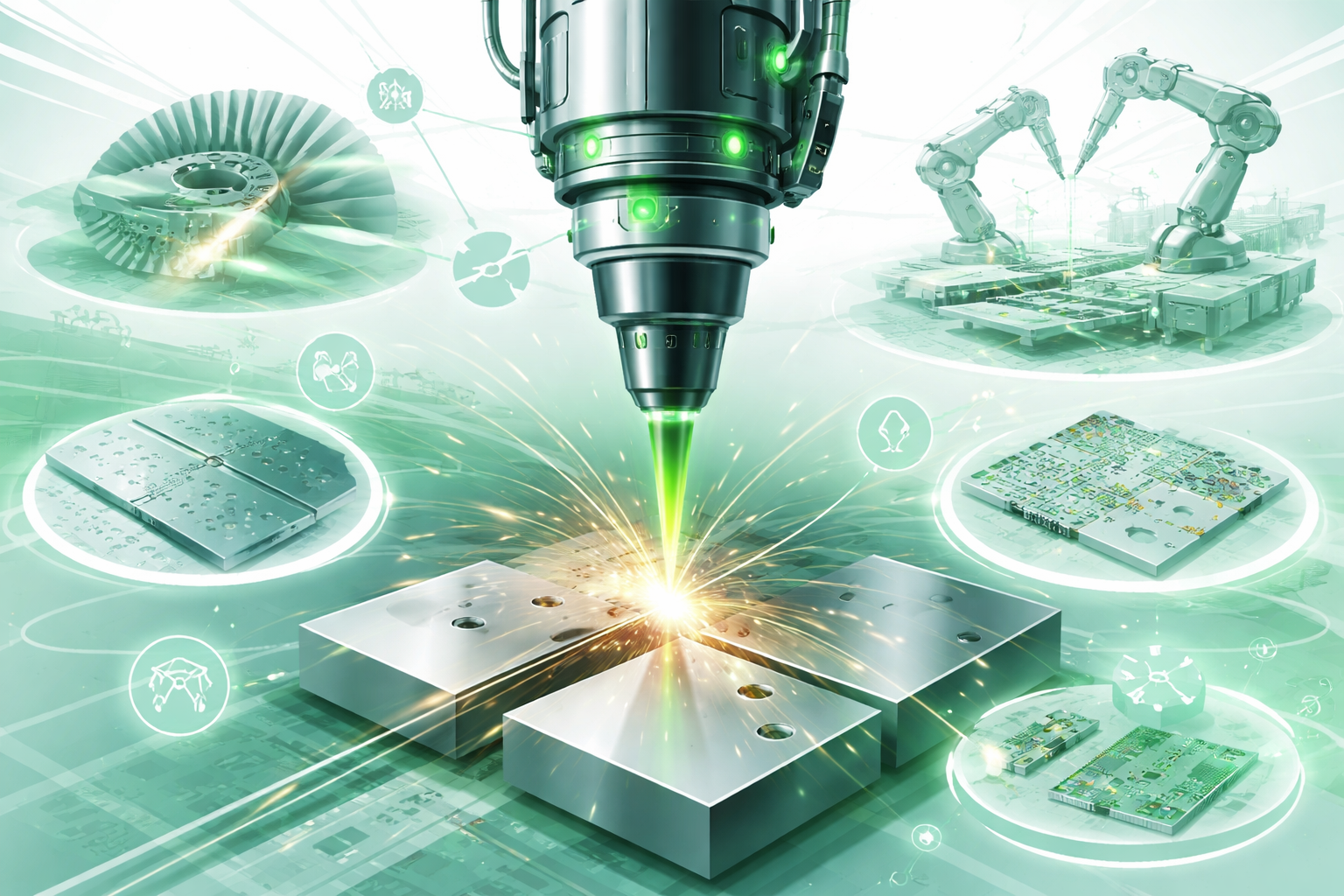
This article is brought to you by RPMC Lasers - your reliable source for ultrafast, solid-state, and diode lasers.
Introduction: Laser Drilling Technology
Laser drilling has evolved far beyond its early role as a niche micromachining tool used primarily for specialized industrial tasks. Today, it sits at the convergence of precision manufacturing, advanced materials science, and digitally integrated production environments. As industries demand ever-smaller features, tighter tolerances, and higher throughput, laser drilling has emerged as a cornerstone technology enabling modern fabrication at scales ranging from microns down to, increasingly, the nanoscale.
Across sectors such as aerospace, semiconductor manufacturing, medical device fabrication, and energy systems, laser drilling is enabling geometries that were previously impractical—or outright impossible with conventional mechanical methods. Turbine blades with intricate cooling hole patterns, high-density interconnects in advanced electronics, microfluidic channels in lab-on-chip devices, and next-generation battery components all rely on the ability to produce high-aspect-ratio, high-quality microholes with exceptional repeatability. Crucially, these features are not only smaller, but also more consistent, cleaner, and more scalable across large production volumes.
What truly distinguishes modern laser drilling from its earlier generations is not simply incremental improvements in power, speed, or beam quality. Rather, it is a fundamental shift in how laser–material interaction is understood, controlled, and engineered. The transition from predominantly thermal processes toward regimes governed by ultrafast laser–matter dynamics has enabled unprecedented precision. At the same time, innovations in beam shaping, temporal pulse structuring, and adaptive optics are allowing engineers to tailor energy deposition with remarkable accuracy, effectively “designing” the interaction at the point of contact.
Equally transformative is the integration of real-time process monitoring, machine vision, and data-driven control systems. Laser drilling is no longer a static process defined solely by preset parameters; it is becoming a dynamic, closed-loop operation capable of adjusting in real time to variations in material properties, geometry, and environmental conditions. This evolution aligns closely with broader Industry 4.0 trends, where intelligent manufacturing systems emphasize flexibility, traceability, and continuous optimization.
In this context, laser drilling is transitioning from a tool into a platform technology, one that can be adapted, scaled, and integrated across a wide range of applications. Whether enabling next-generation photonics, supporting electrification and energy storage, or advancing minimally invasive medical technologies, its role continues to expand.
This article explores the latest developments shaping the field of laser drilling, with a particular focus on ultrafast regimes, advanced process strategies, beam engineering, and the emerging industrial landscape that is redefining what is possible.
From Thermal to Athermal: The Rise of Ultrafast Laser Drilling
Traditional laser drilling relied primarily on nanosecond pulses, where material removal was governed by thermal processes: melting, vaporization, and resolidification. While effective, these processes often resulted in heat-affected zones (HAZ), recast layers, and microcracks.
The introduction of ultrafast lasers, particularly picosecond and femtosecond systems, has fundamentally changed this paradigm. Ultrafast pulses deposit energy on timescales shorter than thermal diffusion, enabling “cold ablation” where material is removed before heat can spread into the surrounding structure. This leads to:
- Minimal heat-affected zones
- Sub-micron feature sizes
- High aspect ratio holes
- Reduced debris and recast
These capabilities have made ultrafast laser drilling indispensable in high-value applications such as microelectronics, medical devices, and photonics manufacturing. Moreover, the rapid growth of the ultrafast laser market, projected to expand significantly through the next decade, reflects the increasing industrial demand for such precision processes.
Advanced Drilling Techniques: Beyond Percussion and Trepanning
While classical methods such as percussion drilling and trepanning remain relevant, modern laser drilling incorporates a range of advanced strategies designed to optimize quality and throughput.
Burst Mode Drilling
One of the most important recent innovations is burst mode operation, where a single pulse is divided into a sequence of closely spaced sub-pulses.
This approach offers several advantages:
- Enhanced material absorption
- Improved ablation efficiency
- Reduced plasma shielding
- Better control over melt dynamics
Recent studies show that GHz and MHz burst modes can significantly improve drilling efficiency in certain materials, particularly when combined with precise spatial pulse control.
Parallel Processing and Beam Splitting
To address industrial throughput challenges, laser systems increasingly use:
- Diffractive optical elements (DOEs)
- Multi-beam splitting
- Spatial light modulators (SLMs)
These techniques enable simultaneous drilling of multiple holes, dramatically increasing productivity without sacrificing precision.
Helical and Spiral Laser Drilling Technology
For applications demanding exceptionally high-quality hole walls, precise geometries, and minimal material stress, helical and spiral drilling methods are increasingly favored. Unlike conventional percussion or trepanning techniques, these methods involve a controlled circular or spiral motion of the laser beam, effectively “screwing” the energy into the material.
This approach offers several key advantages:
- Smooth sidewalls: The gradual, continuous motion minimizes abrupt thermal stresses, reducing microcracks and recast layers.
- Reduced taper: Helical motion ensures that holes maintain a consistent diameter from entrance to exit, improving tolerance in high-precision components.
- Improved roundness: The spiral trajectory compensates for beam divergence and material heterogeneity, producing more perfectly circular holes.
- Enhanced aspect ratios: By controlling feed rate and rotation, helical drilling can achieve deeper holes without sacrificing surface quality.
Helical and spiral drilling has found particular traction in aerospace components, microelectronics, and biomedical device manufacturing, where hole quality is critical not only for performance but also for long-term reliability.
Beam Engineering: Structured Light and Adaptive Optics
A major frontier in laser drilling is beam shaping, where the spatial and temporal characteristics of the laser are engineered to optimize material interaction.
Structured Light
Instead of a conventional Gaussian beam, structured beams such as:
- Bessel beams
- Vortex beams
- Top-hat profiles
are used to achieve deeper penetration, reduced diffraction, and tailored energy deposition. These beam profiles can produce non-diffracting or self-healing beams, enabling consistent drilling even in challenging geometries.
Adaptive Optics and AI Control
Modern systems increasingly incorporate:
- Real-time feedback loops
- Machine vision
- AI-driven process optimization
These technologies allow dynamic adjustment of:
- Pulse energy
- Focus position
- Beam shape
The result is a closed-loop drilling process that adapts in real time to material variations and process conditions.
Materials and Applications: Expanding the Envelope
Laser drilling is no longer limited to metals. Advances in laser technology have expanded its applicability across a wide range of materials.
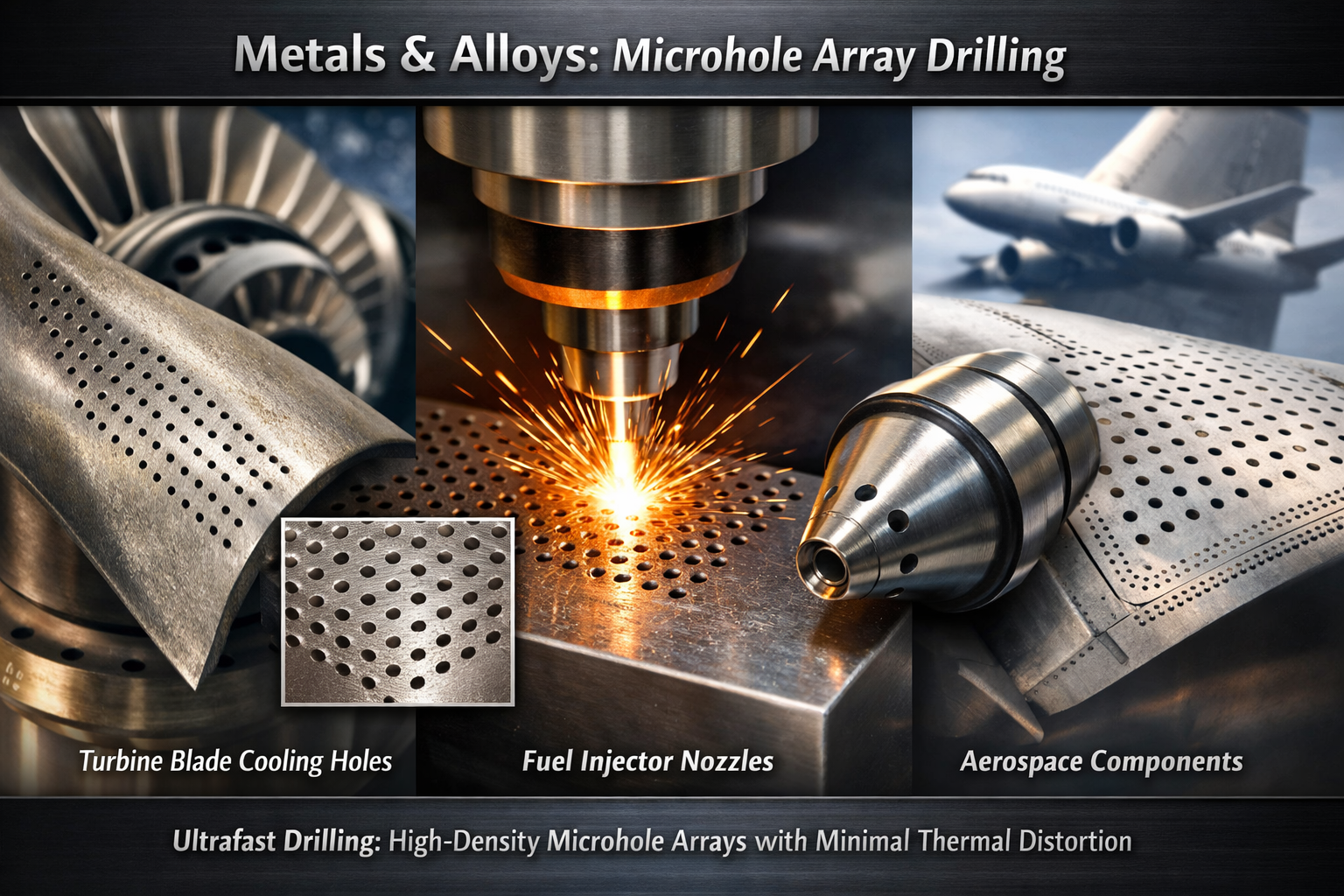
Metals and Alloys
Applications include:
- Turbine blade cooling holes
- Fuel injector nozzles
- Aerospace components
Ultrafast drilling enables high-density microhole arrays with minimal thermal distortion, critical for performance and reliability.
Glass and Transparent Materials
Through nonlinear absorption mechanisms such as multiphoton ionization, ultrafast lasers can drill:
- Fused silica
- Sapphire
- Optical glass
This capability is essential for photonics, microfluidics, and display technologies.
Polymers and Composites
Laser drilling is widely used in:
- Flexible electronics
- PCB manufacturing
- Medical devices
Recent research focuses on improving process control in composites, where heterogeneous structures pose unique challenges.
Emerging Applications
New frontiers include:
- Microfluidic channels and lab-on-chip devices
- Battery and EV components
- Biomedical implants and stents
- Optical fiber structuring
Even experimental techniques, such as laser-driven nanoparticle-assisted drilling, are opening entirely new fabrication possibilities at the nanoscale.
High-Throughput Manufacturing: Scaling Without Compromise
One of the central challenges in laser drilling has always been balancing precision with throughput. Recent innovations are addressing this trade-off.
High-Power Ultrafast Lasers
Modern systems now offer:
- Higher average power
- Increased repetition rates
- Improved beam quality
These advances enable faster material removal while maintaining ultrafast precision.
Multi-Axis and 5-Axis Systems
Complex geometries can now be drilled using:
- 5-axis motion systems
- Galvo scanners combined with stages
This allows precise drilling on curved or complex surfaces, such as turbine blades or medical implants.
Automation and Industry 4.0 Integration
Laser drilling systems are increasingly integrated into smart manufacturing environments, featuring:
- Robotic handling
- Inline inspection
- Data-driven optimization
These capabilities support mass customization and high-mix, low-volume production.
Challenges and Limitations
Despite its advantages, laser drilling still faces several technical and economic challenges.
Thermal Accumulation
Even with ultrafast lasers, high repetition rates can lead to heat buildup, affecting hole quality and process stability.
Process Complexity
Advanced techniques such as burst mode and beam shaping require:
- Precise calibration
- Sophisticated control systems
- Skilled operators
Cost Considerations
Ultrafast laser systems remain relatively expensive, both in terms of capital investment and maintenance.
Future Trends: Where Laser Drilling Technology Is Heading
Looking ahead, several trends are shaping the future of laser drilling.
AI-Driven Process Optimization
Machine learning models are being developed to:
- Predict optimal parameters
- Detect defects in real time
- Enable autonomous operation
Hybrid Manufacturing
Laser drilling is increasingly combined with:
- Additive manufacturing
- Laser welding
- Surface structuring
This creates integrated manufacturing workflows with enhanced functionality.
Extreme Precision and Nanoscale Fabrication
Advances in ultrafast and even attosecond lasers are pushing drilling into the nanoscale regime, enabling:
- Quantum device fabrication
- Advanced photonics
- Next-generation sensors
Sustainability and Efficiency
Laser drilling is inherently a non-contact, chemical-free process, making it more environmentally friendly than many traditional methods. Ongoing developments aim to further reduce energy consumption and material waste.
Conclusion
Laser drilling has entered a new era defined by ultrafast physics, intelligent control, and industrial scalability. What was once a thermal machining process is now a highly precise, tunable, and increasingly autonomous technology. As ultrafast lasers become more powerful and accessible, and as digital manufacturing continues to evolve, laser drilling will play an even more central role in shaping the future of advanced manufacturing.
From microelectronics to aerospace and biomedical engineering, the ability to create precise, high-quality holes at scale is no longer a limitation, it is a competitive advantage.


