
B2B social media marketing rarely gets the same attention as its consumer counterpart. There are no viral trends, no influencer deals, no algorithm-chasing. For technology, industrial, and technical companies, that’s exactly what makes it worth doing well. While everyone else fights for attention, a deliberate presence on the right platforms works in your favor. It puts your expertise directly in front of engineers, scientists, and technical buyers evaluating their next purchase. The payoff is measurable. Brand-follower spending on social media rose from 12% to 75% in a single year, according to one industry study, and that loyalty compounds the longer a brand stays visible and consistent. This guide breaks down B2B social media marketing into four practical steps: choosing the right platform, setting goals you can track, building a consistent brand image, and keeping a posting cadence that actually works.
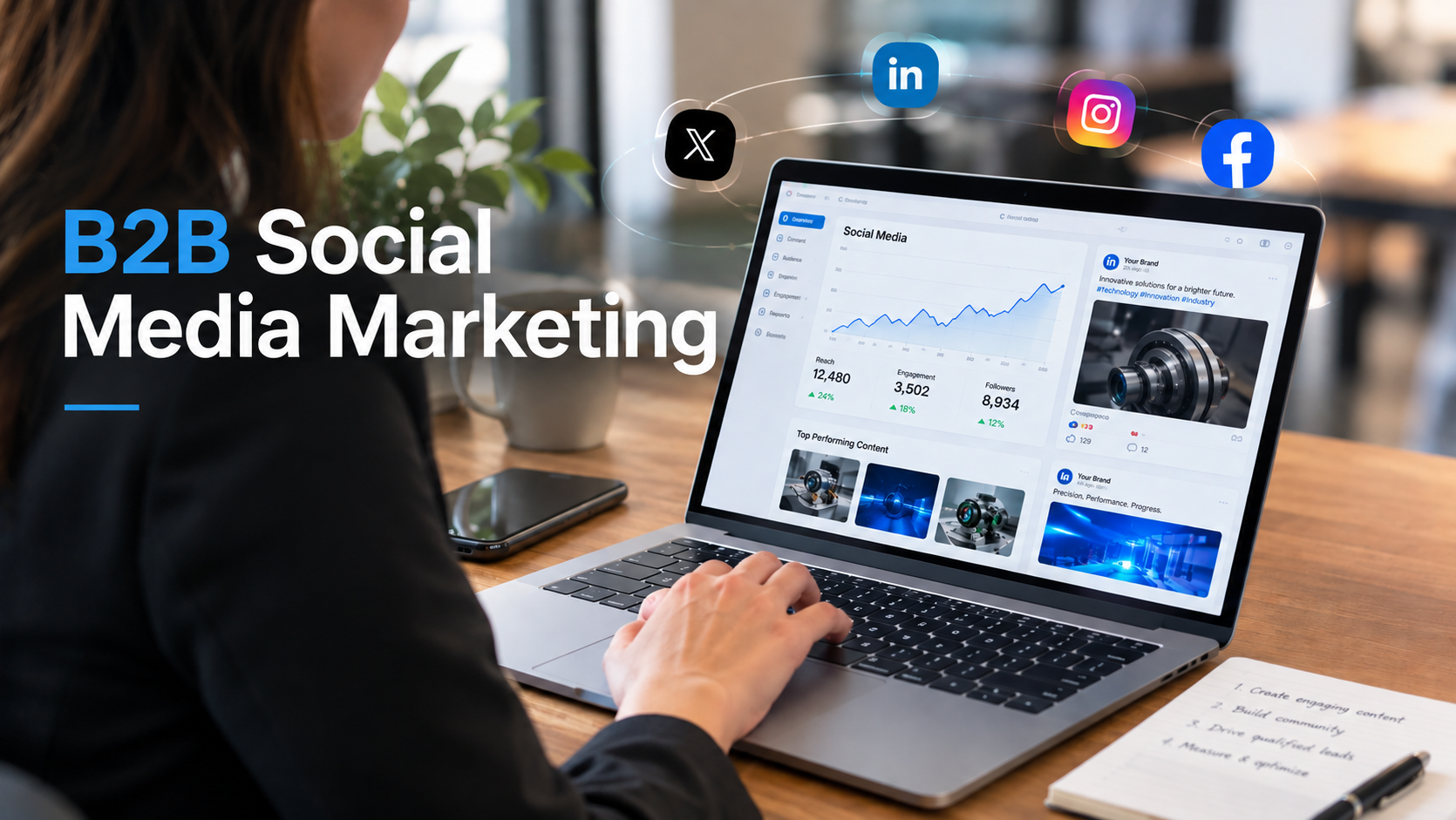
B2B social media marketing combines content, engagement, and analytics to reach business audiences.
Why B2B Social Media Marketing Builds Brand Loyalty
Social media accounts do more than post updates. They widen every pathway your target audience has to find you. Many B2B companies already invest in content creation — blog posts, white papers, in-depth technical notes — to build thought leadership and establish themselves as a market authority. Social media is simply the fastest, cheapest channel to distribute that expertise: a single post with a link can turn a technical article into a qualified lead, and every share extends that reach into networks you’d otherwise never touch. Think of social media as the highway system connecting your expertise to the people who need it — the more entry points you build, the stronger your presence becomes within your target market.

Photo by NordWood Themes on Unsplash
This matters more in B2B than most marketers assume. A widely cited IDC study conducted for LinkedIn found that 75% of B2B buyers use social media to support their purchase decisions — and that figure climbs to 84% among C-level and VP-level executives specifically. For companies selling to engineers, scientists, and technical decision-makers, that means social media isn’t a nice-to-have awareness channel — it’s already part of how your buyers evaluate you, whether or not you’ve shown up there yet.
Trust, Transparency, and Long Sales Cycles
There’s also a trust dimension unique to social platforms. A study from the University of Hawaii found that when a consumer is able to interact with a brand via social media, they’re more likely to feel a sense of membership — a finding that holds especially true in technical communities, where credibility is built by actually engaging with questions and discussion rather than broadcasting at an audience. Answering a technical question in a LinkedIn comment thread, weighing in on an industry debate, or sharing how a real customer solved a problem does more for brand loyalty than a polished product announcement ever will.
Being active on social media also builds transparency. If there’s an issue with a product, a supply chain delay, or a shift in your company’s direction, your social accounts are often the fastest, most direct way to keep customers informed, which matters even more in industries where buying cycles are long and trust has to be earned well before a deal closes.
Step 1: Pick the Right Platform for a Technical Audience
When you’re building a B2B social media marketing strategy, the first decision is picking the right platform before creating a single post. It’s also the one most companies get wrong. Consider your current audience, or the audience you’d like to target. Where do your potential customers actually spend their time, and how much does demographic fit matter versus reach?
Where Your Audience Actually Spends Time
Platform choice should follow audience, not habit. TikTok might make sense for a consumer brand, since 62% of the app’s users fall between ages 10 and 29, but that skews far younger than most B2B buying committees. If your audience is primarily academic, X tends to have stronger reach. For most B2B technology and industrial companies, LinkedIn is where the audience already is. 87% of B2B marketers use LinkedIn, according to Statista, and roughly four out of five LinkedIn members are reported to influence business purchasing decisions at their companies. If your buyers are engineers or technical decision-makers, LinkedIn is rarely optional.
Beyond LinkedIn
LinkedIn isn’t the only channel worth building. YouTube remains one of the most underused platforms in B2B and industrial marketing. It’s a natural fit for product demos or facility walkthroughs. For companies whose buyers participate in technical forums, a presence on X or niche engineering communities can put you directly inside conversations your prospects are already having. These channels need a lighter, more participatory touch than a broadcast-style LinkedIn page.
Know Your Audience’s Real Demographics
The easiest way to find out where your audience spends time is to check your own website traffic through an analytics tool. Google Analytics, a free platform, gives you data on your visitors’ age groups, geography, and more. That tells you far more about your audience’s real behavior than industry-wide averages can. Whatever platform you choose, it should let you actually engage with your audience instead of just broadcasting at it. Kelley Myers, director of social media for consumer brands at Microsoft, put it well: “Social is a place for us to be more personal, to be more relevant, to be, in some ways, more candid because we’re literally in the same space that our audiences exist for themselves.”

Photo by Carlos Muza on Unsplash
Going International
A localized website with multiple language options isn’t always realistic, and that can limit your presence in some regions. A social media platform popular in a specific market can act as a workaround. Weibo and WeChat, for instance, are dominant in the APJ region. Building a presence there creates brand awareness with a new audience, and it can also open an early-adoption pathway for your technology among customers you wouldn’t otherwise reach.
Step 2: Set SMART Goals You Can Actually Track
The core of your B2B social media marketing strategy is a set of goals, and they need to be more than aspirations. Goals should be SMART: specific, measurable, achievable, realistic, and timely. A goal like “get better at social media” isn’t actionable. A goal like “grow LinkedIn engagement 15% in 90 days” is something you can track and adjust.
Common goals for B2B social media marketing include:
- Improving website traffic from social referrals
- Growing newsletter signups
- Increasing awareness of a new product or launch
- Building a community around your brand
- Increasing engagement on a specific platform
Match Each Goal to a Real Metric
Each of these goals maps to a specific metric your platform’s analytics already track. Website traffic ties to click-through rate and referral traffic in Google Analytics. Newsletter signups tie to conversion rate on your link-in-bio or post CTAs. Product awareness ties to impressions and reach. Community building ties to follower growth and comment activity. Of all these, engagement tends to matter most. It’s a leading indicator that predicts the others. An audience that engages frequently with your brand is more likely to follow you across other channels too. That interaction compounds your reach over time.
Different platforms call for different goals, too. LinkedIn rewards thoughtful, professional engagement like comments and shares on long-form posts. Twitter/X rewards frequency and timeliness. Treating every platform the same way usually means doing all of them poorly.
Step 3: Build a Consistent Brand Image
Every post you make on social media contributes to your brand’s image and reputation. Brand image is what people assume about you before they even interact with your company. It includes the aesthetics, values, and attitude you communicate through every post.
Define Your Visual Style
Your aesthetic matters even on less visual-first platforms like LinkedIn or X. Decide on a consistent look before you start posting. Will you use high-quality photography with specific color grading and consistent fonts? Or will your content feel more casual, filmed on a smartphone and featuring the same recurring people? Neither approach is wrong, but switching between them randomly makes your brand harder to recognize. A consistent aesthetic across platforms is one of the easiest ways to build recognition over time.
Go Beyond the Logo
Branding on social media has to go beyond a logo and a color palette. How will your brand actually interact with customers? Will you curate broader industry news, promote your own products, or do both?
B2B and industrial brands don’t need a consumer playbook to do this well. General Electric built one of the most cited industrial social media strategies around exactly this question. Its #6SecondScienceFair campaign turned jet engines, wind turbines, and medical equipment into short, visually striking clips. The result made technical engineering genuinely shareable. GE’s former CMO Linda Boff said the goal was real conversations with consumers, employees, and investors, not a broadcast.
On the consumer side, PlayStation offers a different but related lesson. It uses social media to preview new products, show gameplay footage, and promote events. It also built goodwill during the pandemic with its #PlayAtHome initiative, encouraging followers to stay home and play. Both brands succeed for the same underlying reason. They use social media to show real substance instead of just announcing it.
Step 4: Create a Posting Cadence and Stick to It
Consistency matters at every stage of your B2B social media marketing strategy. That means staying consistent with your posting schedule, brand image, voice, and tone across every platform you use.
How Often Should You Actually Post?
More isn’t always better. One analysis of 247 B2B LinkedIn company pages over 18 months found a clear pattern. Pages posting two to three times a week generated 4.7 qualified leads per month on average. Pages posting daily generated only 2.1. The pages posting three times less often actually generated more than twice the qualified leads. A steady rhythm, like every Monday and Thursday, or Monday, Wednesday, and Friday, tends to outperform a flood of content.
A predictable schedule builds a relationship with your audience. People who follow you develop a general sense of when you post. They’ll know when to expect to interact with your brand. Get specific: pick the days, the times, and the number of posts per week, and stick to it.
Trial and error is part of the process. As you build your presence, some posts will land and others won’t. Once your brand finds its place on social media, a consistent schedule takes over. It turns early experiments into sustained, long-term growth.
Quick-Reference Checklist
Before you publish another post, run through this list:
- Pick your platform based on audience, not habit. LinkedIn for most B2B and technical buyers, Twitter/X for academic audiences, YouTube for product demos, regional platforms like Weibo or WeChat if you’re expanding internationally.
- Set SMART goals and track a real metric for each one. Website traffic, newsletter signups, impressions, follower growth, or engagement, whichever ties to your actual business goal.
- Build a consistent brand image across every platform. Same visual style, same tone, same way of showing up, whether that’s a GE-style technical showcase or something entirely your own.
- Post two to three times a week and hold the line. Consistency beats volume. A steady rhythm builds trust faster than a flood of content.
B2B social media marketing rewards patience over virality. Do these four things consistently, and the results compound over months, not days.
Don’t Have the Bandwidth to Do This Yourself?
Building a consistent B2B social media marketing strategy takes real time, and not every team has someone dedicated to it. If you’re a FindLight seller who’d rather have the distribution handled for you, our Promoted Content service puts your product or announcement in front of more than 55,000 social media followers across X, Facebook, and LinkedIn, plus a homepage banner and a blog backlink, starting at $275 per campaign. It won’t replace an ongoing strategy, but it’s a fast way to get real reach on a specific launch while you build your own presence.


