
AI-powered photonics product discovery – FindLight’s platform advancement feature introduced earlier this year – is the topic of this news article.
Finding the right photonics component often requires more than a simple keyword search.
A buyer may know the application they are working on, the wavelength they need, or the measurement they are trying to perform—but not necessarily the exact product name or specification they should be searching for. Even after finding a promising product, technical questions can arise about specifications, compatibility, applications, or how a particular component compares with other solutions.
FindLight is making that process easier with AI-powered assistance directly on product listing pages.
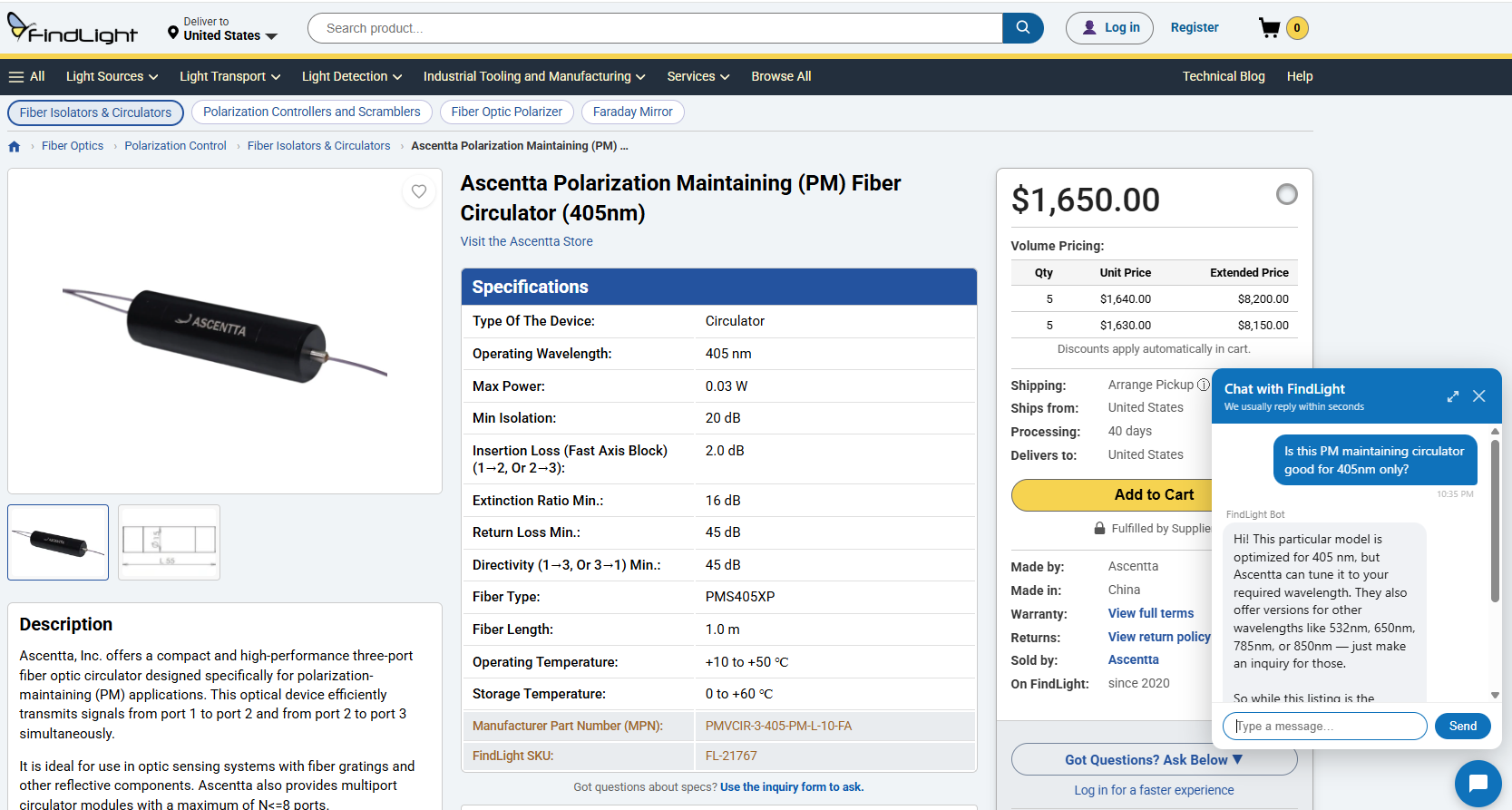
Example product page with a user prompt to get the AI assistant’s help on technical questions
A New Way to Explore Photonics Products
FindLight’s AI assistant is designed to help buyers interact with product information in a more natural way. Instead of relying exclusively on menus, filters, specifications, and keyword searches, users can ask questions about a product or describe what they are trying to accomplish.
For example, a buyer evaluating an ultrafast laser might want to know whether a particular repetition rate is appropriate for an application, what pulse duration means for a measurement, or whether the laser could serve as a seed source for another system. A user looking at an optical filter might instead want to understand its tuning range, wavelength compatibility, or whether it is suitable for a particular fiber-based setup.
Rather than requiring the buyer to already know the terminology used by manufacturers, the AI assistant provides another way to navigate the technical information available on FindLight.
From Product Search to Product Understanding
Traditional product search is particularly challenging in photonics because the terminology is highly technical and the relevant specifications vary substantially between product categories.
A search for a laser, for example, may involve wavelength, average power, pulse duration, repetition rate, beam quality, spectral bandwidth, polarization, coherence, or a combination of many of these parameters. Similarly, selecting an optical component can require understanding parameters such as aperture, coating range, transmission, damage threshold, dispersion, numerical aperture, or fiber compatibility.
FindLight already provides technical specifications and filtering tools to help buyers narrow down products. The AI assistant adds another layer: the ability to ask questions in natural language and receive assistance while evaluating a product.
This can be particularly useful when a buyer knows what they need to accomplish but is less certain about which technical parameters matter most.
Ask Technical Questions While Looking at a Product
One of the key advantages of placing the AI assistant directly on product pages is context. Rather than starting a completely separate conversation and explaining which product is being considered, the user can ask questions while viewing the product itself.
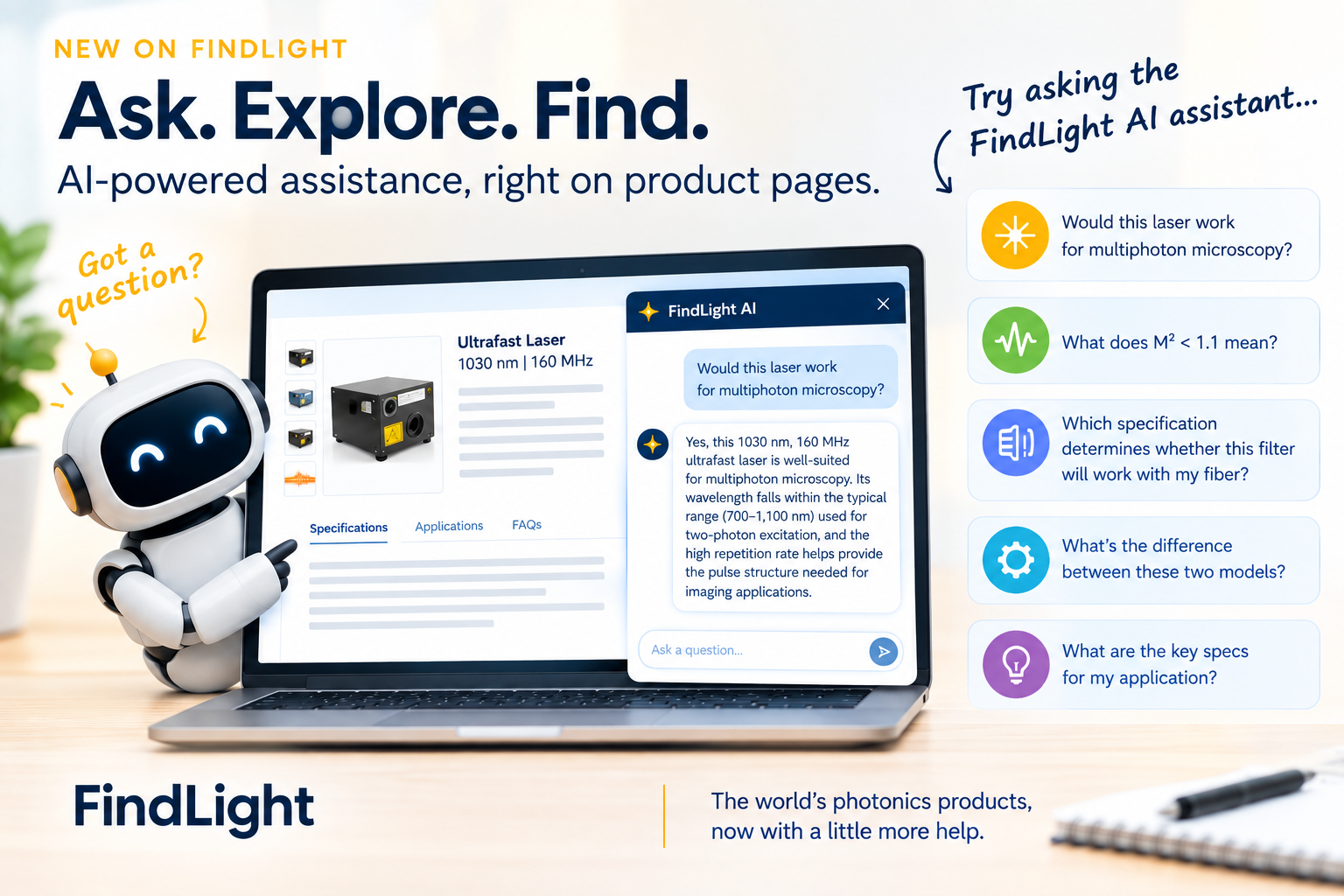
Questions can range from basic clarification to more technical considerations, such as:
- “What is this product designed for?”
- “Would this wavelength work for my application?”
- “What does the specified pulse duration mean?”
- “How does the repetition rate affect the pulse energy?”
- “What are the most important specifications to compare with another laser?”
- “Would this component be suitable for a fiber-coupled system?”
This makes the product page more than a static catalog entry. It becomes an interactive resource for learning about and evaluating technical products.
Helping Buyers Who Don’t Know Exactly What They Need
The technology can also be useful earlier in the purchasing process. A researcher or engineer may arrive at FindLight knowing the problem they need to solve rather than the product they need.
For example:
“I need a light source around 1030 nm for a high-speed optical measurement system.”
Or:
“I need to selectively tune a narrow wavelength range in a fiber-based setup.”
These questions describe an application rather than a specific commercial product. AI-assisted guidance can help bridge the gap between the user’s requirements and the terminology used to describe products in the photonics industry.
This is an important distinction for FindLight. The goal is not simply to help users search faster. It is to help them understand what they are looking for and make better-informed purchasing decisions.
AI That Works Alongside FindLight’s Product Data
FindLight is a specialized marketplace for lasers, optics, fiber optics, imaging, metrology, motion control, and other photonics technologies. The platform organizes products using industry-specific categories, specifications, and technical information to make specialized products easier to discover.
The AI assistant builds on this product-centric approach. Instead of treating AI as a general-purpose chatbot disconnected from the marketplace, FindLight integrates AI assistance into the product discovery experience itself. The result is a more conversational way of interacting with the technical information already available on the platform.
Making Photonics Sourcing More Efficient
For engineers, researchers, procurement teams, and other technical buyers, finding a suitable product can involve several stages:
Define the requirement → identify relevant product types → understand technical specifications → compare available products → contact suppliers.
AI assistance can help reduce the friction between these steps. A buyer can use the assistant to clarify terminology, understand specifications, explore potential applications, and determine which characteristics deserve closer attention before contacting a supplier. Once a promising product has been identified, FindLight’s existing inquiry process allows buyers to contact the supplier directly for additional information, pricing, availability, and application-specific questions.
The AI assistant therefore complements rather than replaces the supplier relationship.
AI Assistance, Not a Replacement for Engineering Expertise
Photonics products can be highly application-specific, and no AI system can replace detailed engineering analysis or direct communication with a manufacturer. FindLight’s AI assistant is intended to make product information easier to understand and help buyers navigate the discovery process. For application-specific requirements, final product selection, performance guarantees, compatibility questions, and custom configurations, buyers should continue to consult the product manufacturer or supplier.
That combination—AI-assisted discovery followed by direct access to specialized suppliers—is particularly valuable in a technical marketplace.
A More Conversational Photonics Marketplace
The introduction of AI assistance reflects a broader evolution in how engineers and researchers find technical products.
Product discovery is moving beyond the traditional model of entering a keyword, opening a product page, and manually working through specifications. Increasingly, users expect to be able to describe a problem, ask questions, and interact with technical information conversationally.
For FindLight, the objective is straightforward: make the world’s photonics products easier to find, understand, compare, and source. With AI assistance now available directly within the product discovery experience, buyers have another tool for navigating an increasingly broad and technically sophisticated marketplace.
FindLight is continuing to develop its platform around a simple idea: finding the right photonics technology should be easier than it has traditionally been.