
Optical fiber standards in data centers and telecom is the subject of this blog article.
Disclosure: this article contains sponsored content
This article is brought to you by j-fiber - high-performance optical fibers Made in Germany
Table of Contents
ToggleIntroduction
As global data consumption continues to surge, driven by AI workloads, cloud computing, 5G expansion, and edge infrastructure, the role of optical fiber in enabling high-speed, low-latency communication has never been more critical. For engineers designing and maintaining modern networks, understanding optical fiber standards is no longer optional; it is essential for ensuring interoperability, scalability, and long-term performance.
In 2026, the landscape of fiber standards is evolving to accommodate higher data rates, denser architectures, and increasingly complex deployment environments. From hyperscale data centers to metropolitan telecom networks, the choice of fiber type and adherence to established standards directly impact both performance and cost efficiency.
This article explores the key optical fiber standards shaping today’s infrastructure and what engineers need to consider when designing future-ready systems. It also examines how emerging technologies, evolving bandwidth demands, and stricter performance requirements are influencing standardization efforts, helping engineers make informed decisions that balance immediate needs with long-term network resilience and upgradeability.
Why Optical Fiber Standards Matter
Optical fiber standards in data centers and telecom and beyond exist to ensure that components from different manufacturers work seamlessly together. In large-scale environments such as data centers and telecom networks, this interoperability is crucial. Without standardized specifications, network upgrades would be costly, integration would be error-prone, and performance would be unpredictable.
Standards define parameters such as core size, bandwidth, attenuation, connector compatibility, and transmission distance. They also provide guidance on testing methods and compliance requirements, enabling engineers to make informed decisions when selecting components.
Beyond interoperability, standards also serve as a roadmap for future scalability. By adhering to recognized classifications, organizations can design infrastructure that supports higher data rates without requiring complete system overhauls.
Multimode vs. Singlemode Fiber: The Core Distinction
At the heart of fiber optic design lies the distinction between multimode and singlemode fibers. Each serves a different purpose and is governed by its own set of standards.
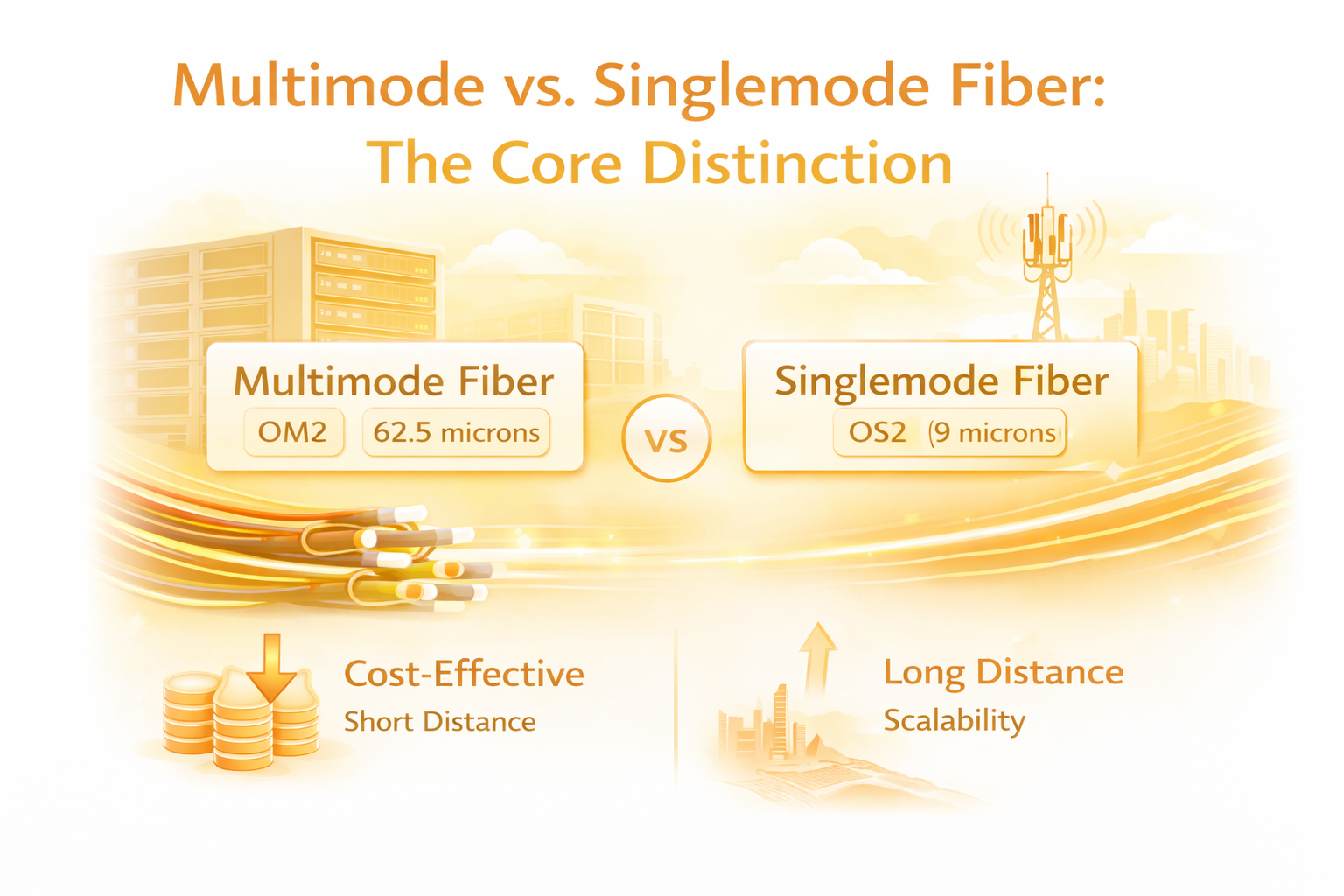
Multimode fiber (MMF) features a larger core, typically 50 or 62.5 microns, allowing multiple light modes to propagate simultaneously. This makes it well-suited for short-distance, high-bandwidth applications such as intra-data center connections. Multimode systems are generally more cost-effective in terms of transceivers, making them attractive for high-density deployments.
Singlemode fiber (SMF), by contrast, has a much smaller core, e.g. around 9 microns, allowing only a single propagation mode. This significantly reduces modal dispersion, enabling transmission over much longer distances with higher signal integrity. As a result, singlemode fiber is the preferred choice for telecom backbones, long-haul networks, and increasingly, hyperscale data centers.
The decision between multimode and singlemode is not simply a technical one; it is also economic. Engineers must balance upfront costs with long-term scalability, considering factors such as future bandwidth requirements and upgrade paths.
Understanding OM and OS Classifications
To standardize performance characteristics, optical fibers are categorized into specific classes. For multimode fibers, these are the OM (Optical Multimode) classifications, while singlemode fibers are defined by OS (Optical Singlemode) standards.
OM Standards (Multimode Fiber)
OM classifications define bandwidth and performance for multimode fibers:
- OM1 and OM2 are legacy fibers, largely phased out in modern installations.
- OM3 introduced laser-optimized fiber, supporting 10 Gb/s over moderate distances.
- OM4 extended performance for 40 Gb/s and 100 Gb/s applications.
- OM5, the most recent standard, supports short wavelength division multiplexing (SWDM), enabling multiple wavelengths to increase capacity over a single fiber.
OM5 is particularly relevant in 2026, as data centers seek to maximize bandwidth without significantly increasing fiber count. Its ability to support parallel transmission technologies makes it a forward-looking choice for high-density environments.
OS Standards (Singlemode Fiber)
Singlemode fibers are primarily classified into:
- OS1, typically used for indoor applications with tighter attenuation specifications
- OS2, optimized for outdoor and long-distance transmission with lower attenuation
OS2 has become the dominant standard for modern telecom and large-scale data center interconnects due to its superior performance over long distances.
Key Standards Bodies and Specifications
Several organizations define and maintain optical fiber standards, ensuring global consistency.
The International Telecommunication Union (ITU) plays a major role in defining singlemode fiber standards, particularly through the G.65x series. These specifications address fiber characteristics such as dispersion, attenuation, and wavelength compatibility.
The Telecommunications Industry Association (TIA) is responsible for many of the standards used in North America, including OM classifications and structured cabling guidelines.
Meanwhile, the International Electrotechnical Commission (IEC) provides global standards for fiber performance, testing, and safety.
For engineers, familiarity with these standards is critical. In many cases, compliance with multiple standards bodies is required, especially for systems deployed across different regions.
Data Center Requirements in 2026
Modern data centers are evolving rapidly, with increasing demands for speed, density, and flexibility. The transition to 400G and 800G Ethernet is already underway, and early discussions around 1.6T are emerging.
These trends place new demands on fiber infrastructure. High-density cabling systems must support greater bandwidth while maintaining manageable power consumption and thermal performance. In this context, fiber standards play a crucial role in enabling efficient scaling.
Multimode fiber remains relevant for short-reach connections within racks and rows, particularly where cost sensitivity is high. However, many hyperscale operators are shifting toward singlemode fiber even for shorter distances, citing its superior scalability and alignment with future standards.
Another important consideration is connector technology. High-density connectors such as MPO/MTP are becoming standard, allowing multiple fibers to be connected in a single interface. These connectors must also comply with strict alignment and performance standards to ensure reliable operation at high data rates.
Telecom Network Evolution
In the telecom sector, the deployment of 5G and the expansion of fiber-to-the-home (FTTH) networks are driving significant infrastructure upgrades. These applications require fibers that can support long distances, high reliability, and minimal signal loss.
Singlemode fiber, particularly OS2, remains the backbone of these networks. However, new variants such as bend-insensitive fibers are gaining traction, especially in urban environments where installation constraints are more challenging.
Standards also play a role in enabling advanced technologies such as dense wavelength division multiplexing (DWDM), which allows multiple signals to be transmitted simultaneously over a single fiber. This capability is essential for maximizing the efficiency of existing infrastructure.
As telecom networks become more software-defined and data-driven, the importance of reliable physical infrastructure remains unchanged. Fiber standards ensure that this foundation can support increasingly complex network architectures.
For consumers, reliable home connectivity also depends on how effectively the broadband connection is distributed within the home. A Wi-Fi range extender such as the NETGEAR AC750 WiFi Range Extender can help extend wireless coverage to areas where the signal from the primary router is weaker.
Emerging Trends and Future Directions
Looking ahead, several trends are shaping the evolution of optical fiber standards.
One key development is the increasing use of wavelength multiplexing in both multimode and singlemode systems. Technologies such as SWDM and DWDM are enabling higher data rates without requiring additional fibers, improving both efficiency and cost-effectiveness.
Another trend is the push toward higher fiber counts in cables and connectors. As data center densities increase, engineers must find ways to manage large numbers of fibers within limited physical space. This is driving innovation in cable design, connector technology, and installation practices.
Sustainability is also becoming a consideration. Efficient fiber infrastructure can reduce power consumption by enabling more efficient data transmission and minimizing the need for active components.
Finally, the integration of photonics into broader system design is becoming more pronounced. Optical interconnects are moving closer to the chip level, blurring the line between traditional networking and advanced photonics applications.
Best Practices for Engineers
Designing with fiber standards in mind requires a holistic approach. Engineers should consider not only current requirements but also future scalability. Choosing standards-compliant components ensures compatibility and simplifies future upgrades.
It is also important to validate vendor specifications against recognized standards. Not all products marketed as “high-performance” meet the necessary compliance criteria, and discrepancies can lead to performance issues down the line.
Documentation and testing are equally critical. Proper certification of fiber links ensures that installations meet required performance thresholds and can support intended applications.
Finally, collaboration between design, procurement, and operations teams is essential. Fiber infrastructure decisions have long-term implications, and alignment across stakeholders helps ensure optimal outcomes.
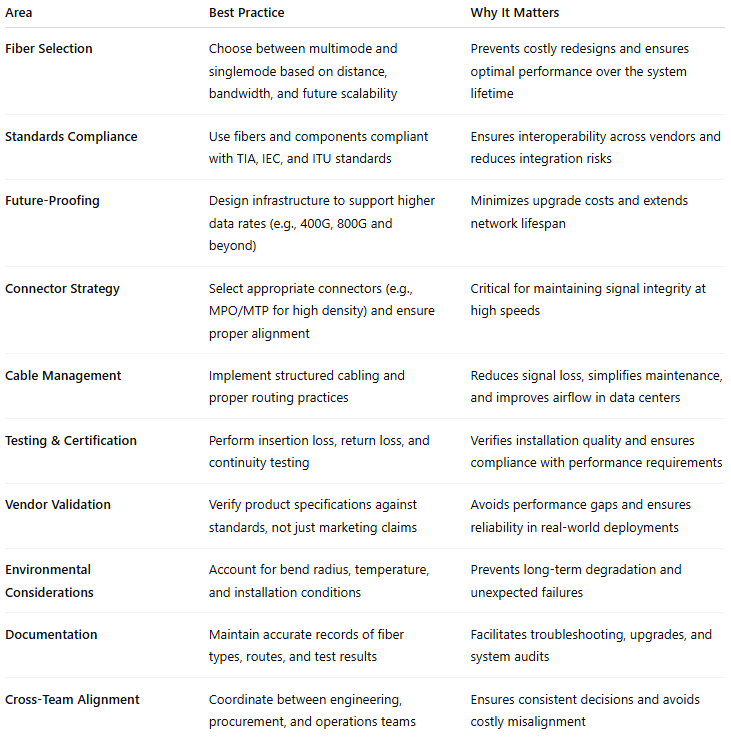
Summary of Best Practices for Engineers
Conclusion
Optical fiber standards form the backbone of modern data centers and telecom networks. As bandwidth demands continue to grow and network architectures become more complex, adherence to these standards is essential for ensuring performance, interoperability, and scalability.
In 2026, engineers must navigate a landscape defined by rapid technological change, balancing cost considerations with the need for future-ready infrastructure. By understanding key standards such as OM and OS classifications, staying informed about emerging trends, and prioritizing compliance, organizations can build networks that are both robust and adaptable.
Ultimately, the right approach to fiber standards is not just about meeting today’s requirements, it is about enabling the next generation of connectivity.


