
Types of optical fibers, their applications and future trends is the topic of this blog article.
Optical fibers are among the most transformative technologies in modern photonics, quietly enabling the global internet, precision sensing, minimally invasive medicine, and high-power industrial laser systems. At their core, all optical fibers perform the same fundamental task – guiding light through a transparent medium with extremely low loss. Yet subtle differences in structure, materials, and modal behavior create distinct fiber types optimized for very different performance regimes.
This article is brought to you by j-fiber GmbH - a leading manufacturer of state-of-the-art optical fibers
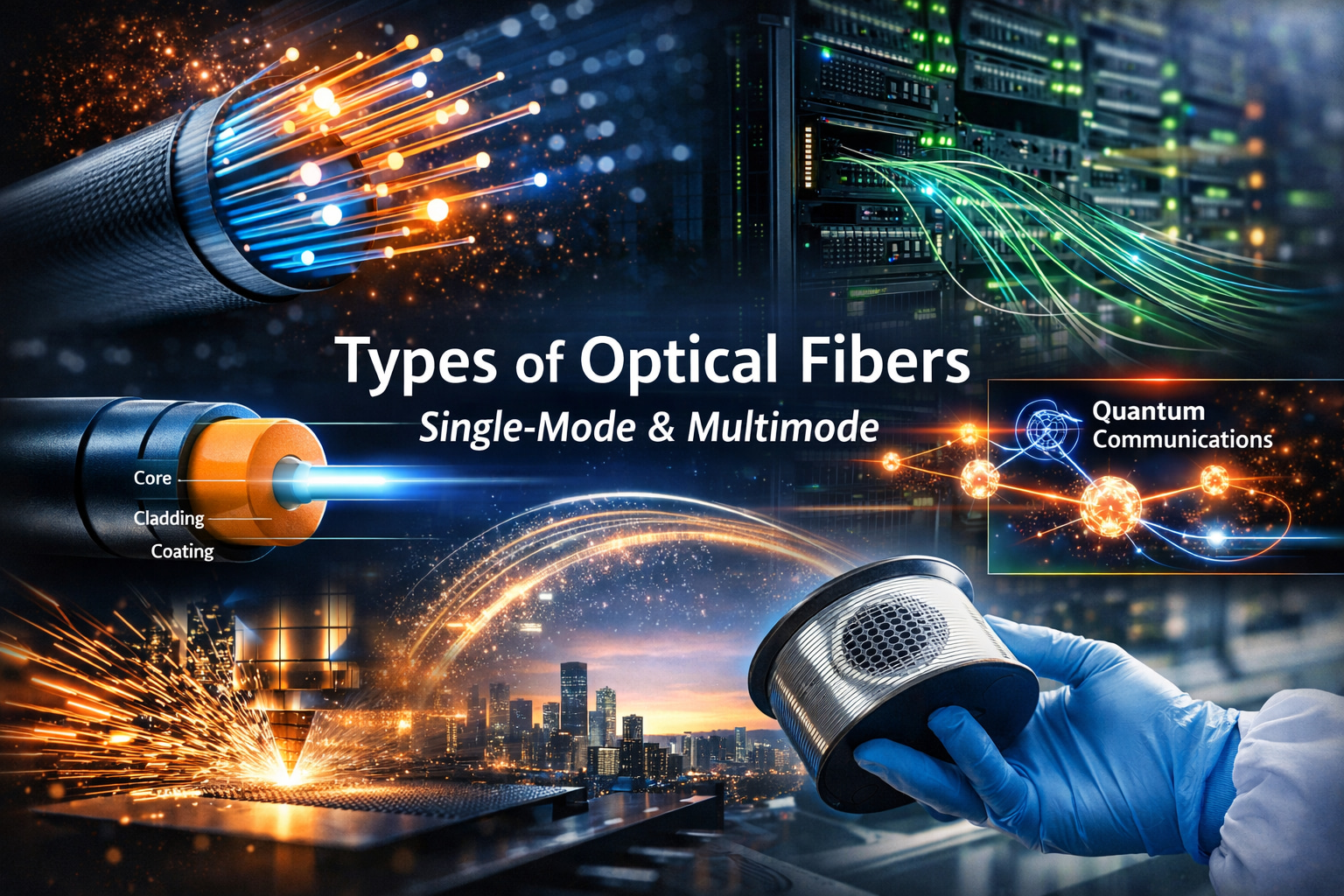
Understanding the differences between single-mode, multimode, and specialty optical fibers, along with their manufacturing constraints and emerging applications, is essential for engineers, researchers, and system designers working across the photonics ecosystem.
Fundamentals of Optical Fiber Structure
An optical fiber is a cylindrical dielectric waveguide composed of a central core surrounded by cladding with a slightly lower refractive index. This carefully engineered index contrast confines light within the core through total internal reflection, enabling optical signals to travel with remarkably low attenuation over distances that can range from a few centimeters in sensing probes to thousands of kilometers in global communication networks. Surrounding the glass structure, multilayer polymer coatings provide mechanical strength, flexibility, and resistance to moisture, temperature variation, and microbending, ensuring long-term reliability without interfering with optical propagation.
Although the geometry appears simple, the internal structure of an optical fiber is the result of extremely precise materials engineering. Subtle variations in dopant concentration, refractive-index profile, and core diameter directly influence modal behavior, dispersion characteristics, nonlinear response, and power-handling capability. These parameters determine whether a fiber is optimized for ultra-long-haul data transmission, high-power laser delivery, precision interferometric sensing, or emerging quantum and biomedical applications.
Modern silica fibers achieve attenuation below 0.2 dB/km at key telecommunications wavelengths near 1.55 µm, representing one of the lowest loss transmission media ever developed. This extraordinary transparency is what makes the global internet physically possible. Yet attenuation alone does not define system performance. Chromatic and modal dispersion shape bandwidth limits, wavelength compatibility governs usable spectral regions, and nonlinear optical effects emerge at high power or long interaction lengths. Mechanical reliability, bend sensitivity, and environmental stability further influence real-world deployment.
As a result, optical fiber design is best understood not as a single technology, but as a finely balanced integration of materials science, waveguide physics, and precision manufacturing – each playing a critical role in enabling the diverse photonics applications that rely on fiber today.
A key concept underlying fiber behavior is the idea of spatial modes, which describe the distinct electromagnetic field patterns that can propagate along the fiber core while satisfying the waveguide’s boundary conditions. Each mode represents a stable distribution of light intensity and phase across the cross-section of the fiber. In fibers with very small cores and carefully chosen refractive-index contrast, only a single spatial mode can exist, leading to uniform propagation and minimal dispersion. Larger cores, by contrast, allow many spatial modes to travel simultaneously, each following a slightly different optical path and velocity. The number and nature of these modes strongly influence bandwidth, signal distortion, coupling efficiency, and overall system performance, making modal control one of the most important design parameters in optical fiber engineering.
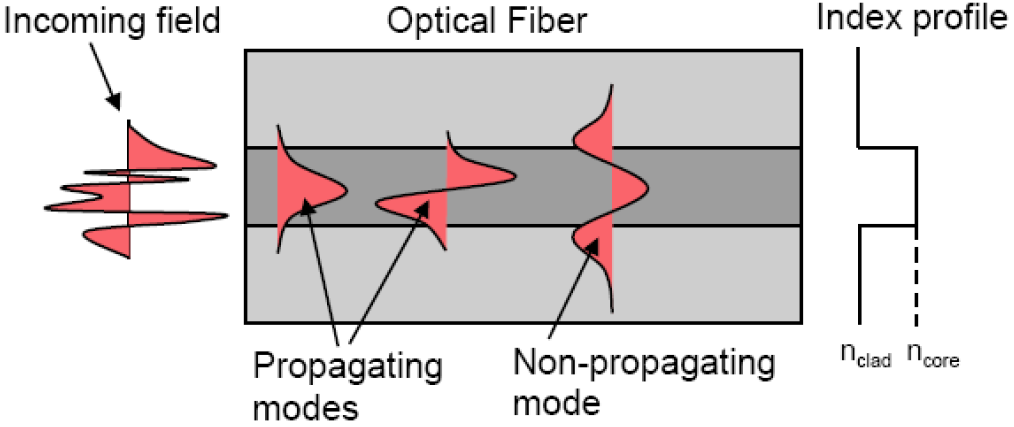
Courtesy of Professor B.C. Choudhary
Single-Mode Optical Fiber and Long-Distance Precision
Single-mode fiber is engineered so that only one spatial mode of light can propagate through the core, which typically measures about 8 to 10 micrometers in diameter at telecom wavelengths. By eliminating modal dispersion, single-mode fiber enables extremely high bandwidth transmission over continental and transoceanic distances while maintaining signal integrity.
This capability has made single-mode fiber the foundation of long-haul telecommunications, submarine cables, coherent optical networks, and precision interferometric sensing. It is equally critical in fiber laser architectures and optical frequency metrology, where phase stability and narrow linewidths are essential.
State-of-the-art research continues to push single-mode performance further. Hollow-core fibers that guide light primarily through air are demonstrating dramatically reduced latency and nonlinear distortion, while multicore and few-mode designs aim to expand total transmission capacity through space-division multiplexing. These advances are driven largely by exponential bandwidth demand from cloud computing, artificial intelligence infrastructure, and hyperscale data centers.
Multimode Optical Fiber and Short-Reach Efficiency
In contrast, multimode fiber uses a much larger core, commonly 50 or 62.5 micrometers, allowing many spatial modes to propagate simultaneously. This simplifies optical coupling and enables the use of lower-cost light sources such as VCSELs, making multimode fiber highly attractive for short-distance communication.
Because different modes travel at slightly different speeds, multimode systems experience modal dispersion that limits transmission distance. Nevertheless, for local area networks, enterprise infrastructure, and intra-data-center links, multimode fiber provides an optimal balance of performance, cost, and energy efficiency.
Recent innovation in wideband multimode fibers and parallel optical architectures is extending data-center speeds toward 400G and 800G while maintaining manageable power consumption. As switching hardware evolves toward co-packaged optics, multimode fiber remains central to scalable short-reach interconnect strategies.
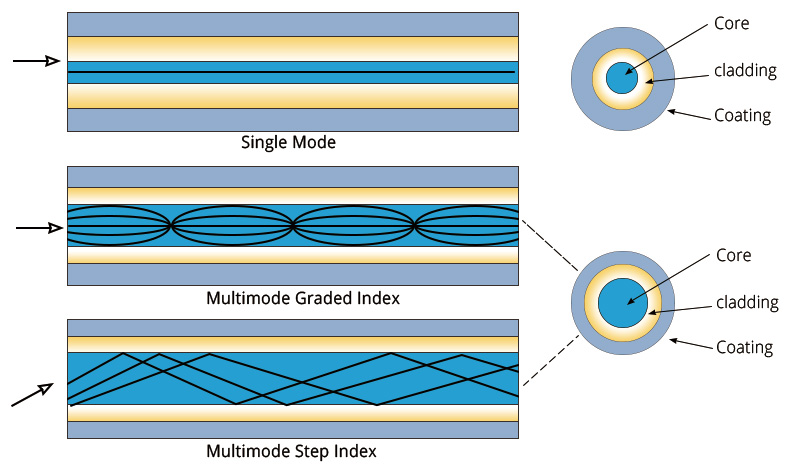
Curtesy of QSFPTEK
Step-Index, Graded-Index, and Dispersion Control
The refractive-index profile within a multimode fiber core plays a decisive role in determining how light propagates and how much dispersion accumulates during transmission. In step-index fibers, the refractive index changes abruptly at the boundary between the core and the cladding. As light rays or modes reflect sharply at this interface, different propagation paths can vary significantly in length, causing portions of the optical signal to arrive at different times. This modal dispersion rapidly broadens pulses and limits usable bandwidth, which is why step-index multimode fibers are generally confined to short-distance applications such as illumination, basic sensing, and low-speed links where timing precision is not critical.
Graded-index fibers address this limitation through a carefully engineered radial refractive-index profile that gradually decreases from the center of the core toward the cladding. Instead of reflecting sharply, light continuously bends along curved trajectories. Modes traveling farther from the core center move through regions of lower refractive index, and therefore higher optical velocity, compensating for their longer physical paths. This elegant balance substantially equalizes modal transit times and reduces pulse spreading by orders of magnitude compared with step-index designs.
The result is a dramatic increase in achievable bandwidth and transmission distance, enabling graded-index multimode fibers to support modern high-speed data communication inside buildings, campuses, and data centers. Ongoing refinements in index-profile engineering, material purity, and manufacturing precision continue to push dispersion lower and bandwidth higher, ensuring that graded-index technology remains a cornerstone of short-reach optical networking even as overall data-rate demands accelerate.
Specialty Fibers Enabling Advanced Photonics
Beyond conventional single-mode and multimode designs, a diverse class of specialty fibers is expanding what fiber-based photonics can achieve. Polarization-maintaining fibers preserve the orientation of light for interferometry, quantum optics, and precision sensing. Double-clad fibers enable efficient pumping of high-power fiber lasers that now reach multi-kilowatt output levels for cutting, welding, and additive manufacturing.
Photonic crystal fibers introduce microscopic air-hole structures that allow unprecedented control of dispersion and nonlinearity, supporting applications such as supercontinuum generation and frequency comb development. Meanwhile, mid-infrared-transmitting fluoride and chalcogenide fibers open access to molecular absorption bands critical for environmental monitoring, medical diagnostics, and defense sensing.
Multicore fibers, one of the most actively researched directions today, promise dramatic scaling of communication capacity by transmitting independent data streams within a single cladding. Such approaches may become essential as conventional single-core scaling approaches fundamental information limits.
Manufacturing Precision and Scalability Challenges
Producing optical fiber with consistent, high performance requires extraordinary control over materials and geometry. The process begins with fabrication of a glass preform, typically using vapor deposition techniques that must maintain dopant uniformity at parts-per-million levels while eliminating bubbles and contamination. During fiber drawing, the preform is heated and stretched into kilometers of fiber while diameter, tension, and temperature are controlled in real time within micron-scale tolerances.
Emerging fiber architectures, particularly hollow-core, multicore, and photonic crystal designs—introduce new fabrication complexity that directly affects yield, reliability, and cost. As a result, manufacturing innovation is becoming just as important as optical design in determining which next-generation fibers achieve widespread adoption.
This YouTube video provides a nice and short overview of optical fiber production.
Expanding Applications Beyond Telecommunications
While telecommunications remains the largest market, optical fibers are rapidly penetrating new technological frontiers. Distributed fiber sensing enables continuous monitoring of temperature, strain, and acoustic signals across pipelines, infrastructure, and geophysical environments. In medicine, fiber-based imaging and laser delivery support minimally invasive diagnostics and surgery. Quantum communication experiments rely on ultra-low-noise fiber links, while high-power industrial processing depends on robust double-clad delivery fibers.
At the same time, explosive growth in artificial intelligence computing is reshaping optical interconnect requirements inside data centers, reinforcing the importance of both advanced single-mode transmission and energy-efficient multimode architectures.
Aluminum- and copper-coated optical fibers are engineered for operation in extreme thermal, mechanical, and radiation-intensive environments where conventional polymer coatings fail. Metal coatings provide superior hermetic sealing, high temperature tolerance, often exceeding several hundred degrees Celsius, and improved resistance to moisture, hydrogen ingress, and chemical corrosion. Copper coatings additionally enhance thermal conductivity and mechanical robustness, making them suitable for harsh industrial sensing, downhole oil and gas monitoring, and aerospace applications. These specialized fibers enable reliable signal transmission and distributed sensing in conditions that would rapidly degrade standard silica fibers with organic coatings.
Looking Ahead: The Future of Optical Fiber Technology
Optical fiber has evolved from a telecommunications medium into a universal platform for photonics innovation. Progress in hollow-core guidance, space-division multiplexing, quantum networking, and high-power laser delivery suggests that the next decades will bring not incremental improvement but fundamental transformation in how light is generated, transmitted, and used.
As global demand for bandwidth, sensing, automation, and precision medicine accelerates, continued advances in fiber materials, design, and scalable manufacturing will remain central to the future of the photonics industry.


The type of fiber that we make, and make into laser power delivery and spectroscopic products, is routinely overlooked in these summaries. It's large silica core, multimode, step index fiber. For example, our NASA certified (for space flight) PowerCore fiber is capable of delivering pulses of instantaneous laser power in the GW/cm-cm realm.