
Laser cooling enabling quantum computers is the topic of this blog article.
Quantum technologies are transforming fields ranging from computing and communications to navigation and precision measurement. While these systems often appear futuristic, many rely on a surprisingly fundamental capability: the ability to cool atoms to temperatures just fractions of a degree above absolute zero.
This article is brought to you by Connet Laser Technology
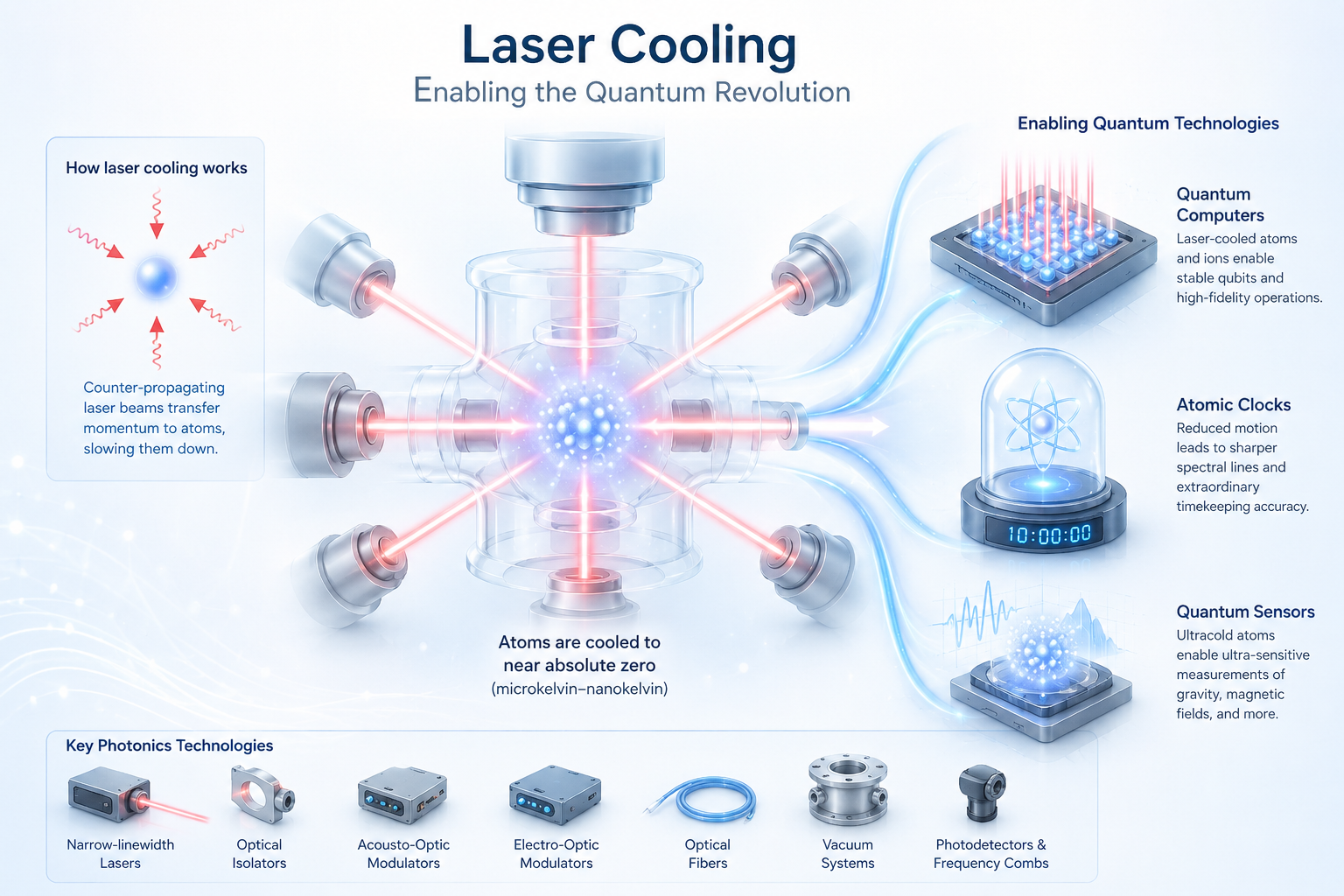
Conventional cooling methods can reduce the temperature of materials to cryogenic levels, but quantum systems often require temperatures far below what traditional refrigeration can achieve. This is where laser cooling comes into play. By carefully manipulating the interaction between light and matter, scientists can slow the motion of atoms and ions, effectively reducing their temperature to the microkelvin or even nanokelvin regime.
Today, laser cooling serves as a foundational technology for quantum computers, atomic clocks, quantum sensors, and fundamental physics experiments. In this article, we explore how laser cooling works and why it has become one of the most important enabling technologies of the quantum era.
Why Quantum Systems Must Be Cold
Temperature is fundamentally linked to motion. The higher the temperature of a material, the faster its atoms and molecules move.
For many quantum applications, thermal motion creates several problems:
- It introduces noise and uncertainty.
- It disrupts quantum coherence.
- It broadens spectral lines.
- It reduces measurement precision.
- It makes controlling individual particles more difficult.
Quantum phenomena such as superposition and entanglement are extremely sensitive to environmental disturbances. Even small amounts of thermal energy can destroy fragile quantum states. By cooling atoms to extremely low temperatures, researchers can dramatically reduce atomic motion and isolate quantum effects that would otherwise be hidden.
What Is Laser Cooling?
Laser cooling is a collection of techniques that use carefully tuned laser light to reduce the kinetic energy of atoms, ions, or molecules. At first glance, the idea may seem counterintuitive. Lasers carry energy, so one might expect them to heat objects rather than cool them. The key lies in the momentum carried by photons. Although photons have no mass, they possess momentum given by:
p = h / λ
where:
- p = photon momentum
- h = Planck’s constant
- λ = wavelength
When an atom absorbs a photon, it receives a small momentum kick. By arranging laser beams so that atoms preferentially absorb photons opposing their motion, scientists can gradually slow the atoms down. Since temperature is directly related to average kinetic energy, reducing atomic velocity effectively cools the atomic ensemble.
Doppler Cooling: The Foundation of Laser Cooling
The most widely used laser cooling technique is Doppler cooling, which exploits the interaction between atomic motion and the Doppler effect to selectively slow moving atoms.
The Doppler effect causes the frequency of light observed by an atom to depend on the atom’s velocity relative to the light source. An atom moving toward a laser beam perceives the light frequency as slightly higher than the frequency emitted by the laser. Conversely, an atom moving away perceives a lower frequency.
To take advantage of this effect, researchers tune the laser slightly below an atomic absorption resonance. This condition is known as red detuning. Under normal circumstances, the laser frequency is too low to be efficiently absorbed. However, when an atom moves toward the laser beam, the Doppler shift increases the apparent frequency of the light, bringing it closer to resonance and significantly increasing the probability of absorption.
When an atom absorbs a photon, it receives a small momentum kick in the direction of the photon’s propagation. Since the photon is traveling opposite to the atom’s motion, this momentum transfer acts as a braking force, reducing the atom’s velocity. Although the momentum of a single photon is extremely small, an atom can scatter millions of photons per second. The cumulative effect of these repeated absorption events produces a measurable deceleration.
After absorption, the atom quickly returns to its ground state by spontaneously emitting a photon. Because spontaneous emission occurs in a random direction, the resulting momentum kicks average to nearly zero over many cycles. In contrast, the momentum transfer from absorption is directional and consistently opposes the atom’s motion. Consequently, the net effect is a gradual reduction in atomic velocity and kinetic energy.
In practice, Doppler cooling is implemented using pairs of counter-propagating laser beams. An atom moving in any direction encounters a stronger scattering force from the beam opposing its motion because that beam is Doppler shifted closer to resonance. This creates a velocity-dependent restoring force that continuously opposes atomic motion.
Mathematically, the resulting force can be approximated as:
F = -αv
where v is the atomic velocity and α is a damping coefficient determined by the laser intensity and detuning. This expression resembles the viscous drag experienced by an object moving through a fluid, which is why laser-cooled atoms are often described as moving through an “optical molasses.”
As the atoms slow down, their average kinetic energy decreases. Since temperature is directly related to kinetic energy, the atomic ensemble cools. Using Doppler cooling alone, temperatures of a few hundred microkelvin can be achieved, more than a million times colder than room temperature and sufficiently low for many quantum technology applications.
This deceptively simple technique laid the foundation for modern ultracold atom physics and remains one of the most important tools used in quantum computing, atomic clocks, precision spectroscopy, and quantum sensing.
Optical Molasses
When three pairs of counter-propagating laser beams intersect along orthogonal axes, the resulting environment is called optical molasses. Atoms moving in any direction encounter a restoring force that opposes their motion. The effect resembles an object moving through thick syrup, hence the name. Optical molasses can cool atoms to temperatures of only a few hundred microkelvin.
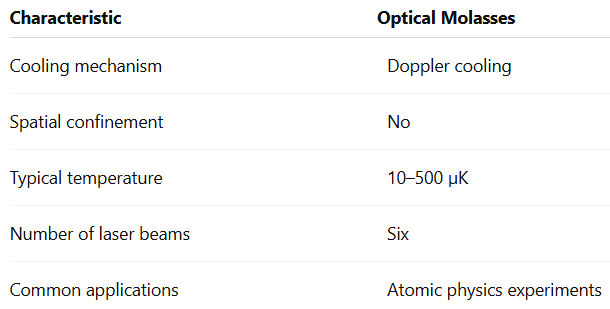
While optical molasses slows atoms effectively, it does not trap them in space.
Magneto-Optical Traps (MOTs)
To both cool and confine atoms, researchers use Magneto-Optical Traps (MOTs).
A MOT combines:
- Six laser beams
- Magnetic field gradients
- Doppler cooling forces
The magnetic field causes atomic energy levels to shift depending on position. As atoms drift away from the trap center, they become more resonant with laser beams that push them back toward equilibrium. This creates a restoring force that continuously cools and confines the atoms. Today, MOTs are standard components in many quantum technology platforms, including atomic clocks, neutral-atom quantum computers, and precision sensing systems.
The Doppler Cooling Limit
Doppler cooling cannot reduce temperatures indefinitely. The theoretical Doppler cooling limit is approximately:
T_D = ℏΓ / (2k_B)
where:
- T_D is the Doppler limit temperature
- Γ is the atomic transition linewidth
- k_B is Boltzmann’s constant
- ℏ is the reduced Planck constant
For many alkali atoms, this limit lies near a few hundred microkelvin. Researchers later developed sub-Doppler cooling techniques capable of reaching temperatures far below this theoretical limit.
Beyond Doppler Cooling
Several advanced cooling methods enable ultracold temperatures approaching the nanokelvin regime.
Polarization Gradient Cooling
This technique exploits polarization variations in laser fields to remove additional kinetic energy from atoms. Temperatures can fall well below the Doppler limit.
Raman Sideband Cooling
Widely used in trapped-ion and neutral-atom systems, Raman sideband cooling selectively removes vibrational energy from trapped particles.
Evaporative Cooling
In evaporative cooling, the highest-energy atoms are allowed to escape from a trap. The remaining atoms rethermalize at lower temperatures, much like how a hot cup of coffee cools as energetic molecules evaporate. This technique played a critical role in producing the first Bose-Einstein condensates.
Laser Cooling and Quantum Computing
Quantum computers require exceptional control over quantum states. In trapped-ion quantum computers, ions serve as quantum bits (qubits). Laser cooling reduces ion motion, allowing quantum logic operations to be performed with extremely high fidelity. Similarly, neutral-atom quantum computing platforms use laser-cooled atoms trapped in optical tweezers or optical lattices. Without laser cooling, thermal motion would rapidly destroy the coherence needed for quantum computation.
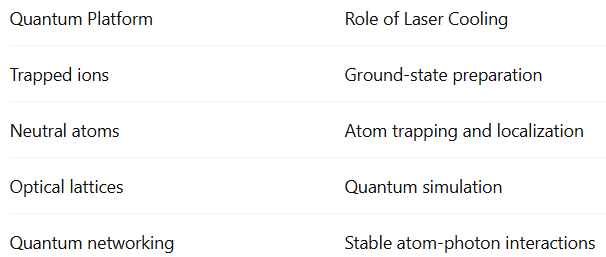
As quantum computing systems scale toward thousands or millions of qubits, laser cooling will remain a critical enabling technology.
Laser Cooling and Atomic Clocks
Modern atomic clocks represent the most accurate timekeeping devices ever created. The accuracy of an atomic clock depends on measuring atomic transition frequencies with extraordinary precision. Thermal motion introduces Doppler broadening, which reduces measurement accuracy. Laser cooling minimizes atomic velocity, resulting in narrower spectral lines and improved frequency stability.
Today’s optical atomic clocks achieve uncertainties approaching one part in 10¹⁸. At this level, a clock would lose less than a second over the age of the universe.
These clocks support:
- Global navigation systems
- Telecommunications networks
- Fundamental physics research
- International time standards
Laser Cooling and Quantum Sensors
Quantum sensors exploit quantum effects to measure physical quantities with unprecedented sensitivity.
Examples include:
- Atomic gravimeters
- Atomic magnetometers
- Inertial navigation systems
- Quantum gyroscopes
Many of these devices rely on laser-cooled atom clouds.
Because colder atoms move more slowly, measurements can be performed over longer interaction times. Longer interaction times generally translate into higher sensitivity and improved accuracy.
Quantum sensors are finding applications in:
- Geological surveying
- Underground structure detection
- Navigation without GPS
- National security
- Climate monitoring
Photonics Technologies Behind Laser Cooling Systems
Laser cooling experiments require far more than just a laser source. Modern systems typically incorporate numerous photonics components.
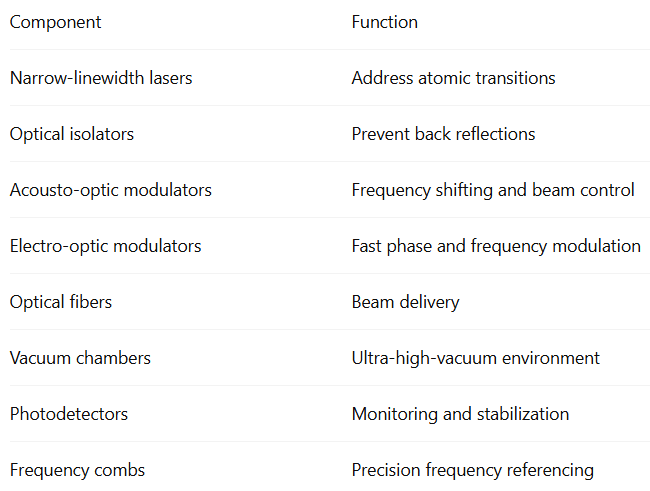
The growing commercialization of quantum technologies is driving demand for highly reliable and integrated photonics solutions.
Future Outlook
Laser cooling has evolved from a laboratory curiosity into one of the foundational technologies of the quantum age. As quantum computers become more powerful, atomic clocks become more precise, and quantum sensors move into real-world deployment, the importance of laser cooling will continue to grow. Researchers are now exploring laser cooling of molecules, advanced optical refrigeration techniques, and integrated photonic architectures that could make ultracold quantum systems more compact and accessible.
The remarkable ability to use light to cool matter has fundamentally reshaped modern physics. More importantly, it is helping transform quantum technologies from scientific experiments into practical tools that may redefine computing, sensing, communications, and precision measurement in the decades ahead.


