
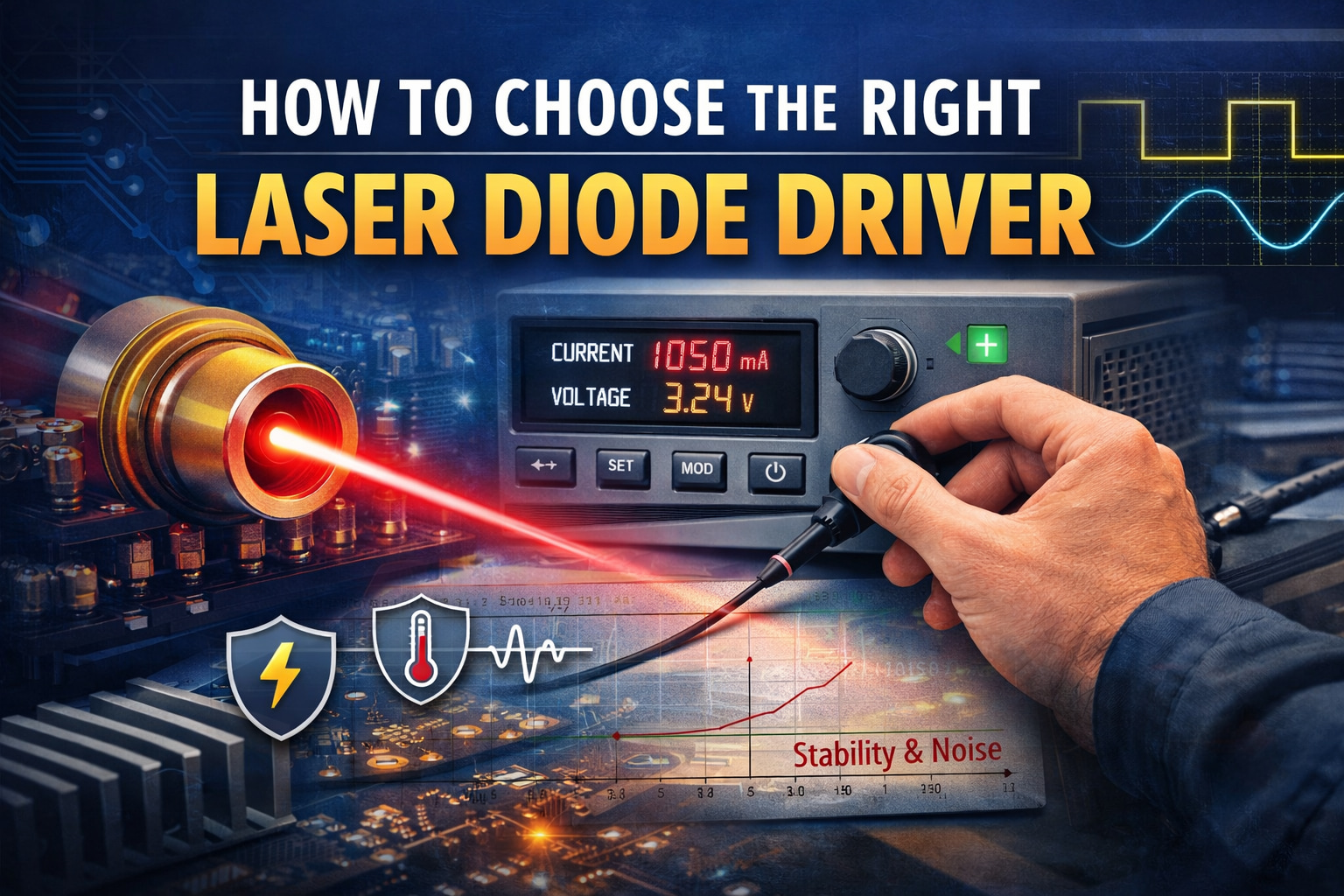
How to choose the right laser diode driver and what to be aware of is the topic of this blog article.
This article is brought to you by LECC Technology, a leading Taiwanese manufacturer of diode laser modules and solutions.
How to Choose the Right Laser Diode Driver: Introduction
Selecting a laser diode driver is not a trivial task. While laser diodes themselves often receive the most attention in system design, the driver is just as critical to performance, stability, and long-term reliability. A poorly matched driver can introduce noise, limit modulation speed, reduce lifetime, or even permanently damage the diode. For engineers working in photonics, medical devices, materials processing, spectroscopy, or sensing, understanding how to choose the right laser diode driver is essential.
This article walks through the key technical specifications and practical considerations you should evaluate before selecting a driver for your application.
Why the Laser Diode Driver Matters More Than You Think
Laser diodes are current-driven devices. Unlike LEDs, they are extremely sensitive to current fluctuations and voltage spikes. Small overshoots can cause irreversible damage to the junction. Thermal drift, electromagnetic interference, and power supply ripple can all translate directly into optical instability if the driver is not properly designed.
The driver determines:
Output power stability
Wavelength stability (via thermal effects)
Modulation performance
Noise characteristics
Protection against transient events
In precision applications such as spectroscopy, interferometry, or quantum optics, driver noise can directly degrade measurement accuracy. In industrial systems, insufficient protection or poor thermal design can reduce system uptime. Therefore, selecting the correct driver is fundamentally about ensuring performance, reliability, and longevity.
Current Output Range and Resolution
So, how to choose the right laser diode driver? The first and most obvious parameter to evaluate is output current capability. The driver must comfortably support the maximum operating current of the laser diode while providing sufficient resolution at lower levels.
Two mistakes are common:
Selecting a driver that barely meets the maximum current rating.
Choosing a high-current driver without considering resolution at low currents.
If your diode operates at 12 A, a 12 A-rated driver leaves no margin for transient conditions. A better approach is to allow at least 10–20% headroom. Conversely, if your application requires fine power tuning near threshold, the minimum current step size becomes critical.
Resolution matters in applications such as spectroscopy or coherent detection where fine optical power control is required. Digital drivers with high DAC resolution provide better granularity than coarse analog control systems.
Current Stability and Noise Performance
For many precision applications, current stability is more important than maximum current capability. Laser output power is directly proportional to drive current above threshold. Any current noise appears as optical noise.
Key parameters to examine include:
RMS current noise (often specified over a defined bandwidth)
Long-term current drift
Temperature coefficient
Power supply rejection ratio
Low-noise drivers are particularly important for single-frequency lasers, interferometry, Raman spectroscopy, and sensing systems. Even small fluctuations can broaden linewidth or reduce signal-to-noise ratio.
Pay attention to how noise is specified. A driver quoting low RMS noise over a narrow bandwidth may perform differently in your real operating environment. Always verify the frequency range used in the measurement.
Compliance Voltage
Compliance voltage is often overlooked but critically important. It defines the maximum voltage the driver can supply to maintain the programmed current.
Laser diodes have forward voltages that vary depending on:
Wavelength
Temperature
Device architecture
Current level
If the driver’s compliance voltage is insufficient, it will saturate and fail to maintain constant current. This results in unstable output and unpredictable behavior.
When evaluating compliance voltage, consider worst-case conditions:
Maximum operating temperature
Peak current
Any additional voltage drop from wiring or connectors
High-power diodes and stacked diode bars often require significantly higher compliance voltages than standard single emitters.
Modulation Bandwidth and Speed
If your application requires intensity modulation, modulation bandwidth becomes a key selection criterion.
Applications such as:
Optical communication
Fluorescence lifetime measurements
Pump-probe experiments
require high-speed modulation. In these cases, you must evaluate both analog and digital modulation capabilities.
Important considerations include:
Small-signal modulation bandwidth
Large-signal response
Rise and fall times
Overshoot and ringing
A driver with excellent DC performance may still perform poorly in fast modulation scenarios. Ensure the driver’s modulation architecture aligns with your system’s switching speed requirements.
For nanosecond or sub-nanosecond pulsing, specialized pulsed laser diode drivers are often required rather than standard CW current controllers.
Protection Features
Laser diodes are fragile. Protection circuitry is not optional. Essential protection features include:
Soft start capability
Current limiting
Overvoltage protection
Reverse polarity protection
Transient suppression
Interlock systems
Soft start ensures that the current ramps gradually rather than applying a sudden spike at power-on. Transient suppression protects against electrostatic discharge and switching events.
In industrial or OEM environments, interlocks are often mandatory to comply with safety regulations. Drivers used in regulated markets such as medical devices may require additional certifications and fail-safe design features.
Protection architecture should not compromise performance. Poorly implemented protection circuits can introduce noise or limit bandwidth.
Thermal Management and Temperature Control Integration
Laser performance is highly temperature dependent. Many systems use thermoelectric coolers (TECs) for precise temperature control.
Some drivers integrate both current control and TEC control in a single module. This can simplify system design and reduce wiring complexity.
When evaluating integration, consider:
Independent TEC current capacity
Temperature sensor compatibility (NTC, PT100, etc.)
Stability and resolution of temperature control
Loop response time
For wavelength-sensitive applications such as DWDM or precision spectroscopy, temperature stability can be just as important as current stability.
Thermal design also affects the driver itself. High-current drivers generate heat and must be properly cooled to maintain accuracy and prevent drift.
Analog vs Digital Control Interfaces
Modern laser diode drivers often provide digital control via USB, Ethernet, RS-232, or fieldbus protocols. Others rely on purely analog interfaces.
Digital control offers advantages:
Remote programmability
Data logging
Repeatability
Integration with automated systems
Analog control may provide faster response in certain high-speed applications.
When designing OEM systems or automated production environments, communication protocol compatibility becomes critical. EtherCAT, CANopen, and Modbus are common in industrial environments.
Your choice should align with system architecture and control requirements.
Form Factor and Integration
Laboratory systems may use benchtop drivers, while OEM designs require compact board-level or rack-mount solutions.
Form factor considerations include:
Size and mounting method
Cooling requirements
Connector types
Shielding
Compact drivers may sacrifice certain features, while modular rack systems offer flexibility and scalability.
For embedded designs, board-level drivers allow tighter integration but require careful system-level EMI management.
Reliability, Lifetime, and Certification
Industrial and medical applications require high reliability and compliance with standards.
Consider:
MTBF specifications
Environmental ratings
Certification (CE, UL, RoHS)
EMC compliance
In mission-critical applications, long-term drift and component aging must be evaluated. High-quality drivers use precision current sensing components and stable reference sources to minimize drift over time.
Application-Specific Considerations
Different applications emphasize different parameters.
In spectroscopy, low noise and fine current control dominate decision-making. In materials processing, high current capability and thermal robustness may be more important. In LIDAR systems, modulation speed and pulse fidelity are critical. In medical systems, safety interlocks and regulatory compliance become decisive factors.
Understanding your application’s primary constraints ensures you prioritize the correct specifications rather than focusing on headline current numbers alone.
Avoiding Common Selection Mistakes
Even experienced engineers can underestimate how sensitive laser diode systems are to seemingly secondary design details. While maximum output current and voltage compliance are critical starting points, they are only part of the story. In practice, long-term stability, spectral purity, and device lifetime are often determined by parameters that receive far less attention during the selection process.
One of the most common mistakes is focusing exclusively on peak current capability while overlooking current noise density and ripple performance. A driver that meets the required 10 A or 16 A output specification may still introduce micro- or nanoamp-level noise that directly translates into optical power fluctuations. In precision applications such as spectroscopy, interferometry, or Raman measurements, this noise can broaden linewidth, degrade signal-to-noise ratio, or mask weak spectral features. The result is not always catastrophic failure—but rather compromised performance that is difficult to diagnose later.
Another frequent oversight is insufficient voltage compliance margin. Engineers sometimes select a driver whose maximum voltage rating barely exceeds the nominal forward voltage of the diode. However, laser diode forward voltage changes with temperature, aging, and current setpoint. If the compliance voltage is too close to the operating point, the driver may clip or fall out of regulation under dynamic conditions. This leads to distorted modulation, unstable output, or unexpected shutdown behavior during temperature transitions.
Cabling and physical layout are equally critical yet commonly underestimated. Laser diode drivers operate in regimes where microseconds and millivolts matter. Long cable runs introduce parasitic inductance and resistance, which can cause overshoot during fast current transitions. Even a high-quality driver can become unstable if paired with poorly routed wiring. Twisted pairs, shielded cables, and Kelvin connections are not optional details – they are fundamental to preserving stability and minimizing electromagnetic interference.
Grounding strategy is another frequent source of hidden instability. Ground loops between the driver, laser mount, and measurement instrumentation can inject noise directly into the current regulation loop. In high-current systems, milliohms of shared ground resistance can translate into measurable current fluctuations. A star-ground topology and careful separation of analog and digital return paths significantly reduce these risks.
Engineers should also account for wiring resistance and connector quality. At high currents, even small resistive losses can produce voltage drops that affect regulation accuracy. Poor connectors can heat up, oxidize, and drift over time, gradually degrading system performance. This is particularly relevant in industrial environments where vibration and temperature cycling are present.
Thermal environment is another factor that is often evaluated only at the diode level but not at the driver level. High-current drivers dissipate significant heat internally. If airflow is restricted or ambient temperature rises beyond specification, internal component temperatures increase, affecting regulation precision and long-term reliability. Thermal derating curves should be reviewed carefully, especially in enclosed racks or compact OEM integrations.
Mechanical layout can influence electrical behavior more than many engineers expect. For example, mounting the driver close to switching power supplies or high-frequency digital electronics can introduce electromagnetic interference that couples into sensitive analog regulation circuits. Physical separation, shielding, and thoughtful enclosure design help maintain ultra-low noise performance.
It is also important to evaluate the quality of the upstream power supply. A driver cannot fully compensate for excessive ripple, transient dips, or poor load regulation from its input source. Low-noise linear supplies or well-filtered switching supplies are often necessary for demanding photonics applications. Input filtering and proper decoupling further improve stability.
Transient protection is another frequently overlooked consideration. Laser diodes are highly sensitive to current spikes, especially during startup and shutdown. Engineers sometimes assume that a reputable driver inherently guarantees safe power sequencing. However, understanding soft-start behavior, interlock logic, and fault response timing is essential to prevent catastrophic diode damage.
When evaluating the full system, consider:
Power supply quality and ripple performance
Cable length, shielding, and inductance
Wiring resistance and connector integrity
Thermal management at both diode and driver levels
Grounding topology and loop avoidance
Physical layout relative to EMI sources
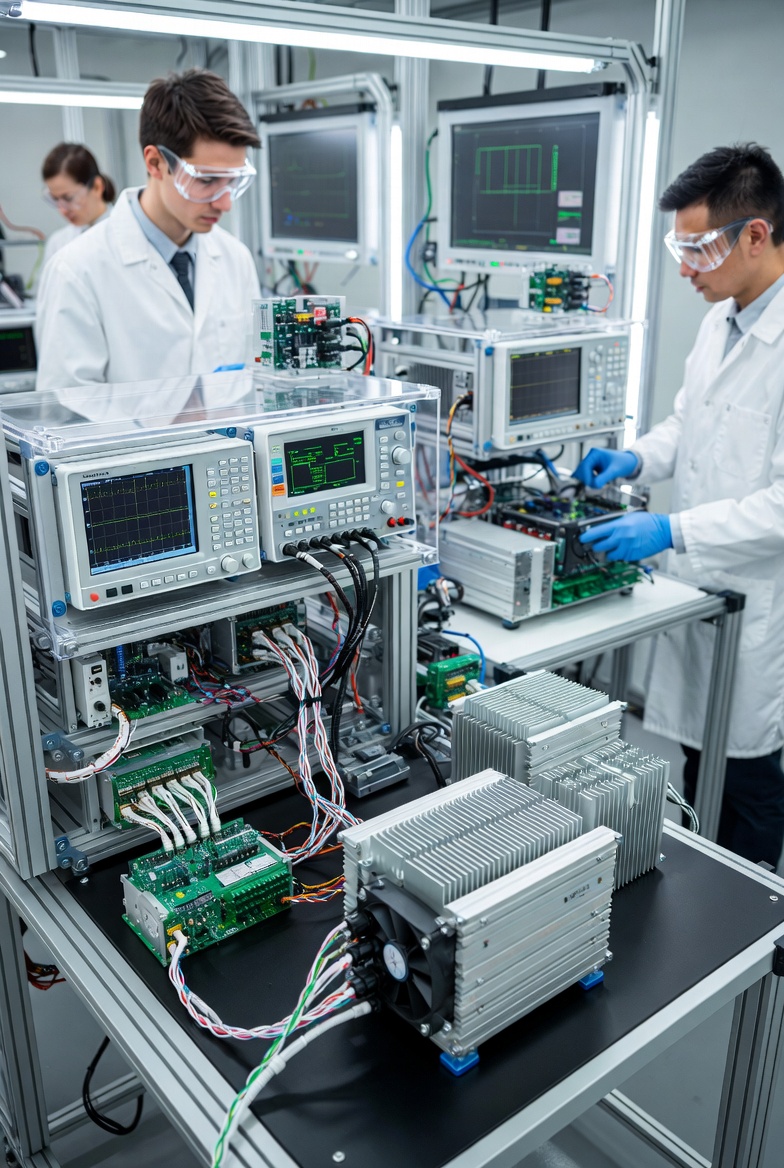
The key lesson is that laser diode driver performance is not defined by its datasheet in isolation. It is defined by the entire electrical and mechanical ecosystem in which it operates. A premium, ultra-low-noise driver can underperform dramatically if integrated into a poorly designed environment. Conversely, thoughtful system-level engineering allows the driver to achieve its specified precision, stability, and reliability.
By approaching driver selection and integration holistically rather than focusing solely on headline current and voltage numbers, engineers can avoid costly redesigns, protect expensive laser diodes, and ensure that optical performance meets expectations from the very first prototype through full production deployment.
Final Thoughts
Choosing the right laser diode driver is about far more than matching current ratings. It requires a careful evaluation of stability, noise, compliance voltage, modulation capability, protection features, thermal management, and system integration requirements.
A well-selected driver protects your investment in the laser diode, improves performance, enhances reliability, and reduces long-term system risk. Whether designing a laboratory setup, an industrial inspection system, or a medical device, taking the time to analyze these key specifications will pay dividends in performance and durability.
Understanding how to choose the right laser diode driver ultimately means aligning electrical performance with optical goals. When the driver and diode are properly matched, the entire photonic system performs at its full potential.
References
- Laser Electronics
Verdeyen, Joseph T. Laser Electronics. Prentice Hall. Optoelectronics and Photonics: Principles and Practices
Kasap, Safa O. Optoelectronics and Photonics: Principles and Practices. Pearson.Solid-State Laser Engineering
Koechner, Walter. Solid-State Laser Engineering. Springer.


