
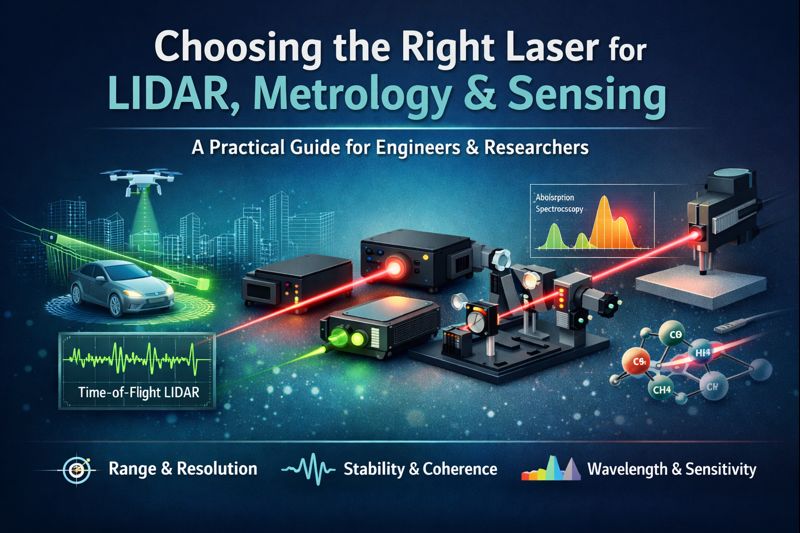
Choosing the right laser for LIDAR as well as metrology and optical sensing is the subject of this blog post.
This article is brought to you by Gentec-EO, a world leader in the development and manufacture of laser beam measurement solutions
Introduction
Lasers sit at the heart of modern LIDAR systems, precision metrology tools, and optical sensing platforms. Yet choosing the “right” laser is rarely straightforward. Spec sheets can look similar, performance claims are often measured under ideal conditions, and small differences in wavelength, pulse format, or coherence can dramatically impact system-level performance.
For engineers and researchers, the challenge is not just finding a laser that works, but selecting one that is optimized for the application, reliable in real-world conditions, and scalable for production. This blog article provides a practical, application-driven guide to choosing lasers for LIDAR, metrology, and optical sensing, bridging the gap between component specifications and system performance.
In practice, laser selection is often constrained by factors that extend beyond raw optical performance. Environmental stability, integration complexity, eye-safety requirements, long-term availability, and supplier reliability can be just as critical as output power or linewidth. A laser that performs exceptionally well in a controlled laboratory setup may fall short when deployed in an industrial, field, or high-volume manufacturing environment. Understanding these tradeoffs early in the design process can save significant time, cost, and redesign effort later on.
Why Laser Selection Matters at the System Level
In many photonics systems, the laser is the single most influential component. Its characteristics directly affect resolution, accuracy, signal-to-noise ratio (SNR), and long-term stability. A mismatch between the laser and the application can lead to subtle performance issues that only appear after integration or deployment.
Common system-level consequences of poor laser selection include:
- Reduced measurement accuracy or drift over time
- Increased sensitivity to temperature and vibration
- Higher noise floors limiting detection range
- Integration challenges related to fiber coupling or packaging
Understanding how laser parameters translate into system behavior is therefore essential for choosing the right Laser for LIDAR, metrology and sensing.
In real-world systems, these effects are often interconnected rather than isolated. For example, temperature-induced wavelength drift can degrade interferometric accuracy while simultaneously increasing noise through feedback or mode hopping. Similarly, packaging and coupling decisions can influence polarization stability and back reflections, which in turn affect coherence and long-term reliability. Taking a holistic, system-level view of laser behavior, rather than evaluating individual specifications in isolation, allows engineers to anticipate these interactions and design more robust photonics solutions from the outset.
Core Laser Parameters to Understand
Before diving into specific applications, it is useful to review the key laser parameters that matter most across LIDAR, metrology, and sensing.
Wavelength Selection
Wavelength is often the first filtering criterion. It determines interaction with materials, atmospheric transmission, detector compatibility, and eye safety considerations.
Common wavelength bands include:
- 905 nm: Widely used in short-range automotive LIDAR due to low cost and detector availability
- 1064 nm / 1030 nm: Popular for industrial LIDAR and metrology
- 1310 nm and 1550 nm: Eye-safer wavelengths with advantages for long-range sensing and fiber-based systems
Selecting the correct wavelength is not just about availability as it impacts everything from optics choice to regulatory compliance.
Output Power and Energy
Laser output can be specified as average power, peak power, or pulse energy depending on whether the laser operates in continuous-wave (CW) or pulsed mode. For sensing applications, more power does not always mean better performance. Excessive power can introduce nonlinear effects, saturate detectors, or create safety challenges.
Pulse Format: CW vs Pulsed
One of the most important decisions is whether to use a CW or pulsed laser.
- CW lasers provide stable, narrow linewidth output ideal for interferometry and precision displacement measurements.
- Pulsed lasers enable time-of-flight measurements and high peak power for long-range detection.
Pulse duration, repetition rate, and timing jitter are especially critical in LIDAR and high-speed sensing.
Linewidth and Coherence
Linewidth determines coherence length and phase stability. Narrow-linewidth lasers are essential for interferometric metrology and coherent LIDAR, while broader linewidth sources may suffice for intensity-based sensing.
Noise and Stability
Relative intensity noise (RIN), phase noise, and frequency drift all contribute to measurement uncertainty. These parameters are often overlooked but can dominate system performance over time.
Choosing the Right Laser for LIDAR Applications
LIDAR systems rely on precise measurement of distance using laser light, typically through time-of-flight or phase-based techniques.
Time-of-Flight LIDAR
Time-of-flight (ToF) LIDAR measures the delay between emitted and reflected laser pulses.
Key laser requirements include:
- Short pulse duration for high spatial resolution
- Low timing jitter for accurate ranging
- Sufficient pulse energy to reach target distances
For short-range applications, cost-effective pulsed diode lasers at 905 nm are common. For longer ranges or eye-safe operation, 1550 nm fiber lasers and solid-state sources are increasingly used.
Courtesy of ToFFuture
Coherent and FMCW LIDAR
Frequency-modulated continuous-wave (FMCW) and coherent LIDAR systems rely on phase and frequency stability.
Laser requirements here are more stringent:
- Ultra-narrow linewidth
- Excellent frequency stability
- Low phase noise
These systems often use fiber lasers or external cavity diode lasers, trading simplicity for performance.
In addition to core optical parameters, system architecture strongly influences laser choice in LIDAR. Beam quality, polarization stability, and spectral purity can affect not only ranging accuracy but also target discrimination and velocity measurement. In multi-channel or scanning LIDAR systems, laser-to-laser consistency and long-term repeatability become critical, especially when calibration must be maintained across temperature changes or extended operating periods.
Environmental and regulatory considerations further shape laser selection. Automotive and outdoor LIDAR systems must operate reliably across wide temperature ranges, under vibration, and in the presence of optical feedback from reflective targets. Eye-safety constraints often drive designers toward longer wavelengths and lower peak intensities, influencing detector choice and overall system cost. As a result, selecting a laser for LIDAR is rarely a single-parameter decision; it is a balance between optical performance, system robustness, safety compliance, and scalability for production deployment.
Laser Selection for Precision Metrology
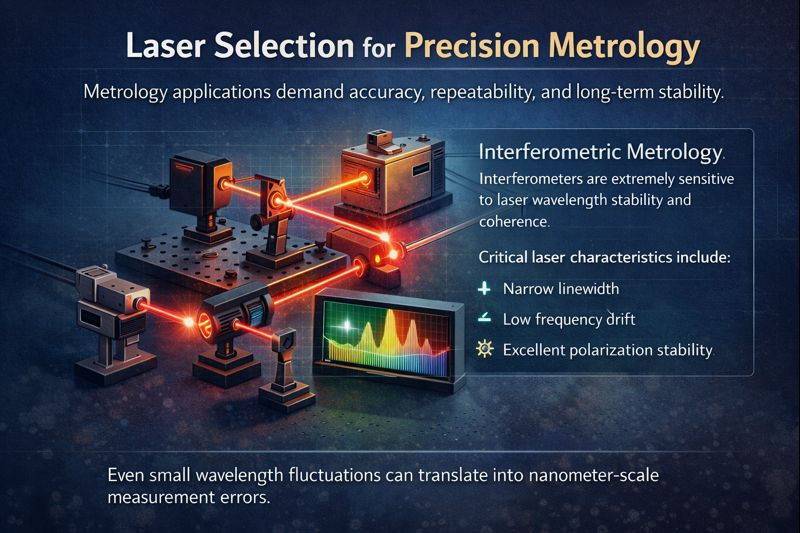
Metrology applications demand accuracy, repeatability, and long-term stability.
Interferometric Metrology
Interferometers are extremely sensitive to laser wavelength stability and coherence.
Critical laser characteristics include:
- Narrow linewidth
- Low frequency drift
- Excellent polarization stability
Even small wavelength fluctuations can translate into nanometer-scale measurement errors.
Industrial and Production Metrology
In factory environments, robustness can be as important as raw performance.
Engineers should consider:
- Passive vs active cooling
- Environmental sensitivity
- Long-term reliability and maintenance requirements
Lasers designed for industrial use often sacrifice some peak performance for stability and ease of integration.
Laser Selection for Optical Sensing
Optical sensing spans a wide range of applications, from gas detection to biomedical diagnostics.
Absorption and Spectroscopic Sensing
These techniques rely on precise wavelength alignment with molecular absorption features.
Key considerations include:
- Wavelength tunability
- Spectral purity
- Power stability over time
Tunable diode lasers and quantum cascade lasers are common choices depending on the spectral region.
Beyond core optical specifications, environmental and integration factors are equally important. Temperature fluctuations, mechanical vibrations, and optical feedback can all shift the emission wavelength or introduce noise, potentially degrading sensitivity and detection limits. For high-precision spectroscopic applications, active wavelength stabilization, robust thermal control, and feedback mechanisms are often required to maintain measurement fidelity over time.
System architecture also influences laser selection. For fiber-based or remote sensing setups, coupling efficiency, polarization maintenance, and long-term output stability are critical to achieving reliable signal transmission and detection. Additionally, considerations such as power consumption, compactness, and regulatory compliance (e.g., eye safety or medical device standards) can drive the choice of diode, quantum cascade, or fiber-coupled laser sources. Ultimately, selecting a laser for optical sensing requires balancing wavelength accuracy, stability, integration complexity, and operational robustness to meet both performance and practical deployment requirements.
Distributed and Fiber-Based Sensing
Fiber optic sensors benefit from lasers compatible with telecom components.
Important factors:
- Compatibility with fiber amplifiers
- Low noise for long sensing distances
- Stable operation over temperature
Practical Integration Considerations
Beyond core performance metrics, practical considerations in choosing the right laser for LIDAR, metrology or sensing often determine success.
Packaging and Form Factor: Lasers are available as free-space modules, fiber-coupled units, or fully integrated systems. Fiber-coupled lasers simplify alignment but may limit peak power.
Thermal Management: Temperature fluctuations affect wavelength, power, and noise. Passive cooling improves reliability but may limit power density.
Compliance and Safety: Eye safety standards, especially for LIDAR, can dictate wavelength and power choices. Regulatory compliance should be considered early in the design phase.
Common Mistakes to Avoid
Engineers frequently encounter similar pitfalls when selecting lasers:
- Over-optimizing for peak power instead of stability
- Ignoring noise specifications until late-stage testing
- Assuming lab performance will translate directly to field conditions
A system-level perspective helps avoid costly redesigns.
How Marketplaces Simplify Laser Selection
Sourcing lasers from multiple vendors can be time-consuming and complex, especially when comparing subtle differences in specifications and performance. Online marketplaces provide a centralized platform where engineers can review technologies, compare parameters, and identify compatible sources more efficiently. Platforms such as FindLight offer tools and structured information that make it easier to evaluate options, helping reduce risk and accelerate the selection process without replacing careful technical judgment.
Conclusion
Choosing the right laser for LIDAR, metrology, and optical sensing requires balancing performance, stability, integration complexity, and cost. By focusing on application-driven requirements rather than isolated specifications, engineers can make informed decisions that lead to robust, scalable systems.
As photonics applications continue to expand, thoughtful laser selection will remain a key differentiator between systems that work in the lab and those that succeed in the real world.


